


| Received | : | Mar 25, 2026 |
| Accepted | : | Apr 13, 2026 |
| Published Online | : | Apr 20, 2026 |
| Journal | : | Journal of Plant Biology and Crop Research |
| Publisher | : | MedDocs Publishers LLC |
| Online edition | : | http://meddocsonline.org |
Cite this article: da Rocha JPC, Ventorim RZ, Àzar RISL, Mendonça JGP, Maitan-Alfenas GP. Soybean Hulls as a Dual Substrate for in Situ Enzyme Production and Enzymatic Hydrolysis. J Plant Biol Crop Res. 2026; 10(1): 1115.
The soybean hulls constitute an abundant and low cost agricultural byproduct rich in polysaccharides. These compounds, in turn, are a promising substrate to produce sweeteners and biofuels via enzymatic hydrolysis. This work aimed to produce lignocellulolytic enzymes from three phy topathogenic fungi: Nectriaceae sp., Cladosporium clado sporioides, and Phaeoacremonium parasiticum, using the soybean hulls both as an inducer for cultivation and as a substrate for enzymatic hydrolysis. The enzymatic extracts were produced by semi-solid cultivation, using raw soybean hulls, for 8, 10, and 12 days. The biomass was subjected to two distinct pretreatments (hydrothermal with only distilled water, and acid with 0.5% H2 SO4 ). Hydrolysis was conducted with 2.5 Filter Paper Units per gram (FPU/g) of pretreated hulls (10% solids) for 120 h at 50 C, using the commercial cocktail Multifect® CL Cocktail as a positive control. The en zymatic profile showed that Nectriaceae sp. was promptly discarded due to lack of activity, while C. cladosporioides stood out, achieving high specific activities for enzymes such as mannanase (80 U/mg), xylanase (43 U/mg), and α-galactosidase (27 U/mg). The hydrolysis results showed that the commercial cocktail released the highest concen tration of glucose (2.222 g/L) in the acid-pretreated hulls, but only 0.452 g/L of xylose. In contrast, the extract pro duced by C. cladosporioides, when applied to hydrothermal pretreated hulls, generated 1.007 g/L of glucose and 1.096 g/L of xylose, demonstrating an efficient and more balanced release of these sugars.
Keywords: Soybean hulls; Lignocellulolytic enzymes; Enzymatic hydrolysis; Phytopathogenic fungi.
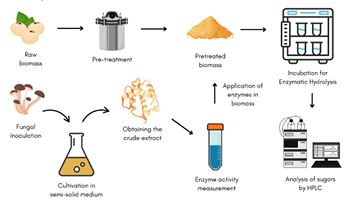
Soybeans are one of the world’s most relevant agricultural commodities, playing a central role in global food and energy se curity. Soybean grain is used in the production of vegetable oil, protein for animal feed, and various industrial derivatives, mak ing it essential for agribusiness [1]. In this context, Brazil stands out as the world’s largest producer and exporter of soybeans, responsible for approximately 40% of global production. For the 2024/25 period, the Brazilian soybean harvest was estimated at 169.7 million tons, generating revenue of R$ 334.1 billion [2,3].
During the processing of the grain for oil extraction and meal production, large volumes of residues are generated, including the soybean hulls. Although often underutilized, this lignocel lulosic biomass is rich in cellulose and hemicellulose, show ing potential as a renewable raw material [4]. It is estimated that for every ton of processed soybean, 40 to 50 kg of hulls are obtained, representing an abundant and low-cost source for biotechnological applications [5]. This approach of valoriz ing residual biomass, such as the soybean hulls, is essential to produce second-generation biofuels through the fermentation of biomass sugars [6].
The utilization of soybean hulls depends on the deconstruc t ion of their lignocellulosic matrix, a process that can benefit from the high catalytic specificity of lignocellulolytic enzymes, which function under mild conditions and minimize the formation of toxic byproducts that hinder fermentative processes [7]. How ever, due to the rigid and recalcitrant structure of the biomass, chemical pretreatment is necessary so that the enzymes can access the polysaccharides. Successful pretreatment strategies, which employ temperatures above 50 °C, are effective in disor ganizing the biomass and facilitating enzymatic penetration [8].
Among the main enzymatic groups involved, the combina t ion of cellulases and xylanases is considered the most effective in degrading lignocellulose [9]. Cellulases catalyze the depoly merization of cellulose and are composed of three enzymes: endoglucanases (EC 3.2.1.4), beta-glucosidases (EC 3.2.1.21), and exoglucanases (EC 3.2.1.91), which act in synergy to com pletely hydrolyze cellulose into glucose monomers [10]. Simi larly, xylanases are essential for the hydrolysis of hemicellulose and comprise a set of enzymes: endo-1,4-beta-D-xylanases (EC 3.2.1.8), beta-D-xylosidases (EC 3.2.1.37), feruloyl-esterases (EC 3.1.1.73), acetylxylan-esterases (EC 3.1.1.72), alpha-gluc uronidases (EC 3.2.1.139), alpha-L-arabinofuranosidases (EC 3.2.1.55), and p-coumaric esterases (EC 3.1.1.B10). These en zymes work together to degrade xylan from hemicellulose into monosaccharides and xylo-oligosaccharides [11].
Fungi, due to their natural capacity to secrete extracellular enzymes, have been widely explored as producers of these lignocellulolytic enzymes [12]. Among them, phytopathogenic fungi stand out for their ability to degrade the plant cell wall during infection, efficiently producing enzymes such as cellu lases, xylanases, and laccases [13]. Despite this potential, their use for lignocellulases production is still limited and little stud ied compared to non-pathogenic fungi, such as those of the genera Trichoderma and Aspergillus [14].
In this scenario, the soybean hulls assume a dual and stra tegic role in biotechnological processes. It not only serves as a raw material for enzymatic hydrolysis, generating fermentable sugars, but it can also function as an inducing substrate to pro duce lignocellulolytic enzymes by microorganisms. This capacity to act on both fronts, as a carbon source for enzyme production and as an input for saccharification, makes it a biomass of great interest in the production of biofuels [15].
Thus, the use of soybean hulls as a substrate to produce fermentable sugars through enzymatic hydrolysis emerges as a sustainable and economically attractive strategy. In addition to adding value to a low-cost agro-industrial residue, this process f its within the context of the circular economy, contributing to waste reduction, mitigation of environmental impacts, and the generation of essential inputs for strategic sectors such as en ergy and food [16].
Pretreatment of soybean hulls
The soybean hulls samples, supplied by the company CJ Se lecta, were dried in an oven at 70 °C until constant weight was achieved, and subsequently ground in a knife mill to particles smaller than 1 mm. The hulls were subjected to acid and hydro thermal pretreatments, using a 0.5% (w/v) H2 SO4 solution for acid pretreatment and only water for hydrothermal treatment. The pretreatments were carried out in an autoclave at 120 °C for 30 min, with a solid concentration of 10% (w/v). Subsequently, the obtained solution was filtered by vacuum filtration and the retained solid was dried in an oven at 50 °C.
Determination of inhibitor compounds after pretreatment
The determination of acetic acid, formic acid, furfural, and 5-Hydroxymethyl-2-Furaldehyde (HMF) contents were per formed by HPLC with an HPX-87H column (300×7.8 mm), main tained at 60 °C and 5 mM sulfuric acid eluent with a flow rate of 0.6 mL/min. The concentration of total phenolic compounds was determined by the Prussian blue method [17].
Cultivation of phytopathogenic fungi
The phytopathogenic fungi Nectriaceae sp., Cladosporium cladosporioides, and Phaeoacremonium parasiticum were ob tained from the mycological collection of the Forest Pathology Laboratory at UFV and were maintained at 28 °C on PDA (Potato Dextrose Agar) plates.
These fungi were cultivated in a semi-solid medium contain ing soybean hulls as a carbon source: 5 g in 12 mL of cultivation medium with the following composition, in g/L: NH4 NO3 1.0; KH2PO4 1.5; MgSO4 ; CuSO4 0.25; yeast extract 2.0 and trace el ements, in mg/L: MnCl2 0.1; H3 BO3 0.075; Na2 MoO4 0.02; FeCl3 1.0; ZnSO4 3.5. The medium was inoculated with 10 discs of ap proximately 1.5 cm, obtained from the plates containing the fungi, and incubated for 8, 10, and 12 days at 150 rpm and 28 °C.
Extraction of cellulases and hemicellulases
The enzymes secreted by the phytopathogenic fungi during cultivation in semi-solid medium were extracted with 50 mM, pH 5 sodium acetate buffer, at a ratio of 10:1 (buffer: substrate mass), under stirring at 150 rpm for 60 minutes at room temper ature. The crude extracts were obtained by vacuum filtration.
Determination of enzymatic activities
The crude extracts obtained after 8, 10, and 12 days were subjected to different assays for the determination of enzymat ic activities. The assays were performed using 100 mM, pH 5.0 sodium acetate buffer and a temperature of 50 °C, for different t imes.
For assays based on the quantification of total reducing sug ars, the 3,5-Dinitrosalicylic acid (DNS) colorimetric method was used [18]. A standard curve for reducing sugars was prepared using a glucose solution of 2 g/L. Serial dilutions were made, and the standards were subjected to the same DNS reaction procedure as the enzymatic assays, with absorbance measured at 540 nm to quantify the released product in μmol of glucose.
For assays based on the quantification of total reducing sug ars, the 3,5-Dinitrosalicylic acid (DNS) colorimetric method was used [18]. A standard curve for reducing sugars was prepared using a glucose solution of 2 g/L. Serial dilutions were made, and the standards were subjected to the same DNS reaction procedure as the enzymatic assays, with absorbance measured at 540 nm to quantify the released product in μmol of glucose.
The colorimetric assays using synthetic substrates con taining para-nitrophenol (pNP) were employed for the de termination of α-glucosidase, β-glucosidase, β-xylosidase, α-galactosidase, β-galactosidase, α-arabinofuranosidase, and β-cellobiohydrolase activities, respectively, for 15 minutes in a water bath. A standard curve for pNP was constructed using a solution of pNP 2 μmol/mL. Aliquots of this standard were diluted in 100 mM, pH 5.0 sodium acetate buffer, and the reac t ion was stopped by adding an alkaline solution (e.g., Na2 CO3 ) to develop the color, with absorbance measured at 405 nm for the quantification of released pNP in μmol.
For the determination of laccase activity, the substrate ABTS (2,2’-azino-bis(3-ethylbenzothiazoline-6-sulfonate)) was used, incubating in a water bath for 15 minutes. The activity was quantified by spectrophotometry at 420 nm, and the conver sion of absorbance to product concentration was performed using the Lambert-Beer Law.
The assays were performed in triplicate for the calculation of means and standard deviation. The unit of enzymatic activity was defined as U/mL, where U corresponds to the amount of enzyme that releases 1 μmol of product per minute.
Determination of protein content
The determination of the protein concentration of the dif ferent crude enzymatic extracts was performed by the Bradford method [19].
Enzymatic hydrolysis of pretreated soybean hulls
The enzymatic extracts from the phytopathogenic fungi Clad osporium cladosporioides and Phaeoacremonium parasiticum were selected for saccharification experiments, and the choice was based on the enzymatic profile of these extracts. Further more, a 1:1 mixture of the two enzymatic extracts was tested.
The enzymatic extracts were applied to the saccharification of pretreated soybean hulls, at 50°C, 250 rpm, for a period of 120 hours. The reaction volume consisted of 5% pretreated soybean hulls and fungal extract containing 2.5 FPase units Per gram of biomass (FPU/g), plus 10 mM sodium azide and 40 μg/ mL tetracycline to prevent microbial contamination. For the positive control of the reaction, the commercial cocktail Mul t ifect® CL Cocktail (Genencor Intl., USA) was used, and for the negative control, 50 mM, pH 5.0 sodium acetate buffer was used in the same proportions as the fungal extract. Each assay was performed in reaction triplicates. Aliquots were taken at different incubation times: 0, 24, 48, 72, 96, and 120 hours.
Quantification of glucose and xylose release after enzymat ic hydrolysis
The aliquots derived from the saccharification experiment were analyzed by HPLC for the quantification of the released glucose and xylose sugars. A Shimadzu 10A series instrument with a refractive index detector was used, as described by Falkoski et al. (2013). The standard curve for quantification was prepared using solutions of glucose and xylose, both at 5 g/L. These solutions were serially diluted to cover the expected concentration range of the enzymatic saccharification samples. The column used in the HPLC was the Aminex HPX-87P (300×7.8 mm). Elution was performed with water, at a flow rate of 0.6 mL/min, at 80°C [20].
Statistical analysis
All data were statistically analyzed using one-way Analysis of Variance (ANOVA). Where significant differences were iden t ified (p<0.05), Tukey’s HSD test was subsequently applied for mean separation. All statistical analyses were performed using the R software [21].
Enzymatic profile of fungal extracts
After cultivation in semi-solid medium, the profile of ligno cellulolytic enzymes secreted by each fungus, when induced on soybean hulls, was determined. Table 1 shows the protein con tents of the crude enzymatic extracts obtained after growth of the phytopathogenic fungi Nectriaceae sp., C. cladosporioides and P. parasiticum on soybean hulls after 8, 10, and 12 days of cultivation. It is noticed that the protein content of the crude extracts obtained is quite similar, and the concentrations were close to 0.2 mg of protein per mL of enzymatic extract.
Table 2 details the specific enzyme activities for 11 different enzymes obtained from the crude extracts of the phytopatho genic fungi Nectriaceae sp., C. cladosporioides, and P. parasiti cum following 8, 10, and 12 days of cultivation on soybean hulls. The overall fungal enzymatic profiles showed considerable vari ability. It is important to note that α-glucosidase and cellobiohy drolase activities were not detected across the samples. Based on the initial screening results, the extract from Nectriaceae sp. was immediately discarded from subsequent steps due to its near-total lack of activity across the tested enzymes.
In contrast, C. cladosporioides exhibited notably high ac t ivities across multiple enzymes, particularly emphasizing man nanase, β-glucosidase, and β-galactosidase. This fungus stood out as the top secretor for several key enzymes, achieving maximum activities after 12 days of cultivation. Specific peak values include mannanase (80 U/mg), xylanase (43 U/mg), α-galactosidase (27 U/mg), endoglucanase (19 U/mg), pectin ase (16 U/mg), and β-glucosidase (6 U/mg).
Despite the 12 days of cultivation showing superior results compared to 8 and 10 days for C. cladosporioides, it was not possible to find a significant difference by ANOVA between the different times for most of the enzymes investigated. However, a statistically significant difference was found for a few specific enzymes in the 12-day extract. In this regard, for the hydroly sis steps, it was decided to produce and use the extract in the shortest possible time, i.e., 8 days of cultivation for both C. clad osporioides and P. parasiticum.
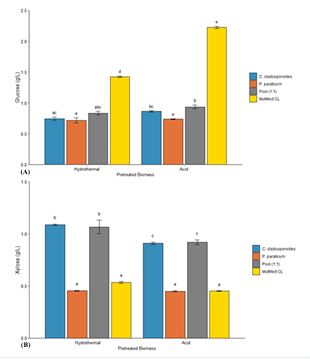
Figure 1: (A) Glucose and (B) xylose concentration (g/L) re leased after enzymatic hydrolysis of the pretreated biomass using enzymes from the fungi C. cladosporioides (blue), P. parasiticum (red), a 1:1 mixture of C. cladosporioide and P. parasiticum extracts (gray), and the commercial cocktail Multifect® CL Cocktail (yellow). Bars with different letters indicate statistically significant differ ences (Tukey’s test, p<0.05).
 Table 1
Table 1: Protein content of crude extracts produced by the fun gi after cultivation for different times on soybean husk. Data are presented as the mean ± standard deviation (n=6). The statistical comparison among all groups in each enzyme was performed us ing Analysis of Variance (ANOVA) followed by the Tukey’s HSD test (p< 0.05). Different uppercase letters (A, B, C, ...) indicate statisti cally significant differences between the tested groups.
Table 2
Table 2: Specific enzyme activities (U/mg) of different enzymes produced by different fungi cultivated for 8, 10, and 12 days. Data are presented as the mean±standard deviation (n=6). Different letters indicate statistically significant differences (Tukey’s test, p<0.05) between the groups of each enzyme. Activity results for α-glucosidase and β-cellobiohydrolase are not presented as activity was below the detection limit in all samples. ND, Not Detected; FPase, Filter Paper Activity.
Table 3
Table 3: Inhibitors produced during the different pretreatments (mg/mL).
Inhibitors produced in pretreatment
Table 3 shows the results of inhibitors quantification during the different pretreatments: hydrothermal and acid.
From these results, it can be observed that the hydrothermal and acid pretreatments produced formic acid and acetic acid in measurable concentrations, with the acid pretreatment yielding the highest concentration of formic acid (0.283±0.011 mg/mL). Hydroxymethylfurfural (HMF) was quantified exclusively after the acid pretreatment, in a small concentration (0.045±0.001 mg/mL). Phenolic compounds were not found as inhibitors produced by either pretreatment. This result is very interesting because phenolic compounds are described as the most inhibi tory, potentially culminating in the precipitation and irreversible inhibition of enzymes [22].
Enzymatic hydrolysis
Figure 1 shows the concentration of glucose (g/L) (Figure 1A) and xylose (g/L) (Figure 1B), respectively, after 120 hours of en zymatic hydrolysis of the soybean hulls under different condi t ions.
From these results, it can be observed that the glucose re lease by the fungal enzymatic extracts was inferior to that performed by the commercial Multifect® CL Cocktail, which was expected as this cocktail is rich in cellulases. The mixture of enzymatic extracts did not result in a statistically significant increase in glucose release over the individual extracts of C. cladosporioides and P. parasiticum.
Both the hydrothermal and acid pretreatments yielded simi lar glucose release levels with the fungal enzymatic extracts, except for the commercial cocktail, which showed a greater re lease when applied to the acid-pretreated biomass.
Based on these results, both the extract from the fungus C. cladosporioides and the mixture of enzymatic extracts demon strated superior xylose release compared to the Commercial Multifect® CL Cocktail, achieving up to a 2-fold increase.
However, the absence of a synergistic advantage in the mix ture compared to the individual extracts, combined with the observation that the C. cladosporioides extract exhibited activ ity like the mixture, confirms its role as the predominant con tributor to the mixture’s overall enzyme activity.
Furthermore, xylose release was consistently higher when the enzymatic extracts were applied to the hydrothermally pre treated biomass as opposed to the acid-pretreated biomass.
Soybean hulls proved to be an efficient and low-cost in ducer for the in-situ production of lignocellulolytic enzymes by the phytopathogenic fungi C. cladosporioides and P. para siticum. The resulting fungal enzymatic extracts were shown to be promising by efficiently hydrolyzing the different pretreated soybean hulls samples, with a particular emphasis on xylose release. These results establish both soybean hulls (as a sub strate) and the fungal extracts (as enzyme sources) as viable candidates for the low-cost production of specific enzymes and for the saccharification of biomass, aiming at the production of second-generation ethanol.
Acknowledgements
This work was supported by Fundação de Amparo à Pesquisa do Estado de Minas Gerais (FAPEMIG APQ-01251-22). Coorde nação de Aperfeiçoamento de Pessoal de Nível Superior (CA PES) and Conselho Nacional de Desenvolvimento Científico e Tecnológico (CNPq) are also acknowledged for contributing to the University’s structure in previous projects.
We always work towards offering the best to you. For any queries, please feel free to get in touch with us. Also you may post your valuable feedback after reading our journals, ebooks and after visiting our conferences.

