


| Received | : | Dec 16, 2025 |
| Accepted | : | Jan 06, 2026 |
| Published Online | : | Jan 13, 2026 |
| Journal | : | Journal of Orthopedics and Muscular System |
| Publisher | : | MedDocs Publishers LLC |
| Online edition | : | http://meddocsonline.org |
Cite this article: Gobbi A, Salvador AJ, Acosta M, Bersola KA, Bizzoco L, et al. Platelet-rich Plasma Versus the Platelets Adipose Stromal Treatment for Arthritis (PASTA) Technique for Knee Arthropathy and Chondropathy: Clinical and Functional Outcomes. J Orthop Muscular Syst. 2026; 9(1): 1030.
Background: Platelet-Rich Plasma (PRP) and adipose-derived cell-based treatments are widely used for knee osteoarthritis (OA), yet comparative evidence between PRP alone and PRP combined with adipose-derived products remains limited. The Platelets Adipose Stromal Treatment for Arthritis (PASTA) technique integrates leukocyte-poor PRP with SVF from microfragmented adipose tissue.
Purpose: To compare pain, function, and quality-of-life outcomes between intra-articular PRP injections and the PASTA technique in patients with knee OA and focal chondropathy.
Methods: In this single-center randomized clinical trial, 83 adults with Kellgren-Lawrence grade II-IV OA or Outerbridge grade II-IV chondral lesions were assigned to receive three leukocyte-poor PRP injections (n=46) or a single PASTA injection (n=37). Outcomes (KOOS, EQ-5D-5L, EQ-VAS, VAS Pain) were assessed at baseline, 6 months, 1 year, 2 years, and 3-4 years. Linear mixed-effects models adjusted for baseline severity and covariates were used to compare groups.
Results: PASTA patients were older and had worse baseline pain and function. Both groups improved by 6 months; PRP results plateaued thereafter, whereas PASTA patients continued to improve to 1 year. At 1 year, PASTA achieved superior VAS Pain (mean difference -0.76) and EQ-VAS (mean difference +8.7). Across all follow-up visits, adjusted KOOS estimated marginal means favored PASTA, with significant advantages in Symptoms (+9.6), Pain (+10.3), ADL (+10.6), Sports (+13.3), Quality of Life (+24.9), and KOOS Total (+15.9) (all p< 0.05; QoL and Total p< 0.001). No serious adverse events occurred.
Conclusion: Both treatments improved symptoms, but PASTA produced greater adjusted KOOS outcomes and superior pain and global health scores at 1 year. PASTA may offer broader and more sustained benefits than PRP alone. Larger randomized trials are warranted.
Keywords: Platelet-rich plasma; PASTA technique; MSC; Stromal vascular fraction; Adipose-derived mesenchymal stem cells; Knee osteoarthritis; Chondropathy; Patient-reported outcomes; Orthobiologics.
Osteoarthritis (OA) is the most prevalent degenerative joint disorder and is the leading cause of chronic pain and long-term disability in adults, affecting about 595 million people or 7.6% of the global population, with the knee being the most commonly affected site [1]. Primary OA, compared to secondary OA which stems from identifiable factors like trauma, injury, disease, or deformity, is mainly associated with overuse or agerelated disruption of the homeostasis between articular cartilage degeneration and repair mechanisms, leading to thinning of the cartilage [2]. The disease is characterized by a whole joint pathology involving progressive breakdown of articular cartilage, remodeling and sclerosis of subchondral bone, formation of osteophytes, and chronic inflammation of the synovial membrane. It typically presents as joint pain, swelling, reduced mobility, and ultimately, functional disability, limiting participation in sports and physical activities [3].
Comprehensive management of OA includes an array of conservative options, including physical, behavioral, educational, psychosocial, and pharmacologic interventions, such as oral and topical non-steroidal anti-inflammatory drugs (NSAIDs), corticosteroid injections, oral supplementation, injection with hyaluronic acid, exercise and weight loss, joint support and unloading devices, neuromuscular training, and physical therapy [3,4]. These modalities mainly contribute to managing the symptoms; however, they do not particularly halt, reverse, or solve the cartilage degeneration process, and joint replacement is eventually considered for worsening disease. OA is a major global health burden, with prevalence projected to rise sharply by 2050 [1]. An aging population and longer life expectancy have driven research efforts beyond symptom control toward understanding disease pathophysiology and developing biologic treatments, joint-preserving strategies, and cartilage repair techniques. These approaches aim not only to relieve symptoms and slow progression, but also to offer the possibility of delaying or even avoiding the need for joint replacement.
One such orthobiologic option for OA management is the use of Platelet-Rich Plasma (PRP) as an intra-articular injection. PRP is the plasma segment of whole blood that has been subjected to centrifugation, exhibiting a platelet concentration that is greater than the baseline level prior to the centrifugation [5,6]. It is collected from the patient on the same day the injection is administered and undergoes only minimal processing steps. Its cost-effectiveness and relative ease of use have made it a popular option in orthopaedics. Randomized controlled trials have established the safety and sustained clinical efficacy of PRP for knee OA, with several studies showing superior outcomes compared with hyaluronic acid at the 12th month of follow-up. Additionally, PRP has been repeatedly demonstrated to relieve pain and inflammation linked to OA [7-12].
The α-granules of platelets contain growth factors and cytokines, and when concentrated and applied to sites of injury, healing can be enhanced especially in OA [13,14]. Some of these growth factors and cytokines include Insulin-Like Growth Factor 1 (IGF-1), IGF-2, Vascular Endothelial Growth Factor (VEGF), Transforming Growth Factor-β (TGF-β), Fibroblast Growth Factor (FGF), endothelial growth factor, and Platelet-Derived Growth Factors (PDGF). Due to these, PRP preparations possess the capability to initiate and modulate critical pathways, such as angiogenesis, control of inflammation, and immunomodulation, while also achieving analgesic effects [5,15].
Looking further into augmenting the limited self-healing capacity of cartilage, the potential of Mesenchymal Stem Cells (MSCs) has been explored, capitalizing on its multipotency and disease-modifying capabilities [16]. MSCs can differentiate into various mesodermal tissues, including bone, cartilage, muscle, adipose tissues, tendons, ligaments, marrow, and connective tissues, thus its consideration as a major factor in the regenerative process [14,16,17]. Caplan proposed renaming them to “medicinal signaling cells” due to the discovery that MSCs also induce immunomodulatory and trophic processes via paracrine signaling, wherein they suppress inflammatory T-cell proliferation and maturation of monocytes and myeloid dendritic cells and promote a unique environment inciting repair from its secretion of various bioactive substances [14,16-18]. MSCs have also been found to exhibit anti-inflammatory, anti-apoptotic, and anti-fibrotic mechanisms, further contributing to its disease-modifying capacity, targeting the theorized pathophysiology of OA [14,16]. Multiple meta‑analyses have demonstrated that intra-articular MSC injections consistently reduce pain (VAS, WOMAC) and improve functional scores at 12 months and beyond, showing increased cartilage volume, without elevating adverse events compared with controls or other treatments, such as hyaluronic acid [18-22].
There are multiple sources of MSCs, including bone marrow, umbilical cord, and adipose. However, adipose-derived MSCs have the advantage of having a straightforward harvesting process with a high yield of mesenchymal and progenitor cells [23-25]. Recognizing the potential of combining different but complementary mechanisms, Gobbi et al. initially explored the use of Autologous Microfragmented Adipose Tissue (AMAT) for cartilage lesions and OA. The advantages of growth factors and cytokines from PRP, combined with the regenerative potential and trophic mediator capabilities of MSCs has been reported to be effective, with improvement in both clinical and functional outcomes in their studies [26,27]. After thorough investigations and several publications, Gobbi et al. developed a further refinement of the technique to standardize the combination of autologous leukocyte-poor PRP and MSCs from the Stromal Vascular Fraction (SVF) of microfragmented adipose tissue, called the Platelets Adipose Stromal Treatment for Arthritis (PASTA) technique. This technique has also been associated with improvements in quality of life, functional, and clinical outcomes at short- and long-term follow-up [14,28].
There have been studies on OA and chondral defects which have shown good results with either PRP injection alone [7,8], the use of adipose-derived MSCs through AMAT or SVF [26,29,30], or even a combination of both [14,28,31]. Although PRP and adipose-derived products such as SVF have each shown promise, robust comparative evidence evaluating their combined use versus PRP alone remains limited. This study aims to evaluate the outcomes of PRP injection alone compared with the PASTA technique. We hypothesized that the PASTA technique will show more improvement in quality of life, functional outcomes, and clinical outcomes compared to PRP injection alone.
Study Design
This was a single-center, parallel-group randomized clinical trial of 83 patients diagnosed with generalized arthropathy or focal chondropathy. The patients underwent either 3 sessions of intra-articular leukocyte-poor PRP injections at an interval of 2 weeks or a single injection with the PASTA technique. This study was conducted in accordance with the ethical standards of the Declaration of Helsinki and its subsequent revisions, the International Conference on Harmonisation Good Clinical Practice Guidelines and the WHO/CIOMS International Ethical Guidelines for Health-Related Research. All participants signed an informed consent.
Patients were randomized in a 1:1 ratio without blocking to receive either PRP or PASTA; however, minor imbalances in group size occurred due to chance. The randomization sequence was generated using a computer-based random number generator by an independent research coordinator who was not involved in patient enrollment or treatment. Allocation was concealed using sequentially numbered, opaque, sealed envelopes that were opened only after participants had completed baseline assessments and were deemed eligible.
Because of the nature of the interventions, neither patients nor treating clinicians could be blinded to group assignment; however, data entry and statistical analyses were performed by personnel blinded to treatment allocation. Although assignment was random, subsequent statistical analysis identified baseline differences between groups, with patients in the PASTA arm being slightly older and reporting more severe baseline symptoms by chance.
Inclusion criteria were patients 18 years old or older, diagnosed with knee OA grade II to IV according to the KellgrenLawrence classification or with single chondral lesions grade II to IV according to the Outerbridge classification, with history of knee pain or swelling for more than six months, without gout or other inflammatory/rheumatic disorders, and with limitation of daily activities or sport.
Exclusion criteria included patients with a history of previous surgeries or invasive procedures around the knee, associated injuries of menisci and ligaments around the knee, use of corticosteroids, use of non-steroidal anti-inflammatory drugs within one month prior to treatment, previous injections of any orthobiologics, PRP, or hyaluronic acid, varus/valgus joint malalignment >8°, and cutaneous infections in the injection area.
All patients were managed by a single senior surgeon. PRP injections were performed under aseptic conditions according to the Arthrex ACP® protocol, and PASTA was performed in the operating room using a standardized technique. Diagnostic imaging included standing, weight-bearing anteroposterior and lateral radiographs of the knees and lower limbs to evaluate joint alignment and OA severity. Non-contrast MRI scans were also obtained to assess cartilage condition based on the Outerbridge classification. Patients were followed up at defined intervals: baseline (pre-treatment), then at 6 months, 1 year, 2 years, and 3-4 years after treatment.
Interventions
The interventions were performed under aseptic conditions for both groups. Leukocyte-poor PRP was prepared following the technical guidelines by Arthrex for the ACP® Double-Syringe System [32]. Approximately 15-16 mL of venous blood was drawn, which was centrifuged at 1500 rpm for 5 minutes. 4-7 mL of PRP yield was then intra-articularly injected into the affected knee. The PRP group received a total of three injections, with a two-week interval between injections.
The PASTA technique was done as described in the technical note published by Gobbi et al. [14,28]. The procedure involved harvesting a small amount of adipose tissue under local anesthesia, which was processed by centrifugation and microfragmentation to isolate the SVF. The SVF was then combined with freshly prepared leukocyte-poor PRP to create the final injectable product, which was administered intra-articularly into the affected knee. Only a single injection was done for the PASTA group.
Outcomes
The primary outcome measure was the Knee Injury and Osteoarthritis Outcome Score (KOOS) Total Score at 1 year. The KOOS is a validated, patient-reported outcome measure consisting of five subscales (Pain, Symptoms, Activities of Daily Living [ADL], Sports and Recreation, and Knee-related Quality of Life). Secondary outcomes included the KOOS subscales and the European Quality of Life (EQ-5D-5L) with Visual Analogue Scale (VAS) surveys. These were collected at baseline, at 6 months, 1 year, 2 years, and 3-4 years. Adverse events, including donorsite symptoms in the PASTA group, were systematically recorded at each follow-up visit.
Statistical Analysis
Descriptive statistics were presented for the data in the form of mean and standard deviation for continuous variables, and frequency and percentage for categorical variables. Interassociations between demographic variables and differences in baseline measurements according to group and demographics were checked via t-tests, one-way ANOVAs, and chi-square tests. Analyses followed the intention-to-treat principle, including all available data from randomized participants.
Linear mixed-effects models were fitted using the MIXED syntax of SPSS, with group, time, the interaction between group and time, baseline measurements and covariates specified as fixed effects, and repeated observations clustered per participant ID. Additional interaction terms were specified depending on the presence of significant covariate effects. Between-group comparisons are reported as adjusted Estimated Marginal Means (EMMs), that is, model-adjusted average scores, which account for baseline differences and covariates. EMMs adjusted for covariates and baseline data were obtained for each group, and for each follow-up interval. Selection of final models depended on significance of the included terms, plausibility of interactions, measures of information loss (AIC and BIC), and model parsimony. Models with significant interaction effects between group and time were followed with exploration of simple main effects. When interaction terms were not significant, the main effect of group was considered.
Statistical significance was set at α = 0.05. Statistics were computed using IBM SPSS Statistics (Version 26). Graphs were created using the ggplot2 package of R Software version 4.4.1.
Participants and Baseline Characteristics
A total of 83 patients were included in the analysis (PRP n=46, PASTA n=37). Despite random assignment, patients in the PASTA group were slightly older at baseline (mean age 62.9 vs 53.9 years, p< 0.001) and the sex distribution differed significantly between groups, with proportionally more males in PRP and more females in PASTA (p=0.045). Patients with arthropathy were older than those with chondropathy (62.6 vs 53.8 years, p<0.001), and bilateral cases were older than unilateral cases (61.6 vs 55.1 years, p=0.012).
 Table 1
Table 1: Baseline characteristics of PRP and PASTA patients
At baseline, PRP patients scored substantially better than PASTA patients across nearly all outcome measures. Mean VAS Pain was 3.78 in PRP compared with 6.78 in PASTA (p< 0.001). Similarly, PRP patients had higher (better) scores across all KOOS subscales and the KOOS Total (p< 0.001). PRP patients also reported fewer problems in most EQ-5D domains. The only exception was the Anxiety/Depression domain, where baseline scores favored the PASTA group (Table 2).
Pain and Quality of Life Outcomes
Table 2
Table 2: Mean (SD) VAS and EQ-5D-5L domain scores over time for PRP and PASTA groups. Lower EQ-5D scores indicate fewer problems; higher EQ-VAS indicates better perceived health.
By the 2-year visit, all respondents in both groups reported ‘no problems’ (level 1) on the EQ-5D-5L Anxiety/Depression domain, resulting in a complete ceiling effect. Because there was no variation over time or between groups, this domain was excluded from mixed-effects modeling and is not presented in detail in subsequent tables.
Pain and quality-of-life outcomes showed distinct patterns between the groups. Both groups produced significant improve ments in VAS Pain and several EQ-5D domains by six months. However, while PRP patients plateaued after this point, PASTA patients continued to improve up to one year before reaching stability. At the one-year follow-up, PASTA patients reported significantly better VAS Pain and EQ-VAS scores than PRP patients (Figures 1 and 2), with a borderline difference in EQ-Usual Activities. By the two-year follow-up, between-group differences were less pronounced, reflecting convergence of outcomes over time. In contrast, no significant differences were detected for EQ-5D Mobility or Self-Care in either group throughout follow-up.
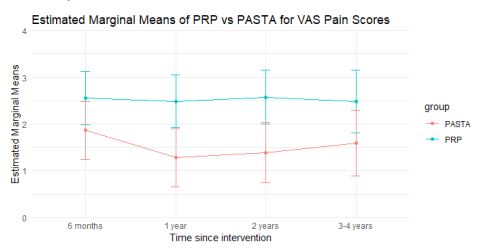
Figure 1: Mean VAS Pain over time. Both groups improved by 6 months; PRP plateaued, while PASTA continued to improve to 1 year, showing a significant advantage (p< 0.05).
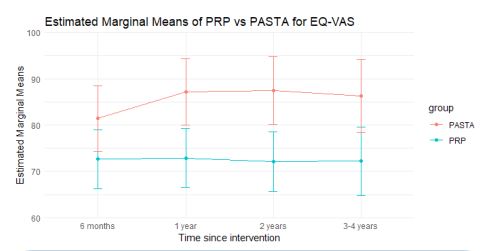
Figure 2: Mean EQ-VAS over time. Both groups improved at 6 months; PRP plateaued, while PASTA continued to improve to 1 year, with a significant advantage at that timepoint (p< 0.05).
KOOS Outcomes
Table 3
Table 3: Adjusted mean differences in KOOS outcomes.
* p< 0.05, **p< 0.01, † p< 0.001
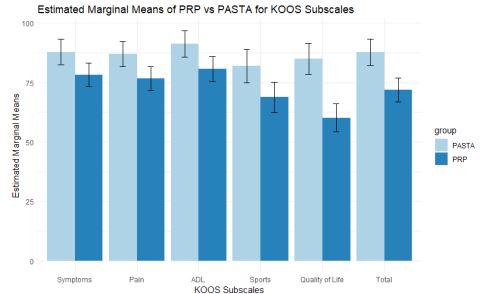
Figure 3: Adjusted KOOS subscale scores. Across all visits, PASTA showed consistently higher scores than PRP, with the largest differences for Quality of Life and KOOS Total (p< 0.001).
Both PRP and PASTA groups demonstrated improvement in KOOS domains over time, with broadly similar trajectories. However, when scores were averaged across all follow-up visits and adjusted for baseline differences and covariates, the PASTA group consistently achieved higher results. On average, PASTA patients scored better in Symptoms, Pain, ADL, Sports, Quality of Life, and the KOOS Total score. These differences were clinically meaningful, as most exceeded the commonly accepted KOOS Minimal Clinically Important Difference (MCID) of 7-10 points. Notably, the largest advantages were observed in Quality of Life (≈25 points) and KOOS Total (≈16 points), both surpassing MCID thresholds by a wide margin. Statistically significant differences were also present in Symptoms, Pain, ADL, and Sports, ranging from 9 to 13 points in favor of PASTA (Table 3 and Figure 3). These findings indicate that although both groups improved, patients treated with PASTA attained a higher overall level of functional recovery and quality of life.
Influence of Diagnosis
Diagnosis influenced outcomes across both treatment groups, with patients presenting with chondropathy reporting better improvements than those with arthropathy in several KOOS and EQ-5D domains. Because all included patients had moderate to advanced disease (Kellgren-Lawrence grades II to IV for arthropathy and Outerbridge grades II to IV for focal chondral lesions), these differences likely reflect the greater reparative potential of localized chondropathy compared with diffuse degenerative changes. Although no age-by-group interaction was detected in the analysis, the observed pattern is consistent with clinical experience that focal, contained cartilage defects retain more capacity for biologic response than higher-grade, multicompartmental arthropathy.
Overall Trajectories
In summary, both PRP and PASTA improved patient-reported outcomes during the early months of follow-up. PRP patients reached their maximal benefit by six months, whereas PASTA patients continued to improve up to one year, with superior pain and global health scores at that timepoint. Across KOOS domains, PASTA consistently achieved higher scores than PRP after accounting for baseline severity and patient characteristics. Patient diagnosis rather than age further influenced results, emphasizing the importance of tailoring biologic interventions to individual profiles.
Adverse Events
No treatment-related or serious adverse events occurred in the PRP group throughout the follow-up period. In the PASTA group, minor postoperative donor-site pain lasting a mean of 3.6 days and typically managed with paracetamol was the most common adverse event. However, no serious donor-site complications (such as infection, hematoma, allergic reactions, or prolonged pain) were reported following adipose tissue harvesting. Minor, self-limited post-injection discomfort was noted in both groups and resolved without intervention. No cases of septic arthritis, thromboembolic events, or neurovascular complications were observed.
This study compared PRP and the PASTA technique for knee arthropathy and chondropathy. The main finding was that PASTA provided greater improvements in patient-reported outcomes than PRP, particularly for KOOS Quality of Life and KOOS Total scores, while both groups showed early pain reduction. PASTA patients demonstrated continued improvement up to 1 year on VAS pain and EQ-VAS, whereas PRP patients plateaued by 6 months. These results suggest that combining PRP with adipose SVF may enhance and prolong treatment efficacy compared with PRP alone.
KOOS outcomes overall favored the PASTA group, indicating broader functional improvement and better patient-reported quality of life compared with PRP. Although there was no significant group-by-time interaction, the consistently higher adjusted KOOS scores across all subscales suggest that PASTA patients achieved greater and more comprehensive gains in symptoms, daily activities, sports participation, and perceived quality of life. These findings are consistent with previous reports by Gobbi and colleagues, who observed comparable improvements after microfragmented adipose tissue or PASTAbased interventions [14,28]. Taken together, this supports the view that supplementing PRP with adipose-derived stromal and perivascular cells may enhance recovery and overall patient satisfaction beyond what PRP alone typically achieves.
Systematic reviews of adipose-derived injectables likewise have reported consistent pain and function gains in OA, though with variable methodology and small sample sizes [29,33]. Our study adds to this evidence by directly comparing PASTA with PRP in the same setting and with standardized follow-up.
Patient characteristics also influenced results. Patients with focal chondropathy consistently reported better outcomes than those with arthropathy, suggesting that diagnosis and thus the underlying pattern of cartilage damage may affect responsiveness to biologic treatment. Because all arthropathy patients in this group were Kellgren-Lawrence grade II-IV and all chondropathy patients had Outerbridge grade II-IV focal lesions, these findings likely reflect the greater reparative potential of contained defects compared with more diffuse degenerative disease. This aligns with long-standing cartilage repair evidence, from autologous chondrocyte implantation to MSC-based therapies, showing that focal lesions typically respond more favorably than advanced, multicompartmental OA [34-37]. These observations reinforce the principle that earlier intervention in patients with less extensive disease may yield greater benefit from biologic interventions.
The VAS and EQ-VAS trajectories are also noteworthy. Prior randomized and longitudinal studies of PRP have shown im-provements that peak within 6-12 months and often plateau or decline thereafter [10,38]. In contrast, adipose-derived products may support more sustained responses over time, likely due to trophic and immunomodulatory properties of MSCs [7,24- 27,39]. Our finding that PASTA patients continued to improve through 12 months is consistent with this hypothesis and highlights a potential biological advantage of the combined approach.
The results of our study also extend the existing evidence for PASTA as Acosta et al. previously reported significant and lasting improvements in KOOS, VAS, and EQ-5D outcomes in a prospective single-arm cohort of patients treated with PASTA alone [14]. The current study builds on that foundation by including a comparison group treated with PRP. The results support the hypothesis that PASTA delivers sustained benefits and suggest that it provides a higher level of function and quality of life compared with PRP, with an added advantage during the first year in terms of pain relief and global health.
Emerging evidence has also examined structural outcomes. Studies combining PRP with adipose-derived MSCs have demonstrated improvements in pain and function together with early MRI signals suggesting stabilization or modest increases in cartilage thickness [40,42]. These findings support the biologic plausibility of combination approaches such as PASTA and highlight structural outcomes as an important target for future research.
Strengths of this study include prospective data collection, repeated outcome measures, and the use of models that account for baseline imbalances and patient differences. Limitations include baseline imbalances despite randomization, modest sample size, the fact that PASTA patients began with worse baseline scores which required statistical adjustment, and the lack of blinding of participants and clinicians to treatment allocation, which may introduce expectation bias in patient-reported outcomes. Although adjustments were made, residual confounding cannot be excluded. Follow-up beyond 3-4 years is needed to determine the longevity of effects of PASTA relative to PRP. In addition, as highlighted by several systematic reviews, heterogeneity in preparation methods and reporting standards complicates interpretation across studies [12,43-45]. Standardization of PRP and MSC treatment protocols, together with high-quality randomized trials, will be essential to confirm these results.
Both PRP and PASTA improved symptoms in knee OA and chondropathy, but PASTA demonstrated a consistent advantage. Patients treated with PASTA achieved higher functional and quality-of-life scores overall and continued to improve up to one year, with superior pain and global health outcomes at that timepoint. These findings, in line with previous prospective PASTA evidence, support PASTA as a promising treatment option that may offer broader benefits than PRP. Larger randomized trials with more long-term outcomes are needed to confirm these results and to better define the patient populations most likely to benefit.
Table 4
Table 4: Adjusted mean differences in KOOS outcomes.
We always work towards offering the best to you. For any queries, please feel free to get in touch with us. Also you may post your valuable feedback after reading our journals, ebooks and after visiting our conferences.

