


| Received | : | Aug 14, 2025 |
| Accepted | : | Sep 01, 2025 |
| Published Online | : | Online: Sep 08, 2025 |
| Journal | : | Annals of Ophthalmology and Visual Sciences |
| Publisher | : | MedDocs Publishers LLC |
| Online edition | : | http://meddocsonline.org |
Cite this article: Lee DMX, Naing T, Lim V. Malignant Hypertension Diagnosed at A Primary Eye Care Clinic Setting via Fundus Imaging: A Case Report. Ann Ophthalmol Vis Sci. 2025; 8(2): 1052.
Introduction: The retina is sensitive to acute changes in systemic blood pressure and retinopathy can be the first manifestation of malignant hypertension. This case explores the use of retinal imaging at a primary care centre.
Methods: A 39-year-old patient reported seeing a con stant central black ring in the right eye for 1 day. He was examined at primary care eye clinic at a community branch of a tertiary eye centre and found to have right macular oe dema and bilateral disc swelling. He was referred to a hos pital to be admitted where antihypertensive therapy was commenced.
Results: Admission was uneventful and the patient was discharged with oral antihypertensive therapy. 2 weeks af ter, at an outpatient review, he reported visual field defects directly corresponding to hypertensive changes at the mac ula in the shape of a star. Retinopathy resolved later.
Conclusion: This interesting case highlights the utility of fundus imaging as a screening modality at primary care cen tres for complications of malignant hypertension, allowing for delivery of time-critical appropriate treatment.
Keywords: Case report; Fundus imaging; Malignant hypertension; Primary care; Retinopathy.
Hypertension is a major global health problem affecting 1.13 billion people as declared by the World Health Organization (WHO) [1]. Fewer than 1 in 5 people with hypertension have optimal control of the condition [1] and some go on to develop acute complications of systemic hypertension, of which includes Malignant Hypertension (MH). In severe cases, hypertensive emergency affects the heart, aorta, brain, kidneys and retina through the disruption of vascular autoregulation [2].
Visual field testing assesses optic nerve function and integ rity of the retina. The visual field represents the total sum of points perceived including in the periphery when the eye fo cuses on a specific point in space and the pattern of visual field defect can be a useful in locating defects in the afferent visual system. Specific patterns of visual field defects can correspond to pathology in the retina and disrupted anatomical distribution of the retinal nerve fibres [5]. Central scotomas are visual field defects commonly associated with macula disease.
Recently with the advent of telemedicine, portable fundus imaging systems have been on the rise in retinal screening pro grams [10]. Fundus cameras work by capturing the image of a retina during illumination through the cornea, pupil and lens. Even illumination and focus are ensured through aligning the camera with the visual axis [10].
We report an interesting case of visual field defects directly corresponding to hypertensive changes at the macula. This case of MH was diagnosed at a primary care setting from identifying retinal microvascular changes via fundus photography.
A 39-year-old patient without relevant past medical history reported a seeing a constant central black ring in the right eye with blurring of vision. He was examined at a community branch of a tertiary eye centre in January 2021. The symptoms started on the morning of presentation and was associated with red desaturation. There were no neurological symptoms reported.
The patient was examined and sent for investigations at the community eye clinic. Visual Acuity (VA) was 6/12 (logMAR 0.30) with effort in the right eye and 6/6 (logMAR 0.00) in the left eye. Intraocular Pressure (IOP) in the right eye was 9 mmHg and 11 mmHg in the left eye. Pupils were equal and brisk, there was no RAPD and Ishihara’s test was slower than the contralat eral eye albeit full. Amsler chart revealed a central scotoma in the right eye (Figure 1B). Indirect bio-microscopy, fundus pho tographs (Figure 1B) and investigations by Optical Coherence Tomography (OCT) disclosed bilateral disc swelling (Figure 2A) and presence of flamed shaped retinal haemorrhages, cotton wool spots in both eyes and intra as well sub-retinal fluid at right eye macula (Figure 2B). He was noted to have hyperten sion (220/140 mmHg) on arrival. The diagnosis of malignant hy pertension and grade IV hypertensive retinopathy were made. He was referred to the tertiary care hospital (mother unit of community eye centre). Urgent Computed Tomography (CT) showed no intracranial lesion or bleed. The patient was admit ted for additional investigations and discharged clinically stable within a week with outpatient review appointments in the eye clinic and medicine clinic.
Two weeks after the initial presentation, the patient turned up complaints of seeing black lines radiating from a central blurred patch in the right eye. VA in the affected eye had im proved to 6/7.5 (logMAR 0.10, gain of 10 ETDRS letters) and IOP was 11. Examination under a slit lamp demonstrated a less swollen disc with residual cotton wool spots and absence of f lame-shaped haemorrhages. Presence of hard exudation form ing a nasal half macular star was noted (Figure 3b). Linear de fects radiating from a central blurred patch were documented with Amsler chart corresponding to the morphology of hard exudation in the right eye (Figure 3a). OCT showed abnormal fluid involving the right macula was also reduced (Figure 4b). Retinopathy subsequently resolved.
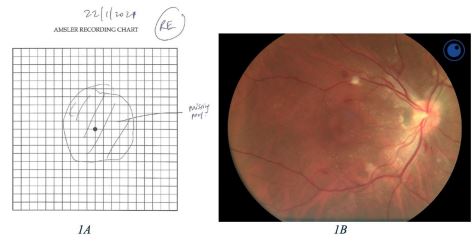
Figure 1: Amsler chart with central scotoma at first presenta t ion in the right eye (Figure 1A) and fundus photo with disc swell ing and presence of flamed shaped retinal hemorrhages, cotton wool spots at first presentation in the right eye (Figure 1B).
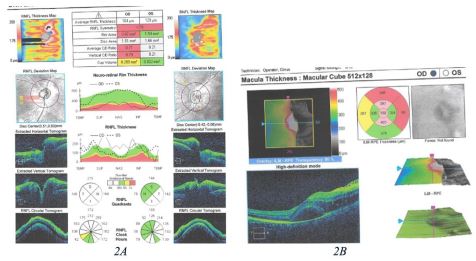
Figure 2: Optical Coherence Tomography (OCT) of the retinal nerve fibre layer of the optic discs with bilateral disc swelling at f irst presentation in both eyes, the right eye more so than the left eye (Figure 2A) and OCT of the macula showed intra and sub-retinal fluid at first presentation the right eye (Figure 2B).
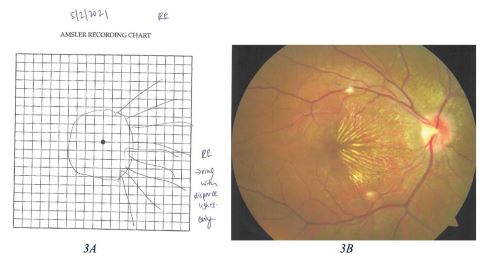
Figure 3: Amsler chart with morphology corresponding to hard exudation in the right macula 2 weeks after first presentation (Figure 3A) and fundus photo with less swollen optic disc, residual cotton wool spots and absence of flame-shaped haemorrhages. The morphology of hard exudation forms a nasal half macular star in the right eye 2 weeks after first presentation (Figure 3B).
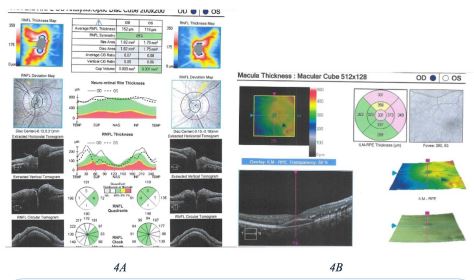
Figure 4: OCT of the retinal nerve fibre layer with less swollen optic discs bilaterally (Figure 4A) and OCT showing that abnormal fluid spaces involving the right macula were also reduced (Figure 4B).
The retina is sensitive to acute changes in systemic blood pressure. Proposed pathophysiology include endothelial cell dysfunction, low-grade systemic inflammation and oxidative stress [1]. The main phases of Hypertensive Retinopathy (HR) and its microvascular changes are (i) vasoconstrictive phase – with decrease in Arteriole to Venule (AV) ratio and arteriolar narrowing, (ii) sclerotic phase – with AV nicking, (iii) exudative phase – with retinal haemorrhages, hard exudates and retinal ischemia [3]. Around the macula, these hard exudates are com monly deposited in a characteristic configuration of a “macular star” [4]. Papilledema can also occur when cerebral autoregula tion is impeded in hypertensive emergency [3].
Hypertension remains to be the leading cause of premature death worldwide [2] and the occurrence of one or more hyper tensive-mediated organ damage warrants early recognition and prompt commencement of blood pressure lowering measures to avoid end organ failure. Among the initial investigations for MH, fundoscopy is recommended according to international guidelines as treatment for retinopathy of grade III/IV differs [6]. When present, grade IV hypertensive retinopathy indicates that normal cerebral autoregulation is compromised and the blood pressure should be controlled by intravenous anti-hyper tensives, under strict monitoring [9]. In fact, the eye is the only organ in the human body where vascular changes in response to high blood pressure can be detected in real time [1].
In clinical practice, fundoscopy could be technically difficult especially in non-specialist centres such as the emergency de partments and community care centers [8]. These locations still receive high patient load and patients do not commonly present with visual symptoms [9]. Hence the lack of fundoscopy or its improper use can lead to misdiagnoses, delays in treatment or incorrect treatment [9].
A possible alternative to fundoscopy is the fundus camera which is proven to be sensitive and still feasible [8] while being less operator dependent. A study performed at a primary care centre with a fundus camera in Singapore illustrated its util ity in diagnosing confirmed hypertension and retinal arteriolar narrowing which can be picked up from fundus photographs (ambulatory MABP [Pearson correlation coefficient r = -0.46, p=0.002] and home MABP [r = -0.40, p=0.009]) [7].
To our knowledge, this is the first reported case of subjec t ively seeing macular star as black lines radiating from a central black patch. Visual presentations are common in patients with MH. Retinal imaging by fundus imaging can hence be a good screening modality at primary care centres for complications of MH, allowing for delivery of time-critical appropriate treat ment.
We always work towards offering the best to you. For any queries, please feel free to get in touch with us. Also you may post your valuable feedback after reading our journals, ebooks and after visiting our conferences.

