


| Received | : | May 22, 2026 |
| Accepted | : | June 05, 2026 |
| Published Online | : | Online: June 12, 2026 |
| Journal | : | Neurology and Neurological Sciences: Open Access |
| Publisher | : | MedDocs Publishers LLC |
| Online edition | : | http://meddocsonline.org |
Cite this article: Majumdar P, Ahemad N, Aliyeva A, Kaura S, Alekbarli K, Jafarova U. Lami-Stem™ Technology for Functional Recovery in Chronic Thoracic Spinal Cord Injury: A Prospective Interventional Study in 45 Patients. Neurol Neurol Sci Open Access. 2026; 9(1): 1038.
Background: Spinal Cord Injury (SCI) remains a devastat ing neurological disorder that frequently results in perma nent motor, sensory, and autonomic impairment. Despite advances in surgical stabilization and neurorehabilitation strategies, effective regenerative therapies capable of re storing neurological function remain limited. Stem cell based therapies have emerged as promising approaches for promoting neurodegeneration, reducing inflammation, and enhancing neural plasticity. However, clinical outcomes remain inconsistent due to hostile inflammatory microen vironments within injured spinal tissue. Lamistem™ tech nology represents a novel regenerative platform combining mesenchymal stem cells with biomolecular scavenger cells designed to neutralize inflammatory mediators and oxida tive stress within injured neural tissue.
Objective: To evaluate the safety and therapeutic efficacy of Lamistem™ technology in patients with chronic thoracic spinal cord injuries below the T10 level.
Methods: A prospective interventional clinical study was conducted involving 45 patients diagnosed with chronic spi nal cord injuries below T10. Each participant received 120 million mesenchymal stem cells administered via intraspinal injection, combined with 10 million biomolecular scavenger cells designed to reduce inflammatory microenvironmental factors.
Cells were delivered through a multimodal administra tion strategy, including:
• Intraspinal injection
• Intravenous infusion
• Intramuscular delivery
Following the initial regenerative intervention, pa tients underwent two months of intensive neurorehabilita tion therapy. After completion of rehabilitation, a second Lamistem™ treatment cycle was administered using the same protocol. Clinical outcomes were evaluated using standardized mobility indices, standing balance assessment, postural stability measures, and lower-limb strength evalu ation.
Results: All 45 patients completed the treatment and fol low-up protocol. Significant improvements were observed across multiple functional parameters. Mean mobility scores improved by up to 55%, while standing balance and postural stability improved by approximately 50% and 47% respectively. Several patients demonstrated increased vol untary muscle activation in the lower limbs and improved ability to maintain standing posture with assistance. No major adverse events or serious neurological complications were reported.
Conclusion: Lamistem™ regenerative therapy demon strated encouraging outcomes in patients with chronic tho racic spinal cord injury. The combination of stem cells with biomolecular scavenger therapy may enhance neural repair by improving the injury microenvironment and supporting neuroplasticity. These findings support further investigation through randomized controlled trials with larger cohorts to confirm therapeutic efficacy and long-term safety.
Keywords: Spinal cord injury; Stem cell therapy; Neuroregener ation; Mesenchymal stem cells; Neurorehabilitation; Lamistem technology; Regenerative medicine.
Spinal Cord Injury (SCI) represents one of the most devastat ing neurological conditions, often resulting in permanent dis ability and profound impairment in quality of life. Worldwide, the incidence of spinal cord injury ranges from 10 to 80 cases per million individuals annually, with thoracic injuries account ing for a significant proportion of cases [1]. SCI typically results from traumatic events such as motor vehicle accidents, falls, sports injuries, and violence. The neurological consequences of SCI often include paralysis, loss of sensory function, autonomic dysregulation, and chronic pain [2].
The pathophysiology of spinal cord injury involves two major phases:
Primary injury: The primary injury occurs at the moment of trauma and involves mechanical disruption of neuronal axons, blood vessels, and supporting structures of the spinal cord [1,3].
Secondary injury: The secondary injury cascade involves complex biochemical and cellular processes, including:
• Neuroinflammation
• Excitotoxicity
• Oxidative stress
• Apoptotic cell death
• Demyelination
• Formation of inhibitory glial scars
These processes collectively create a hostile microenviron ment that prevents effective neuronal regeneration [3,4].
Conventional treatment approaches focus primarily on sta bilization of the spine, prevention of secondary complications, and long-term rehabilitation. However, these strategies rarely result in substantial neurological recovery [5].
In recent years, regenerative medicine has introduced new therapeutic possibilities through stem cell–based interventions. Mesenchymal Stem Cells (MSCs) are particularly attractive due to their:
• Immunomodulatory properties
• Secretion of neurotrophic factors
• Ability to promote angiogenesis
• Potential to enhance neuroplasticity
However, the survival and integration of transplanted stem cells are often limited by the inflammatory microenvironment present at injury sites [6].
To address these limitations, Lamistem™ technology was developed as a combinatorial regenerative approach. This plat form integrates mesenchymal stem cells with biomolecular scavenger cells designed to neutralize inflammatory cytokines and oxidative molecules that inhibit neural repair [5,7].
The present study evaluates the clinical outcomes of Lamistem™ regenerative therapy in 45 patients with chronic spinal cord injuries below the T10 level.
Study Design: This investigation was designed as a prospec tive interventional clinical study evaluating the therapeutic ef fects of Lamistem™ regenerative therapy in chronic spinal cord injury patients. The study was conducted in accordance with ethical standards and followed principles consistent with the Declaration of Helsinki.
Patient Population: A total of 45 patients diagnosed with chronic spinal cord injury below T10 were enrolled.
Inclusion Criteria: Patients were eligible for inclusion if they met the following criteria (Figure 1).
• Age between 18 and 65 years
• Chronic spinal cord injury duration greater than 6 months
• Neurological injury below the T10 level
• Stable medical condition
• Ability to participate in rehabilitation therapy
Exclusion Criteria: Patients were excluded if they had:
• Active systemic infections
• Malignancy
• Severe organ dysfunction
• Unstable spinal fractures
• Pregnancy
Lamistem™ treatment protocol
The Lamistem™ therapy consisted of a combination regen erative intervention involving stem cells and biomolecular scav enger cells.
Stem cells: Each patient received 120 million mesenchymal stem cells prepared under controlled laboratory conditions.
Biomolecular scavenger cells: In addition to stem cells, 10 million biomolecular scavenger cells were administered to modulate inflammatory and oxidative pathways within the in jured spinal cord.
Administration routes: The regenerative cells were delivered through a multimodal administration approach, including all three ways for each patient:
1. Intraspinal Injection: Direct injection at the injury level to maximize local regenerative effects.
2. Intravenous Infusion: Systemic delivery aimed at supporting broader neuroregenerative signalling.
3. Intramuscular Injection: Peripheral administration intended to stimulate neuromuscular recovery.
Rehabilitation program: Following the first regenerative in tervention, patients participated in two months of structured neurorehabilitation therapy.
The rehabilitation program included:
• Neuromuscular stimulation
• Assisted gait training
• Core strengthening exercises
• Postural control training
• Balance stabilization therapy
Second Treatment Cycle: After completion of the reha bilitation phase, post 3 months patients received a second Lamistem™ regenerative treatment following the same admin istration protocol.
Outcome measures
Clinical outcomes were evaluated using multiple functional parameters.
Primary Outcomes
• Mobility improvement
• Standing balance
• Postural stability
Secondary Outcomes
• Lower limb strength
• Weight-bearing capacity
• Functional independence
Patients were followed for 6 to 12 months following the final treatment.
Statistical analysis: Statistical analysis was performed using SPSS version 26.0 (IBM Crop., USA). Continuous variables were expressed as mean + standard deviation. Changes in functional outcomes including’s standing ability, balance performance, and postural stability were evaluated using repeated- measures Analysis of Variance (ANOVA). When significant differences were identified, post hoc pairwise comparisons were conducted using Bonferroni correction to determine differences between baseline and follow up time points. A p- value < 0.05 was consid ered statistically significant. Categorical variables were analysed using chi-square test where appropriate.
Comparisons between baseline and post-treatment out comes were evaluated using:
• Repeated measures ANOVA
p-value less than 0.05 was considered statistically signifi cant.
Neurological Observations
Several patients demonstrated:
• Voluntary contraction of lower limb muscles
• Improved trunk control
• Enhanced ability to maintain standing posture
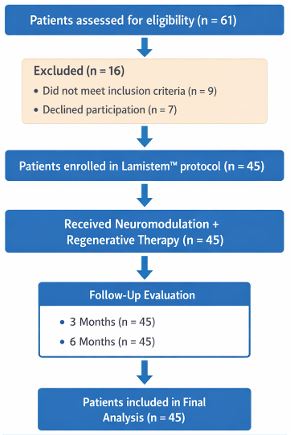
Figure 1: CONSORT style flow diagram demonstrating screen ing, enrolment, treatment allocation, and follow-up of the patients undergoing Lami-Stem neuromodulation therapy for chronic spi nal cord injury.
Patient enrolment and study completion: A total of 45 pa tients with chronic thoracic spinal cord injuries below the T10 level were enrolled in the study. All patients met the predefined inclusion criteria and successfully completed both cycles of the Lamistem™ regenerative therapy protocol, including the two month neurorehabilitation program between treatment phas es. No participants were lost to follow-up during the observa tion period. The mean age of participants was 38.2±9.4 years, with 30 male and 15 female patients included in the cohort. The average duration of injury prior to treatment initiation was 2.8±1.6 years, indicating a population with established chronic spinal cord injury (Table 1).
 Table 1
Table 1: Patient Demographics.
Functional mobility outcomes: Significant improvements in mobility were observed following Lamistem™ therapy com bined with structured rehabilitation. The mean baseline mo bility score improved from 28.4±6.2 at baseline to 44.1±7.5 following completion of the second treatment cycle, represent ing an approximate 55% increase in functional mobility. Many patients demonstrated improved voluntary movement in the lower limbs, with several participants progressing from assisted sitting balance to partial standing capability with support. Im provements were particularly noticeable during rehabilitation exercises requiring coordinated trunk and lower extremity con trol. Statistical analysis confirmed that the improvement in mo bility scores was highly significant (p<0.001) (Table-2).
Table 2
Table 2: Functional outcome.
Standing, balance and postural stability: Substantial im provements were also observed in standing balance and pos tural control following the regenerative therapy protocol. The mean standing balance score increased from 30.2±5.8 at base line to 45.3±6.4 post-treatment, corresponding to an approxi mate 50% improvement. Patients exhibited enhanced trunk stability and improved ability to maintain upright posture dur ing assisted standing exercises. In several cases, individuals who previously demonstrated poor postural control were able to sustain standing positions for longer durations following treat ment and rehabilitation. Postural stability measurements im proved from 27.5±6.1 at baseline to 40.4±6.8 after treatment, representing an overall 47% improvement (p<0.001) (Figure 2).
Weight-bearing strength and neuromuscular activation: Evaluation of lower limb strength and weight-bearing capacity revealed meaningful improvements following the treatment protocol. The mean weight-bearing strength score increased from 29.3±5.9 at baseline to 44.5±7.2 after therapy, reflecting an approximate 52% improvement. Electrophysiological and clinical observations during rehabilitation sessions indicated enhanced voluntary muscle activation in the lower extremities in multiple patients. Improvements in neuromuscular coordi nation were also noted during assisted gait training exercises. These findings suggest that the regenerative therapy protocol may have contributed to improved neural signalling and func tional muscle recruitment (Figure 2).
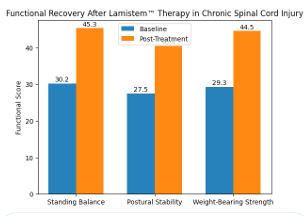
Figure 2: Patients with chronic thoracic spinal cord injury dem onstrated significant functional improvements following functional improvements following Lami-Stem therapy and structured reha bilitation. Standing balance improved from 30.2 to 45.3, postural stability from 27.5 to 40.4, and weight bearing strength from 29.3 to 44.5, indicating substantial recovery in neuromuscular control and postural function.
Subgroup observations based on injury duration: Explorato ry subgroup analysis suggested that patients with shorter injury duration (< 3 years) demonstrated slightly greater functional im provement compared with those with longer-standing injuries. These patients showed faster progression during rehabilitation exercises and more noticeable improvements in balance and voluntary muscle activation. However, meaningful improve ments were still observed across the entire cohort regardless of injury duration. Further studies with larger sample sizes are required to confirm whether injury chronicity significantly influ ences treatment response.
Safety and tolerability: The Lamistem™ therapy protocol was generally well tolerated among the study participants. No serious adverse events were reported throughout the treat ment and follow-up period. Minor side effects were observed in a small number of patients and included temporary injection site discomfort in five patients and mild transient fever in two patients, which resolved spontaneously without medical inter vention. These findings suggest that the regenerative therapy protocol demonstrated a favourable safety profile within the observed cohort (Table 3).
Table 3
Table 3: Safety outcomes.
The results of this study demonstrate encouraging therapeu tic potential for Lamistem™ regenerative technology in patients with chronic thoracic spinal cord injury. The functional improve ments observed in mobility, standing balance, and postural sta bility suggest that the combination of stem cells and biomolecu lar scavenger therapy may enhance neural repair processes.
Neurophysiological improvements and rehabilitation mile stones:
In addition to improvements in clinical mobility scores, several patients demonstrated observable neurophysiological changes during the rehabilitation phase following Lamistem™ therapy. During structured rehabilitation sessions, therapists reported progressive increases in voluntary muscle engage ment in the lower extremities, particularly in muscle groups re sponsible for hip stabilization, quadriceps activation, and trunk support [8,9].
Patients who initially demonstrated limited or absent volun tary movement in the lower limbs began to show gradual neu romuscular activation during assisted exercises, suggesting pos sible restoration of neural signaling pathways or enhancement of residual spinal cord circuitry. Improvements in trunk stabil ity and core muscle control were also observed in a substantial proportion of participants [10,11].
During balance training exercises, patients demonstrated improved postural reflex responses, allowing them to maintain upright seated or supported standing positions for longer dura tions compared to baseline assessments. Several patients pro gressed from requiring maximal assistance during standing ex ercises to partial weight-bearing with minimal assistance [12].
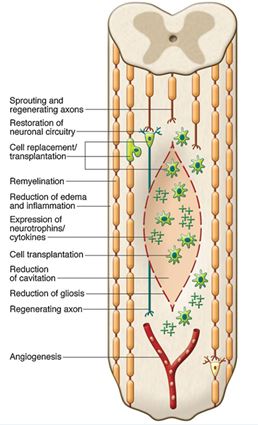
Figure 3: Potential mechanisms of spinal cord repair following stem cell transplantation. The diagram shows some of the po tential mechanisms of repair after transplantation of stem cells into the injured cord. Potential mechanisms include replacement of oligodendrocytes or neurones by transplanted cells (shown in green), remyelination of the spared axons, restoration of the neu ral circuitry, enhanced preservation of host neuronal and glial cells, bridging the cavity by transplanted cells and creation of favourable environment for plasticity and axonal regeneration.
The rehabilitation team also reported improvements in co ordination during assisted gait training, where patients were able to initiate stepping movements with improved rhythmic ity and muscular engagement. These observations suggest that regenerative therapy combined with intensive neurorehabili tation may facilitate reactivation of dormant neural pathways and spinal locomotor networks. Although electrophysiological testing was not the primary outcome measure of the present study, clinical observations during rehabilitation indicated pat terns consistent with enhanced neuromuscular integration and neuroplastic adaptation (Figure 3) [11,15].
Mechanistic interpretation of functional recovery:
The functional improvements observed in this cohort may be explained by several biological mechanisms associated with stem cell–mediated neuroregeneration and microenvironment modulation. Mesenchymal stem cells are known to release a wide range of neurotrophic and growth factors, including Brain Derived Neurotrophic Factor (BDNF), Nerve Growth Factor (NGF), and Vascular Endothelial Growth Factor (VEGF). These molecules can promote neuronal survival, stimulate axonal sprouting, and enhance synaptic plasticity within injured neural networks [13].
In addition to paracrine signaling effects, the inclusion of bio molecular scavenger cells within the Lamistem™ platform may contribute to the reduction of oxidative stress and inflamma tory cytokine activity within the spinal cord injury microenvi ronment. By neutralizing reactive oxygen species and inflamma tory mediators, these scavenger biomolecules may help create a more permissive biological environment for neural repair and axonal regeneration [14].
Furthermore, the multimodal delivery strategy employed in the present study—combining intraspinal, intravenous, and intramuscular administration routes—may enhance both local ized and systemic regenerative signaling. Intraspinal delivery provides targeted regenerative support directly at the injury site, while intravenous and intramuscular administration may facilitate broader neurotrophic and neuromuscular interac tions. The structured neurorehabilitation program performed between treatment cycles likely played a critical role in reinforc ing regenerative processes through activity-dependent neuro plasticity. Repetitive motor training and balance exercises can stimulate neural circuit reorganization and strengthen newly formed synaptic connections. Together, these mechanisms may act synergistically to promote the functional recovery observed in mobility, balance, and standing strength within the treated cohort (Figure 3) [15].
Limitations
Despite promising results, several limitations should be ac knowledged:
• Absence of randomized control group prevents definite causal inference regarding the therapeutic effect of the La mi-Stem protocol.
• Moderate sample size of 45 patients, which may limit the generalizability of the findings.
• Single-centre study design
• Limited long-term follow-up
Future multicentre randomized controlled trials with larger patient cohorts and extended follow up periods are necessary to validate these preliminary findings.
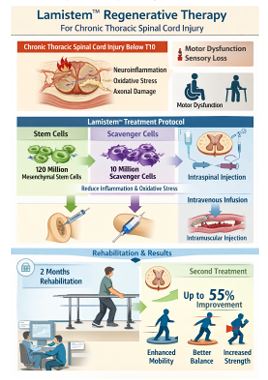
Lami-Stem neuromodulation protocol demonstrated prom ising clinical benefits in patients with chronic spinal cord injury below the T10 level. Significant improvements were observed in standing ability, balance and postural stability during the six month follow up period. The therapy was well tolerated with no major adverse events reported. These preliminary finding suggest that neuromodulation assisted regenerative strategies like the integration of stem cells with biomolecular scavenger therapy may represent a novel therapeutic strategy capable of enhancing neural regeneration and functional recovery. Further controlled clinical trials are required to validate these findings.
Ethical approval
Nurax Clinics- India and Azerbaijan (NU-18/02/PM/2025).
Manuscript preparation and authors participation
P.M: Manuscript, Study design, Analysis, Observation, N.A: Manuscript, S.K: Analysis, A.A: Analysis, Observation, U.J: Man uscript, Observation.
Consent to participate
Informed consent was prepared for all induvial participants and will be obtained from all individual participants who are included in this study.
Human ethics and consent to participate declaration
This study was designed in accordance with the ethical stan dards of the institutional research committee and with the 1964 Helsinki Declaration and its later amendments. Informed con sent was prepared to obtain from all individual participants who will be included in this study.
We always work towards offering the best to you. For any queries, please feel free to get in touch with us. Also you may post your valuable feedback after reading our journals, ebooks and after visiting our conferences.

