


| Received | : | Sep 01, 2025 |
| Accepted | : | Sep 30, 2025 |
| Published Online | : | Online: Oct 07, 2025 |
| Journal | : | Journal of Plant Biology and Crop Research |
| Publisher | : | MedDocs Publishers LLC |
| Online edition | : | http://meddocsonline.org |
Cite this article: Bansal K, Singh S, Rodriguez B, Nageswara-Rao, Dhillon B. Evaluation of in-vitro and in-vivo Antifungal Efficacy of Bioproducts Against the Cosmopolitan Fungus Thielaviopsis ethacetica. J Plant Biol Crop Res. 2025; 9(2): 1110.
This study evaluates the antifungal efficacy of three commercially available bioproducts Double Nickel LC, Serenade ASO, Howler EVO and Serifel against the mycelial growth of Thielaviopsis ethacetica under in vitro conditions and through a detached leaf assay on palm foliage. In vitro trials demonstrated the impressive complete inhibition of fungal growth at 10% and 5% concentrations, with all bioproducts maintaining significant antifungal activity throughout the assessment period. In contrast, the control exhibited unchecked growth, highlighting the effectiveness of the treatments. The 1% concentration revealed a decline in efficacy, yet the bioproducts still showed some inhibition. Additionally, the detached leaf assay mimicked field conditions, allowing observation of bioproduct performance on palm leaf tissues. Treatments at 10% concentration yielded visibly healthier leaves, with fewer disease symptoms compared to the lower concentration and untreated controls. This multifaceted approach underscores the potential of Double Nickel LC, Serenade ASO, Howler EVO and Serifel as practical tools in managing T. ethacetica, offering insights into future disease management strategies in agricultural practices.
Keywords: Bioproduct; Biological control; Thielaviopsis ethacetica; Detached assay.
Thielaviopsis ethacetica is a phytopathogenic fungus belonging to the family Ceratocystidaceae and predominantly resides in soil environments. This organism is recognized as a significant pathogen responsible for causing severe diseases in various economically vital crops. Historically, six principal species; T. paradoxa, T. ethacetica, T. euricoi, T. musarum, T. cerberus, and T. punctulata, were categorized under the formerly designated Ceratocystis paradoxa complex due to their similar morphological characteristics and the pathogens’ associated disease symptoms [18]. Recent advancements in molecular taxonomy have elucidated the distinct identities and pathogenic roles of certainfungi [18]. These organisms are now acknowledged for their extensive distribution and capability to infect various economically valuable plants. Prominent pathogenic species include T. paradoxa and T. ethacetica, both of which are associated with specific diseases affecting tropical and subtropical crops, resulting in substantial agricultural losses [4].
T. paradoxa is recognized as a highly aggressive pathogen with a broad host range among monocot plants, including pineapple, sugarcane, cacao, coconut, oil palm, and date palm. It is responsible for various diseases, including black scorch, heart rot, stem bleeding, fruit rot, and leaf spot, resulting in significant yield reductions. Conversely, T. ethacetica, which has fre-quently been misidentified as T. paradoxa, has recently gained prominence as a distinct pathogen impacting various species, including oil palm, sugarcane, pineapple, cacao, and, more recently, bell pepper [3,6,17,19]. In Nigeria, T. ethacetica has emerged as a substantial threat to oil palm cultivation, instigating a severe disease characterized by upper stem inclination, premature fruit drop, and rapid plant decline. This pathogen primarily affects young oil palms, with incidence rates in affected plantations reaching up to 75%, posing a significant risk to the oil palm industry [12].
The economic repercussions of Thielaviopsis species are profound, impacting both agricultural and ornamental plant industries on a global scale [20]. The effects extend beyond individual farming operations, representing significant threats to international trade and supply chains. These pathogens impose substantial financial burdens on industries dependent on crops such as pineapple, palm oil, and sugarcane. Notably, black scorch disease, caused by T. punctulata, has been reported to lead to significant economic losses within the date palm industry, with nearly fifty percent of newly planted offshoots failing to survive [1].
The fungi’s rapid spread and aggressive infection strategies necessitate effective control measures. Implementing management strategies that include early detection, the development of resistant cultivars, and the adoption of biological control measures is crucial. Continued research into the biological characteristics and host interactions of Thielaviopsis species is crucial for developing sustainable disease management solutions for growers worldwide. The management of Thielaviopsis diseases has traditionally relied on the application of chemical fungicides [1,3,13,26]. Although these fungicides may provide short-term control, their excessive use has raised significant concerns, including environmental pollution, disruption of beneficial soil microbial communities, and the development of fungicide-resistant strains of pathogens [23]. These challenges, alongside the increasing consumer demand for sustainable agricultural practices, have spurred the exploration of alternative management solutions [27]. Bioproducts derived from microbial agents, plant extracts, and natural compounds represent promising alternatives. Fungal antagonists, particularly species of Trichoderma, have demonstrated substantial potential in suppressing pathogenic Thielaviopsis species. For instance, T. asperellum has been formulated as a biocontrol agent to manage black rot disease in pineapples caused by T. paradoxa. An isolate of T. asperellum exhibited complete inhibition of mycelial growth at a concentration of 1% in vitro. When applied to pineapple fruits, T. asperellum effectively prevented the onset of black rot during incubation, underscoring its potential as a natural substitute for chemical fungicides [27]. Bacterial biological control agents have been identified as practical tools in managing Thielaviopsis species, offering promising avenues for sustainable disease control strategies. These bacteria suppress diseases through mechanisms such as the production of antifungal compounds, the competitive exclusion of pathogens for vital nutrients, and the enhancement of plant defense mechanisms. Bacillus and Streptomyces are the most successful genera in this context, and they have demonstrated considerable efficacy in controlling Thielaviopsis across various crops.
Biocontrol products derived from Bacillus species are widely utilized due to their broad-spectrum activity against fungal pathogens. For instance, the Bacillus amyloliquefaciens strain QST 713 exhibits its antifungal effects by disrupting fungalmembranes through the production of lipopeptides, such as surfactin and fengycin, thereby effectively inhibiting the proliferation of pathogens [2,29]. A comparative study evaluating the bioproducts Serenade (B. amyloliquefaciens strain QST 713) and Sonata (B. pumilus QST-2808) against T. paradoxa revealed that both formulations were effective in vitro, achieving complete mycelial growth inhibition at concentrations of 1.0% and 10.0%, respectively [7]. However, under field conditions, the efficacy of these products in reducing disease severity was less pronounced. While Serenade and Sonata did not significantly diminish disease severity, both formulations positively influenced plant performance metrics, particularly the Sprouting Speed Index (SSI) and the number of tillers in pathogen-infested fields. This finding suggests a potential role for these bioproducts in enhancing crop vitality and mitigating the risks associated with early infection. Yeasts have emerged as promising biocontrol agents within the scope of sustainable agriculture, owing to their distinctive ability to suppress plant pathogens through various mechanisms. They are particularly effective in managing postharvest diseases, as their capacity to produce extracellular enzymes and Volatile Organic Compounds (VOCs) significantly inhibits pathogen growth and enhances the preservation of fruits after harvest. Wickerhamomyces anomalus has exhibited considerable potential in combating T. paradoxa, particularly concerning postharvest infections in cacao [28]. This yeast exhibits antagonistic activity by producing extracellular hydrolytic enzymes, including glucanase and chitinase, which have been shown to reduce T. paradoxa spore germination by nearly 100% when applied at a concentration of 31 units of enzyme activity. In vivo studies involving cacao pods have revealed that treatment with a crude enzyme extract derived from W. anomalus effectively inhibits fungal growth, thereby maintaining fruit quality throughout the incubation period. These findings underscore the potential of yeast as a practical and environmentally sustainable alternative for managing postharvest diseases caused by Thielaviopsis species [28].
In addition to utilizing bacterial and yeast-based bioproducts, plant-derived extracts have emerged as effective natural agents for managing Thielaviopsis diseases. Plants synthesize diverse secondary metabolites, including flavonoids, terpenoids, and phenolic compounds, which exhibit strong antifungal properties. These compounds disrupt spore germination, inhibit mycelial growth, and modify fungal cell membranes, providing a sustainable alternative to conventional chemical fungicides [9]. Numerous plant extracts have demonstrated significant antifungal activity against Thielaviopsis species. A study evaluated fourteen plant extracts derived from the leaves of the Myrtaceae family, specifically from Myrciaria floribunda, Myrcia vittoriana, Myrcia amazonica, and Eugenia pruniformis, for their inhibitory effects on fungal growth [9]. Among these extracts, the ethyl acetate extract of Myrciaria floribunda and the dichloromethane extract of Myrcia amazonica exhibited the highest efficacy, with mycelial growth inhibition rates of 93% and 82%, respectively. These extracts had fungistatic effects by interfering with spore germination and mycelial development. Additionally, leaf extracts from Sideroxylon obtusifolium and Annona acutiflora, native to the Brazilian Restinga ecosystem, showed notable inhibitory effects against T. ethacetica [10].
Despite numerous studies identifying potential bioproducts for controlling Thielaviopsis, the range of practical solutions available remains limited, and there has been insufficient emphasis on testing commercially available bioproducts. Most efforts focus on experimental isolates, leaving a gap between ab research and real-world solutions. Validating commercial bioproducts is essential for developing practical alternatives to fungicides. This research investigation aimed to evaluate four commercially available bioproducts for their efficacy against T. ethacetica in-vitro and in a detached leaf assay on palm tissues. By using both controlled and semi-field conditions, we provide insight into their potential for integration into sustainable disease management programs.
Pathogen and growth conditions
T. ethacetica isolate was procured from collaborators at the University of Florida’s Florida Research and Education Center (FLREC), Davie, Florida. The fungal isolate was preserved in a 25% glycerol solution and maintained at -80°C to ensure the viability of both hyphae and spores in suspension. The glycerol stock was revived to obtain an actively growing T. ethacetica isolate, which was subsequently cultured on Potato Dextrose Agar (PDA) medium at room temperature to conduct subsequent experiments.
Bioproduct treatments
Double Nickel LC, Serenade ASO, Howler EVO, and Serifel were evaluated for their effectiveness in inhibiting the mycelial growth of T. ethacetica. The bioproducts and their corresponding active ingredients are detailed in Table 1. The efficacy of all bioproducts was evaluated by measuring the radial growth of T. ethacetica on culture plates amended with these bioproducts. To conduct the efficacy tests, Potato Dextrose Media (PDA, Difco, catalog no. 213400) was autoclaved and cooled before the bioproduct formulations were added. PDA media flasks were supplemented with the bioproducts to achieve 10%, 5%, and 1% (v/v) concentrations for Double Nickel LC and Serenade ASO and w/v for Howler EVO and Serifel. The amended plates were inoculated with 5 mm plugs from three-day-old cultures of T. ethacetica, which were centrally placed in 8 cm-diameter Petri dishes. The inoculated plates were then incubated at room temperature. The radial diameter of the growing cultures was measured at 3, 7, 10, and 14 days following inoculation.
Testing bioproducts using detached palm leaves
The in vivo efficacy of various bioproducts was evaluated using a detached palm leaf assay. Young palm leaves were collected from commercially important palm species viz., foxtail (Wodyetia bifurcata) and two distinct Fiji
dwarf coconut (Cocos nucifera; Fiji 23 and Fiji 26) plants. These leaves underwent surface sterilization by being wiped with a Kim wipe saturated with 70% ethanol. Subsequently, the leaves were cut into pieces measuring 2.5 to 3 inches and placed in Petri dishes lined with sterilized, moist filter paper. Two vertical incisions were made in each leaf segment, and a mycelial plug was positioned on the surface of both incisions. For the bioproduct treatment, the leaves were immersed in bioproduct solutions at concentrations of 10%, 5%, and 1% for a total of thirty minutes. Following this, the leaves were air-dried and returned to the Petri dishes, where they were inoculated with mycelial plugs of T. ethacetica. Each treatment included two replicates. The control conditions comprised of leaves with incisions only and inoculated with mycelial plugs without bioproduct treatment. The treated leaves were incubated in the dark within a growth chamber maintained at 27°C. Lesions on the leaves were observed and documented approximately 2 to 3 days post-inoculation
Inhibition of mycelial growth of T. ethacetica by commercially available bioproducts
An in vitro assessment was meticulously conducted to evaluate the antifungal effectiveness of four commercially available bioproducts—Double Nickel LC, Serenade ASO, Howler EVO and Serifel against the fungal pathogen T. ethacetica. The experiment involving varying concentrations of these bioproducts, specifically 10%, 5%, and 1%, with results presented in Figure 1. At the 10% concentration, three bioproducts, Double Nickel LC, Serenade ASO, and Serifel completely inhibited fungal growth at all time points. No remarkable radial growth was recorded even at 14 dpi, suggesting consistent and prolonged antifungal activity. In contrast, Howler EVO demonstrated limited efficacy at this concentration, with visible mycelial growth beginning by 7 dpi and progressing slightly through 14 dpi. In stark contrast, the control treatment, which utilized Potato Dextrose Agar (PDA) without any bioproduct, showcased an unrestrained and vigorous growth of T. ethacetica, with colonies achieving their maximum size within three days post inoculation.
A similar inhibition pattern was observed at the 5% concentration, as Double Nickel LC, Serenade ASO, and Serifel largely maintained their inhibitory effect. While some minor growth was detectable at later time points (10 and 14 dpi), suppression remained substantial compared to the control plates. Howler EVO again showed reduced effectiveness, with visible fungal growth emerging earlier and expanding more rapidly than other treatments. When the concentration was further reduced to 1%, all treatments showed reduced antifungal activity except Serenade ASO. Double Nickel LC and Serifel initially delayed mycelial growth, but measurable expansion was evident at 10 dpi and further increased by 14 dpi. Serifel exhibited a slightly better suppressive effect that was slightly more pronounced than Howler EVO, that consistently displayed the least inhibition at this dosage, with early and progressive radial growth evident across all time points.
Overall, Double Nickel LC, Serenade ASO and Serifel were highly effective in suppressing T. ethacetica at 10% and 5% concentrations, with durable inhibition throughout the assessment period. Howler EVO, while demonstrating some antifungal activity, was comparatively less effective, particularly at lower concentrations and over extended incubation times. These results highlight the strong dose-dependent performance of these four bioproducts and support their potential for inclusion in disease management programs targeting T. ethacetica.
To provide further visual validation of the quantitative findings, representative images of the petri plates are included in Figure 2. These images distinctly illustrate the variations in the radial growth of T. ethacetica in PDA media enhanced with each bioproduct at concentrations of 10%, 5%, and 1%. The plates treated with all three concentrations of bioproducts were observed over a period of 14 days and the radial growth was recorded. The marked absence or reduction of fungal growth in the treated plates aligns closely with the numerical data, highlighting the pronounced inhibitory effects of Double Nickel LC, Serenade ASO and Serifel at elevated as well as lower concentrations. In contrast, the untreated PDA control consistently exhibited extensive mycelial development, reflecting the pathogen’s natural growth pattern. These compelling visual results further substantiate the efficacy of the selected bioproducts, demonstrating their practical potential as effective tools in managing T. ethacetica and contributing to future developments in agricultural disease management strategies.
Assessment of the effectiveness of bioproducts against T. ethacetica on palm foliage, utilizing a detached leaf assay
To deepen our understanding of radial growth in vitro, we conducted a detached leaf assay to evaluate the effectiveness of selective bioproducts applied directly to palm leaf tissues. This innovative approach, a valuable complement to traditional plate-based in vitro screening methods, allows for close observation of disease progression and the performance of bioproducts under conditions that closely simulate real-world field infections. In this experimental setup, we made a significant shift in our approach. Instead of focusing on artificial growth media, we meticulously prepared segments of palm leaves. We applied three distinct concentrations at the rate of 10%, 5% and 1% of Double Nickel LC, Serenade ASO, Howler EVO and Serifel, before inoculating them with the pathogen T. ethacetica. This shift in focus allowed us to uncover more profound insights into the protective qualities of these bioproducts and their ability to curb lesion development while inhibiting fungal colonization on the delicate tissues of the host. The visual evaluation of three different palm varieties Foxtail, Fiji-23, and Fiji-26 treated with varying concentrations of the bioproducts, as depicted in Figures 3-5, reveals distinct patterns influenced by the unique characteristics of each variety and the concentration applied. We used three different varieties of leaflets from foxtail, fiji-23 and fiji-26 palms, which show a varied range of disease symptoms when inoculated with T. ethacetica (unpublished data). The detached leaflets at 10% concentration revealed distinct patterns in disease suppression across palm varieties and treatments as depicted in figure 3. The more susceptible foxtail palm leaflets treated with Double Nickel LC, Serenade ASO, Howler EVO and Serifel exhibited smaller necrotic lesions at inoculation sites, in comparison to the uninoculated and control treatment (Tp-5448). In moderately resistant Fiji-23 palm leaflets, a similar suppression of necrotic lesions was observed when treated with different bioproducts. Treated and inoculated Fiji-23 leaves looked similar in response to Fiji-26 leaflets, which are resistant to T. ethacetica, and served as another control in terms of resistant response. Taken together, the treatment with 10% concentration of all tested bioproducts showed robust suppression of necrosis across two susceptible palm varieties. These visual outcomes
corroborate the in-vitro findings and underscore the potential of bioproducts in providing foliar protection against T. ethacetica.
At 5% concentration, the bioproducts continued to reduce disease symptoms in palm leaflets, though differences in lesion severity became more apparent compared to the 10% treatment (Figure 4). In foxtail palm leaflets, Howler EVO and Serifel maintained visible protection. In case of Double Nickel LC and Serenade treatments the leaflets exhibited elevated necrosis which can be contributed to the age as well as secondary infection of the leaflets by other fungi. In fiji-23, a response similar to foxtail leaflets was observed, as Howler EVO and Serifel maintained suppression of necrosis, but more pronounced lesions were observed in case of Double Nickel LC and Serenade ASO. In case of Fiji-26, which is the resistant palm, no necrosis was seen on any of the treatments, except for the leaflets treated with Double Nickel LC, which might be contributed to the age of the leaflet or to secondary infection. At 1% concentration, the treated leaflets exhibited visibly reduced efficacy as evident from the size of the necrotic lesions, particularly in susceptible foxtail and fiji-23 palm leaflets (Figure 5). No symptoms were observed in the resistant Fiji-26 palm leaflets. While all bioproducts exhibited a reduced efficacy at 1%, but their efficacy and necrosis control at higher concentrations reinforce the importance of application dosage in achieving effective biological disease control.
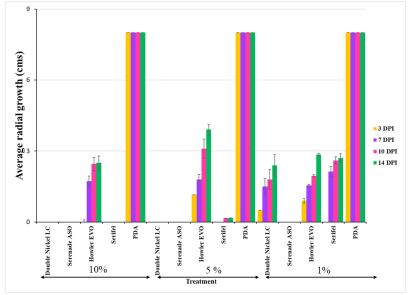
Figure 1: Effect of various bioproducts on the radial growth of Thielaviopsis ethacetica at three different concentrations. The bar graph illustrates the average radial growth (cm) of T. ethacetica colonies on PDA media amended with three different concentrations of Double Nickel LC, Serenade ASO and Howler EVO and Serifel, measured at 3-, 7-, 10-, and 14-days post-inoculation (dpi). Error bars represent standard errors of the mean (n=3). Notably, Double Nickel LC, Serenade ASO and Serifel completely inhibited fungal growth across all time points at concentrations of 10 and 5 %, as indicated by the absence of visible bars. In contrast, the control (PDA without bioproducts) exhibited consistent radial growth, reaching 8 mm by 14 dpi.
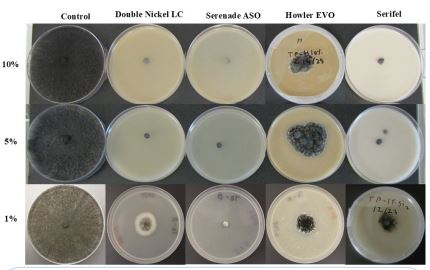
Figure 2: Representative petri plate images showing the in vitro effect of four commercially available bioproducts—Double Nickel LC, Serenade ASO, Howler EVO and Serifel on the radial growth of Thielaviopsis ethacetica at 10%, 5% and 1% concentrations. PDA without bioproducts served as an untreated control. Visual differences in mycelial expansion correspond to the quantitative results, with higher concentrations of Double Nickel LC, Serenade ASO, Howler EVO and Serifel showing complete inhibition of fungal growth.
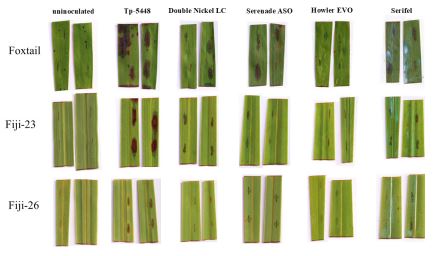
Figure 3: Response of palm leaflet samples to 10% bioproduct treatments. Three different palms; Foxtail, Fiji-23 and Fiji-26, with different levels of resistance against Thielaviopsis ethacetica were used to screen for the effectiveness of bioproducts. This slide emphasizes the differential impact of high concentration bioproduct treatments on disease resistance as a delayed onset of infection was observed on the susceptible palm leaflets when treated with Double Nickel LC, Serenade ASO, Howler EVO and Serifel.
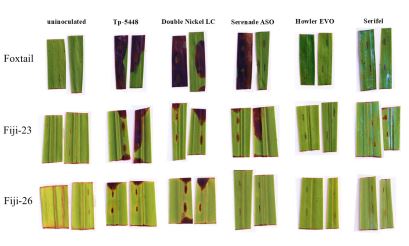
Figure 4: Response of palm leaflet samples to 5% bioproduct treatments. This figure contrasts the subtler effects of lower concentration treatments with those observed at higher concentrations, providing insight into dose-dependent efficacy and varietal resilience
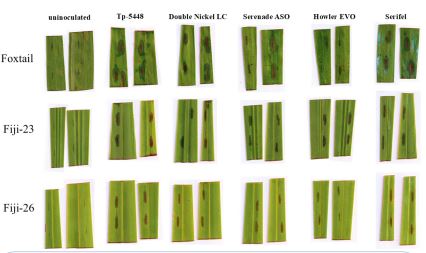
Figure 5: Response of palm samples to 1% bioproduct treatments. A difference in efficacy was observed as the necrotic lesion is more pronounced in comparison to the higher dosage treatments
 Table 1
Table 1: List of bioproducts used in this study
With sustainable agricultural practices becoming a norm, the adoption of bioproducts has emerged as a vital tool to alleviate the impacts associated with conventional chemical products. Bioproducts, which include biopesticides, bio-stimulants, and biofertilizers, are derived from renewable biological sources and offer sustainable options for crop enhancement and protection. Incorporating bioproducts into agricultural practices not only reduces dependence on synthetic chemicals but also promotes soil vitality, biodiversity, and ecosystem resilience [22].
In this study, we evaluated the effectiveness of four commercially available bioproducts; Double Nickel LC, Serenade ASO, Howler EVO and Serifel, against T. ethacetica, a pathogen responsible for significant crop losses in several economically important crops such as palms, pepper and sugarcane. The in-vitro assays revealed that Double Nickel LC, Serenade ASO, Howler EVO and Serifel exhibited complete inhibition of fungal growth at concentrations of 10% and 5%, with reduced effectiveness observed at 1%. Our findings are consistent with other studies, indicating that Bacillus-based products, particularly those containing B. subtilis and B. amyloliquefaciens, possess strong antifungal properties against various plant pathogens. For instance, B. amyloliquefaciens has shown strong antifungal activity against Alternaria species in pepper plants, suggesting its potential as a biocontrol agent [25]. Additionally, B. subtilis and B. amyloliquefaciens strains have been shown to inhibit the growth of a broad spectrum of filamentous fungi, including Penicillium expansum and Fusarium species. In the case of Aspergillus parasiticus, growth inhibition of up to 92% was demonstrated, along with suppression of aflatoxin production [24].
Apart from microbial-based bioproducts, plant-derived compounds, such as essential oils and natural extracts, are also gaining increasing acceptance for their antifungal properties. The success of Double Nickel LC, Serenade ASO, Howler EVO and Serifel underscores the efficacy of biologically derived products in combating fungal diseases. This finding is consistent with recent investigations that have demonstrated the effectiveness of natural substances, such as essential oils and secondary plant metabolites, against soilborne infections comparable to those caused by T. ethacetica. For example, phenolic-rich essential oils have been reported to disrupt fungal cell membranes and inhibit spore germination in pathogenic fungi such as Fusarium oxysporum and Colletotrichum spp. [15]. While the co-application of microbial bioproducts with botanical extracts and other chemical fungicides was not explored in this study, the concept holds promise and has been explored in different contexts [21]. While several studies have investigated the combined effects of microbial bioproducts and chemical fungicides to achieve synergistic disease suppression, the compatibility between bioproducts and botanical compounds remains an area that requires further research, as these interactions may influence microbial viability and efficacy [5,11,14,16]. Future research should investigate not only the individual effects of microbial bioproducts but also the potential of their strategic combinations with botanical compounds to enhance and stabilize fieldlevel disease control outcomes. Our findings contribute to the growing body of evidence supporting the use of bioproducts, particularly those based on beneficial microbes, such as Bacillus species, as practical tools for managing fungal pathogens in agriculture.
This study demonstrated that selected commercially available bioproducts Double Nickel LC, Serenade ASO, Howler EVO and Serifel, exhibit strong antifungal activity against cosmopolitan pathogen T. ethacetica, both in vitro and in vivo on economically important palm species tissues. The strong suppression of fungal growth at higher concentrations, combined with visibly fewer lesions in the leaf assays, demonstrated a real promise for using these bioproducts as practical tools in integrated disease management strategies. The key strength of this study lies in its focus on already available commercial bioproducts, which are often underrepresented in experimental research and their validation. By evaluating these formulations under controlled laboratory conditions, this study generated practical insights that are directly applicable to growers seeking sustainable strategies for pathogen control and limiting the use of chemical fungicides.
Acknowledgements
We would like to formally thank the technicians, research team, retired scientists, and administrative staff at USDA-SHRS, Miami, FL for their invaluable contributions. Additionally, we extend our thanks to Mike for his coordination in collecting bioproducts.
Authors’ contributions
KB conducted the experiments, analyzed and visualized the data, and authored the manuscript. SS conceptualized the experiments, performed data analysis, and wrote, reviewed, and edited the manuscript. BR helped with tissue collection and figure preparation. BD and MR contributed logistical support for the execution of the experiments. All authors have reviewed and approved the final version of the paper.
This research was funded by appropriated funds from the United States Department of Agriculture, Agricultural Research Service (USDA-ARS) Project Number: 6038-13210-04-00D.
Data availability
Datasets generated and analyzed during the current study are presented and available.
Competing interests
The authors declare no competing interests.
We always work towards offering the best to you. For any queries, please feel free to get in touch with us. Also you may post your valuable feedback after reading our journals, ebooks and after visiting our conferences.

