


| Received | : | June 02 2025 |
| Accepted | : | June 27, 2025 |
| Published Online | : | Online: July 04, 2025 |
| Journal | : | Annals of Pediatrics |
| Publisher | : | MedDocs Publishers LLC |
| Online edition | : | http://meddocsonline.org |
Cite this article: Karabuga V, Diarra MF, Coulibaly D, Yazgan H, Yazgan Z. Why Is Urinary Tract Infection So Prevalent in Mali? Investigating the Role of Traditional Pelvic Belts – The First Study in a Pediatric Population. Ann Pediatr. 2025; 8(1): 1154.
Background: Urinary tract infection in children may cause long-term complications. Early diagnosis and appropriate treatment are critical. Understanding incidence and contributing risk factors is essential for improving pediatric urinary tract infection management.
Objective: This study investigates the frequency of urinary tract infections in children in Mali and examines the potential role of traditional inguinal pelvic belts in urinary tract infection development. While adult studies in Mali report high urinary tract infection rates, no pediatric data have been published. In Mali, many infants traditionally wear an inguinal belt from birth, and we aimed to assess its correlation with pediatric urinary tract infections.
Method: We conducted a prospective study with children who may have a urinary tract infection to Golden Life American Hospital. We conducted a study on children aged 0 to 18 years who visited Golden Life American Hospital between January 2019 and March 2025. The study was designed with primary objectives: To determine the frequency of urinary tract infections among children in this region and to assess the impact of the traditional practice of wearing a belt directly on the skin in the pelvic region on urinary tract infection. Participants were categorized into four age groups and stratified based on pelvic belt usage.
Results: A significant correlation was found between urinary tract infection occurrence and pelvic belt usage. We then examined whether there was a statistically significant difference in urinary tract infection occurrence between these two groups. The odds of urinary tract infection were greater in belt users (Odds Ratio = 1.48; 95% CI: 1.23–1.77).
Keywords: Urinary tract infections; Pelvic belt; Traditional practices; Prevalence; Children; Bamako; Mali.
To improve the management of childhood urinary tract infections, it is essential to understand the incidence rates, testing and treatment strategy [1]. Urinary Tract Infection (UTI) is the most common bacterial infection in childhood [2]. In 30% of children with urinary tract anomalies, UTI can be the first sign [3]. Among infants presenting with fever, the overall prevalence (and 95% confidence interval) of UTI was 7.0% [4].
The clinical signs and symptoms of UTI are nonspecific in the first 5 years of age [5]. E. coli was the most common uropathogen overall but the prevalence of E. coli was higher among females than males. Other common species among males were Enterococcus, P. mirabilis and Klebsiella [6].
Estimates on the cumulative incidence of UTIs in American children indicate that up to 180,000 of the annual birth cohort will be diagnosed with a UTI by 6 years of age (3–7% of girls and 1–2% of boys) [7]. The incidence of UTIs varies based on age, sex, and gender. Overall, UTIs are estimated to affect 2.4-2.8% of children in the United States annually [8].
For Mali, we could not find a study in the pediatric population in the literature, in a study conducted in adults the prevalence of 13.64% [9].
Compared with normal skin surfaces, skin fold areas, such as the axillary and inguinal regions, areas behind the external ear, and inframammary areas, have relatively thinner epithelia. The effects of elevated temperature and increased moisture can be seen in these areas. Low levels of oxygen combined with high levels of humidity and elevated temperatures make these areas more prone to microorganism overgrowth [10]. In Mali, most of the population traditionally wears jewelry in the inguinal region as soon as babies are born (Figure 1-A, B, C & D).
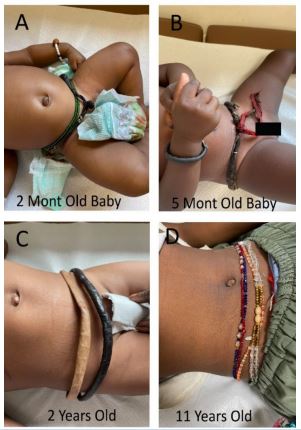
Figure 1:
A cross-sectional study was conducted after obtaining institutional ethical clearance and informed consent from the parents. Urine Cytobacteriological Examination (ECBU) was performed under the following conditions:
In children under five years of age presenting with high fever, in children aged five years and older exhibiting symptoms such as abdominal pain, vomiting, fever with chills, rigors, or suprapubic pain.
This study aims to provide valuable insights into the epidemiology of pediatric UTIs in the region and contribute to improved preventive and therapeutic strategies.
In children aged 1-2 years, the genital area was cleaned with soap and water. Urine was collected in a sterile bag, and approximately 10 ml of urine was transferred into a sterile bottle. In children over 2 years of age, a midstream sample was collected after taking the necessary precautions. The samples were then immediately sent for routine urine analysis and culture to the Golden Life American Hospital’s own laboratory.
First of all, each urine was subjected to dipstick test and direct microscopic examination. The dipstick test was automatically read by the Mission Expert U500 device. For microscopic examination, 10 ml of urine was centrifuged at 2500 rpm for 10 minutes using the Elektro Teknik Medical, 80-2A device, and the sediment was examined under the microscope. And in patients with more than 10 leukocytes per High-Power Field (HPF) in the centrifuged urine sediment in laboratory of Golden Life American Hospital (GLAH) and not suggesting a diagnosis other than UTI, a uroculture with germ count (bacteriuria) on Uriselect agar. A growth of more than 105 colonies per milliliter of a single organism was considered significant.
The identification of bacteria was made on the basis of device Vitek 2 compact. Statistical analyses were performed using EPI INFO software version 7.2.1.0. The chi-square test was used for categorical data comparisons, with significance set at p<0.05.
A routine urine analysis was performed on 4275 patients. 2124 cases were identified with more than 10 leukocytes per High-Power Field (HPF) in the centrifuged urine sediment in GLAH over a 6-year period. 514 of 2124 are culture positive children.
A total of 514/4275 (12.02%) children were found to be culture positive. Culture-positive patients were 292 girls (56.88%), 222 boys (43.12%) (Table 1-a). The most frequently cultured bacteria and their total percentages across all groups are shown in Table 1-b.
• 0–6 months: Pelvic belt was applied to 76 (69.08%) of 110 patients.
• 7 months–2 years: Pelvic belt was applied to 107 (51.94%) of 206 patients.
• 3–5 years: Pelvic belt was applied to 32 (40.00%) of 80 patients,
• 6–15 years: Pelvic belt was applied to 24 (20.33%) of 118 patients.
In culture-positive children, the pelvic belt was applied in 151/514 (29.38%) of girls and 88/514 (17.12%) of boys, totaling 239/514 (46.50%) (Figure 2).
In culture-negative children (3765 children): Girls 1862 (49.46%), boys 1903 (%50.54). In culture-negative children: Pelvic Belt Applied rates in girls 804/3765 (21.35%), in boys 584/3765 (15.51%), totally 1388/3765 (36.86%) (Table 2) (Figure 2).
Table 1: Culture-positive patients and the most frequently cultured bacteria.
 Table 1a
Table 1a: Culture-positive children (n=514): Ratio of Girls to Boys.
Table 1b
Table 1b: Pelvic Belt Applied rates in girls and boys in those with positive cultures (n= 307/514).
In culture-negative children (3765 children): Girls 1862 (49.46%), boys 1903 (%50.54). In culture-negative children: Pelvic Belt Applied rates in girls 804/3765 (21.35%), in boys 584/3765 (15.51%), totally 1388/3765 (36.86%) (Table 2) (Figure 2).
Table 2: Culture-negative patients.
Table 2a
Table 2a: Culture-negative children (n=3765): girls and boy’s rates.
Table 2b
Table 2b: Culture negative (n=1480/3765): Pelvic Belt Applied rates in girls and boys.
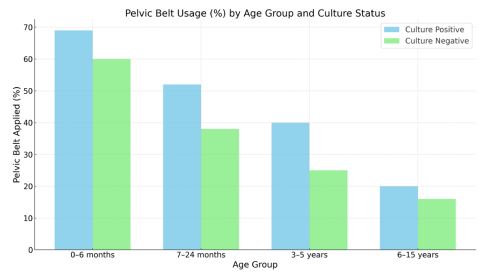
Figure 2: Percentage of pelvic belt usage among culture-positive and culture-negative children by age group.
The list of 514 culture-positive patients is as follows (bacteriological profile, main pathogens). The number of bacteria grown for each of the 4 groups and their antibiotic resistance are as follows (Table 3).
• 0–6 months: 110 patients with bacterial growth observed. E. Coli 56 (50.90%), K. pneumoniae 18(16.36%), E. faecalis 14(12.72%), S. aureus 6(5.45%), Streptococcus 4(3.63%), P. mirabilis 4(3.63%), P. aeruginosa 2(1.81%), Enterobacter 6(5.45%).
• 7 months–2 years: 206 patients, with bacterial growth observed. E. coli 128(62.13%), K. pneumoniae 28(13.57%), E. faecalis 24(11.65%), S. aureus 7(3.39%), Streptococcus 4(1.94%), P. mirabilis 6 (2.91%), P. aeruginosa 3(1.45%), Enterobacter 6(2.91%),
• 3 years–5 years: 80 patients, with bacterial growth observed. E.coil 48(60%), K. pneumoniae 10(12.50%) E.faecalis 12(15.00%), S. aureus 4(5.00%), Streptococcus 6(7.5%).
• 6 years–15 years: 118 patients, with bacterial growth observed. E. coli 76(64.40%), K. pneumoniae 12(10.10%), E. faecalis 6(5.08%), S. aureus 16(13.55%), Streptococcus 2(1.69%), P. mirabilis 2(1.69%), enterobacter 2(1.69%).
The most isolated enterobacterium was E. coli with frequency rate of 59.35%. The other enterobacteria were Klebsiella pneumoniae 13.15%, Enterococcus faecalis 11.11%. Other bacterial strains were Staphylococcus aureus 6.84%, Streptococcus 3.69%, Proteus mirabilis 2.0.5%, Pseudomonas aeruginosa 1.23%, Enterobacter 2.51%.
Table 3
Table 3: Bacterial growth rates in 4 groups.
E. Coli: Escherichia coli; K: Pneumoniae, Klebsiella pneumoniae; E. faecalis: Enterococcus faecalis; S. Aureus: Staphylococcus aureus; P. aeruginosa: Pseudomonas aeruginosa.
The rates of UTI in three studies conducted in the United States are given as follows.
Among infants presenting with fever, UTI’s overall prevalence (and 95% confidence interval) was 7.0% [4]. Estimates on the cumulative incidence of UTIs in American children indicate that up to 180,000 of the annual birth cohort will be diagnosed with a UTI by 6 years of age (3–7% of girls and 1–2% of boys) [7]. The incidence of UTIs varies based on age, sex, and gender. Overall, UTIs are estimated to affect 2.4-2.8% of children in the United States annually [8].
A study conducted in Belgium gave the following results.
There was a statistically significant increase in UTI episodes from 2000 to 2020 in each age group (p<0.05), except in boys 2-4 years. Overall, the change in incidence rate was low. In 2020, the incidence rates of cystitis were highest in girls 2-4 years old (40.3 /1000 person-years 95% CI 34.5-46.7) and lowest in boys 10-18 (2.6 /1000 person-years 95% CI 1.8-3.6) [1].
For Mali, we could not find a study in the pediatric population in the literature; however, a study conducted in adults found a prevalence of 13.64% [9].
Another study in adults in Bamako, Mali, showed that 231(22%) patients out of 1050 were shown to be urine culture positive (70.6% females and 29.4% males). The most isolated entero-bacterium was E. coli, with a frequency rate of 62.3%. The other enterobacteria were Klebsiella pneumoniae (19.5%), Enterobacter cloacea (6.1%), klebsiella oxycota (4.3%), and Proteus mirabilis (2.2%) [11].
Our study found a prevalence of 12.02%. Although our study is single-center, patients from all cities in Mali come to GLAH, which can give Mali clues.
A massive number of bacteria live on the surface of the skin. Some are purely commensal; thus, only their overgrowth can cause infections, most of which are minor. In some cases, colonization of pathogenic bacteria causes more serious infections [10]
In one study, 13.2% of gram-negative rods (Klebsiella, Proteus, Enterobacter, and Escherichia) were found in the groin area. In the same study, the rate of staphylococcus was 12% [12].
Our study highlights a significant association between traditional pelvic belts and the prevalence of Urinary Tract Infections (UTIs) in children in Mali. The findings suggest that wearing a pelvic belt may contribute to an increased risk of UTIs, particularly in younger children.
Pelvic Belt and UTI Occurrence;
The data show that the highest percentage of pelvic belt usage was observed in the 0–6 months group (69.08%, 76 out of 110 patients), followed by a gradual decline in older age groups: 7–24 months (51.94%), 3–5 years (40.00%), and 6–15 years (20.33%). This pattern indicates that infants and younger children are more frequently subjected to this traditional practice.
Notably, among culture-positive children, pelvic belt application was recorded in 46.50% (239/514), compared to 36.86% (1388/3765) in culture-negative children. This difference was found to be statistically significant (p < 0.05), suggesting a potential link between pelvic belt use and increased UTI risk.
The high prevalence of Klebsiella, Proteus, Enterobacter, and Escherichia (13.2%) and Staphylococcus (12%) in the inguinal region flora [13] may explain the higher rates of Klebsiella, Proteus, Enterobacter, and Staphylococcus in the 0–6 months group (except for the 6–15 years group). Similarly, E. coli is lower in the 0–6 month’s group (50.90%) but higher in other groups.
Several mechanisms could explain this association. The belt, when worn directly on the skin in the pelvic region, may create a warm and humid environment that facilitates bacterial growth. Additionally, prolonged use may lead to irritation, minor abrasions, or restricted airflow, potentially increasing the likelihood of bacterial colonization and ascending infections.
Our study also confirmed that girls experienced UTIs more frequently than boys, in line with global epidemiological patterns—likely due to anatomical differences. Among culture-positive cases, pelvic belt use was observed in 29.38% of girls and 17.12% of boys. Similarly, in culture-negative children, usage rates were 21.35% in girls and 15.51% in boys, indicating that girls not only used the belts more often but also exhibited potentially higher susceptibility to infection.
Furthermore, the control group (culture-negative children) showed a significantly lower overall pelvic belt usage rate (36.86%) compared to the culture-positive group (46.50%), reinforcing the hypothesis that pelvic belt use may be an independent risk factor for developing UTIs in pediatric populations.
Golden Life American Hospital patients generally belong to middle- and upper-income groups. Despite this, the incidence of UTIs and the rate of pelvic belt usage in the inguinal area remain notably high. This observation underscores cultural traditions’ persistent and powerful influence on health behaviors, even within more socioeconomically advantaged communities.
This study provides the first pediatric-focused investigation into the relationship between pelvic belt usage and UTIs in Mali. Our findings showed that the prevalence of UTIs among children was 12.02% and that 46.50% of culture-positive patients had a history of pelvic belt usage, compared to 36.86% among culture-negative children. This difference was statistically significant (p<0.05), reinforcing the hypothesis that traditional pelvic belts may be a risk factor for UTI development.
Author contributions
Veli Karabuga conceived the study and was involved in all processes of data acquisition, analysis, and interpretation of the results. Mahamadou Fode Diarra & Demba Coulibaly collected and analyzed data, Ibrahim Tarik & Zerrin Yazgan developed the manuscript, reviewed its contents, and reviewed the research contents.
Ethical approval and trial registration
Informed consent was obtained from the children’s parents for all procedures performed.
Consent for publication
Informed consent was obtained from the children’s parents for all procedures performed and for publication.
Author disclosure statement: No competing financial interests exist.
Funding information: No funding was received for this article.
We always work towards offering the best to you. For any queries, please feel free to get in touch with us. Also you may post your valuable feedback after reading our journals, ebooks and after visiting our conferences.

