


| Received | : | Apr 23 2025 |
| Accepted | : | May 16, 2025 |
| Published Online | : | Online: May 23, 2025 |
| Journal | : | Annals of Pediatrics |
| Publisher | : | MedDocs Publishers LLC |
| Online edition | : | http://meddocsonline.org |
Cite this article: Carlson J, Jones EM, Matheson MB, Manne S, Harshman LA, et al. Covid-19 associated worry and emotional distress in youth and young adults with chronic kidney disease. Ann Pediatr. 2025; 8(1): 1152.
Objective: The COVID-19 (C19) pandemic impacted youth mental/behavioral health with a 25% increase in prevalence of anxiety and depression worldwide. Little is known about the emotional impact of C19 for children with Chronic Kidney Disease (CKD). The purpose of the current study is to describe C19-related distress and worry among youth with CKD.
Methods: C19 questionnaire adapted from the SARS-CoV-19 worry scale was completed for participants. Covariate data were collected at or prior to C19 questionnaire administration.
Analyses examined rates of C19 emotional distress and worry and included logistic regression to identify associations with socioeconomic and disease-related covariates.
Results: The sample included 320 participants from the Chronic Kidney Disease in Children Study: 63% male, 18% African American, 10% Hispanic, median age 16 years, median estimated GFR 52 ml/min/1.73m2 among pre-End Stage Kidney Disease (ESKD) participants and median urine P:C 0.27. 27% were post-kidney replacement, 29% had household income <$36,000 and 29% had maternal education of high school or less. 19% and 17% endorsed C19- related emotional distress and worry, respectively. Having eGFR <30 pre-ESKD was associated with endorsement of emotional distress (OR 3.34; p=0.046). Low household income was associated with endorsement of C19-related worry (OR 5.43; p=0.01).
Conclusion: 15-19% of youth and young adults with CKD endorsed elevated rates of C19- associated emotional distress and worry. Findings suggest that children with poorer kidney function and lower income were more likely to endorse distress and worry related to C19.
Keywords: Chronic kidney disease COVID-19; Pandemic emotional distress worry.
The COVID-19 (C19) pandemic had significant negative effects on the health and well- being of children around the world. Youth faced a variety of pandemic-related stressors including worry about themselves or their family members contracting the disease, remote learning, changes in family financial status, social isolation/quarantine and a great deal of uncertainty about the disease itself [1-3]. In addition, more than 140,000 children lost a primary or secondary caregiver to C19 related death [4]. Evidence suggests that the pandemic had significant negative effects on youth mental and behavioral health [3].
Children with chronic health conditions and their families may have been more impacted by pandemic related stress and lifestyle changes than healthy children [5,6]. These children may have been more worried about contracting an illness known to have a higher likelihood of significant clinical manifestations in patients with co-morbid conditions, and access to medical and behavioral health care was reduced. Additionally, children with chronic illness have known deficits in quality of life that may be exacerbated by a worldwide pandemic [7]. Children with Chronic Kidney Disease (CKD) are known to be at risk for poorer quality of life and internalizing symptoms such as anxiety and depression [8-10].
There is evidence that pediatric patients with underlying CKD presenting with moderate to severe C19 are at risk of significant health-related complications [11]. However, very few studies have looked more broadly at the emotional and psychosocial impact of the C19 pandemic on children with CKD. Two different groups examined the social-emotional effects of the pandemic on caregivers of children with CKD and found them to have increased anxiety and depressive symptoms during the pandemic [12,13]. Regarding youth themselves, one study evaluated anxiety among children with CKD during C19 and found that rates of anxiety were similar to healthy controls [14]. The purpose of the current study is to describe C19-related distress and worry among youths with CKD. This study will add to the literature regarding how the C19 pandemic may have impacted the social-emotional health of youth and young adults with chronic illness.
Participants
The Chronic Kidney Disease in Children (CKiD) study is a prospective, observational cohort study which recruits from approximately 56 sites across the United States and Canada. Participants attend in-person visits that include obtaining laboratory specimens, physical examination, neurocognitive and behavioral assessment, and responding to questionnaires regarding medical and general life history. Participants who are unable to attend in-person visits may continue to contribute abbreviated data via phone or virtual follow-up visits. Legal guardians and participant adults provide consent and youth provide assent. Study protocols were approved by local institutional review boards. A complete description of the study design has been previously published [15].
Measures
Following the onset of the C19 pandemic, the CKiD study added a questionnaire to collect data regarding C19 symptoms as well as C19-related social-emotional impact and worry. This questionnaire was adapted from SARS-CoV-19 worry scale [16] and approved by the Institutional Review Boards for use on March 15, 2021. The scale measuring C19-related social- emotional impact included items that assessed, over the past week, how often the participant had felt nervous, anxious, depressed, or lonely, or felt anxiety-related physiological symptoms, using a 4-point Likert scale ranging from “Not at All” to “5-7 days.” The C19 Worry scale included several items that assessed C19-related worry and associated symptoms (e.g., difficulty sleeping, difficulty concentrating) using a 5-point Likert scale ranging from strongly disagree to strongly agree. A separate single item asked for an overall assessment of the impact of C19 on life, with choices of “No impact,” “Little impact,” “Moderate impact,” or “Extreme impact.”
Procedure
The C19 questionnaire was administered during routine CKiD study visits. The data for this analysis come from questionnaires completed at an in-person visit (70%) or in conjunction with a phone visit or via online survey. Parents complete the main study forms 96% of the time and these forms were added to the main study forms. For children with multiple visits, the earliest is selected regardless of visit type.
Statistical analyses
We examined distributions of responses for each C19 questionnaire item as well as the correlations between items in the same group, and calculated Cronbach’s α to assess the overall agreement among items. For modeling, we created composite scores for Emotion and Worry by summing item responses and scaling the resulting metric to a 0-1 scale. For Emotion, a score of 0 would represent all items answered with “Not at all”, while a score of 1 would represent all items answered “5-7 days”. For Worry, a score of 0 would represent all items answered with “Strongly Disagree” and a score of 1 would represent all items answered with “Strongly Agree.” After examining the distributions of these composite scores, we determined reasonable cut points for dichotomizing each score for logistic regression, with models predicting likelihood of elevated social-emotional distress or worry.
Sociodemographic and disease-related variables included in the analysis are year survey administered (2021 vs. 2022+), age, sex, race, ethnicity, insurance status, household income, maternal education, caregiver employment status, abnormal birth history (defined as birth weight <2500 g, prematurity or small for gestational age), and CKD status (defined as CKD stage using U25 eGFR if the subject had not experienced kidney replacement therapy [dialysis or transplant; KRT], or post-KRT). These data were not always collected concurrently with the administration of the C19 questionnaire, so we determined an appropriate window for each variable whereby we examined previous CKiD study visits to fill in incomplete data. CKD status was required to be evaluated within 6 months of the questionnaire; BMI, health service use, and employment status were taken from a visit within 3 years; insurance status, household income, and maternal education were taken from a visit within 5 years.
Descriptive statistics were reported as median and interquartile range, or frequency and percentage as appropriate. P-values<0.05 were considered statistically significant. Analyses were performed in SAS 9.4 (SAS Institute, Cary, NC).
A total of 320 participants completed the C19 questionnaire during the study. Ages ranged from 3-32 years of age. The majority of patients (72%) were younger than 21 years of age at the time of the questionnaire. For participants with responses from more than one visit, only data from the first visit were included. Table 1 presents descriptive data for the sample and the availability of covariate data. Participants were a median of 16.1 years old at the time of data collection, and 60% of the data was collected in 2022 or later. The sample was 63% male, 18% African-American, and 10% Hispanic. Exactly one-quarter of the sample had experienced dialysis or transplant. Among participants who were KRT-naïve, median eGFR was 52 ml/min/1.73m2 and median urine protein/creatinine was 0.27.
C19-Related social-emotional impact and worry
Table 2A describes the C19 Emotion items from the C19 questionnaire. The majority of participants did not endorse C19 related emotional distress. Twenty-two percent described C19 related nervousness/anxiety, 14% reported depressive symptoms, 19% reported feeling lonely, and 8% reported physiological symptoms associated with emotional distress.
Table 2B describes results from the C19 Worry items. Worry for family and friends was endorsed by 38%, and 31% endorsed worry about infecting others. One quarter endorsed worry about getting C19.
Figure 1 displays percentile boxplots of the two composites that show more than half of the sample indicated no concern at all on the Emotion scale, leading to a scaled value of 0; the median Worry value was 0.25, corresponding to an average response of “Disagree,” with around 10% of subjects indicating no worry whatsoever. Based on these distributions, we chose to classify Emotion scores ≥0.1 (corresponding to two items answered “1-2 days,” or one item answered “3-4 days” or higher) and Worry scores ≥0.5 (corresponding to a general tendency to agree rather than disagree) as outcomes for logistic regression models. We also examined the single item about overall impact, with a response of “moderate” or “extreme” impact as the outcome. The overall prevalence of risk was 19% for emotion, 17% for worry, and 45% for moderate/extreme overall impact.
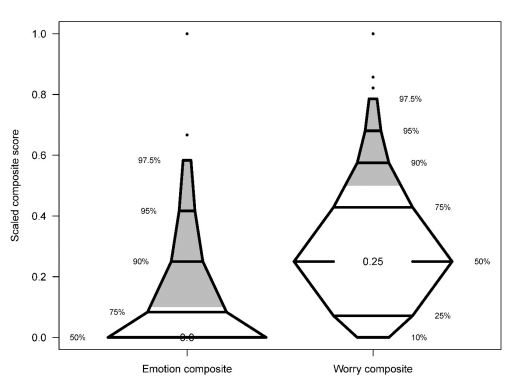
Figure 1:
Predictors of emotional distress and worry
Table 3 shows the results of logistic regression models. No relationships were observed between C19 related social-emotional impact or worry and age, race/ethnicity, insurance status, maternal education, employment status, or birth history. Subjects with eGFR <30 ml/min/1.73m2 who had not yet progressed to KRT were 3.392 (95% CI: 1.021-11.269) times as likely as KRT- naive subjects with eGFR ≥60 ml/min/1.73m2 to report emotional concerns. Participants from lower-income households were 5.435 (95% CI: 1.411-20.927) times as likely as other participants to report C19-related worry. Male participants were 0.446 (95% CI: 0.225-0.883) times as likely as female participants to report elevated rates of C19 social-emotional impact.
 Table 1
Table 1: Patient demographics.
Table 2A
Table 2A: Descriptive Data of the Emotion Items from C-19 Questionnaire.
Table 2B
Table 2B: Descriptive Data of the Worry Items from C-19 Questionnaire.
Table 3
Table 3: Logistic regression predicting emotional distress, worry and overall impact Figure 1. Distributions of Worry and Emotion Composite Scores.
In a large population of healthy children assessed early in the pandemic, Samjii et al. [17] found a high prevalence of C19 fear along with more depressive and anxious symptoms compared to pre-pandemic estimates. Our study, which used a brief survey assessing C19- related social-emotional impact and worry and was administered to youth and young adults with CKD between 2021-2023, suggests that a small but significant percent experienced elevated rates of distress and worry. Fortunately, this means that many patients did not endorse such impact. The prevalence of elevated ratings was 19% for social-emotional impact and 17% for worry. Since patients in this study all had a chronic health condition, we expected higher rates of worry about C19 and the social-emotional impact of the pandemic; however, over 60% of our surveys were administered between 2022-2023 when the degree of social-emotional impact and worry may have abated, C19 isolation protocols were becoming more relaxed, and youth/young adults may have been adjusting to pandemic-related stressors.
Parental income was associated with C19-related worry such that lower income was associated with increased rates of worry. Families with lower incomes may have experienced more worry during the pandemic given the uncertainty of the economy and changes in employment. Families likely worried about losing their jobs, and thus their incomes, while some may have had increased worry due to having greater exposure to the virus (e.g. some categories of essential workers). eGFR <30 ml/min/1.73m2 in participants who were pre-KRT was associated with higher rates of social-emotional impact. These participants may have endorsed greater social-emotional impact given they were already coping with escalation of their disease and the uncertainty associated with planning for kidney replacement therapy. The effects of declining kidney function on their health may have impacted coping and psychological adjustment. Additionally, kidney transplants were universally halted at the start of the pandemic as centers developed new protocols for serving transplant candidates [18]. Unlike Samjii et al. [17], there was a mild increase in C19 impact in males versus females. It is unclear why males would have a higher impact score.
This study was unique in that it assessed the C19-related social-emotional impact and worry of over 300 youth with a wide spectrum of CKD. However, there are some important limitations to this study. First, we used a brief questionnaire adapted from another study that was not a standardized measure of emotional distress and worry. In addition, because of the nature of the study protocol, we cannot rule-out that parents participated in completion of the items and may have influenced the responses which, in turn, may have reflected their feelings of worry and anxiety more so than their child’s. Third, surveys were administered across a time range of 2021-2023 and we cannot fully account for how changing circumstances may have influenced responses, although we attempted to control for timing of the survey in our logistic regressions, which yielded little in our sample. Fourth, the CKiD study does not include a comparison group of healthy patients or patients with another type of chronic disease which would give us helpful information for comparison. Another important point is that being followed in a large cohort study might make parents and their children feel more secure about their health. Finally, this study did not assess social-emotional health broadly and was limited to social-emotional impact and worry related specifically to the C19 pandemic, and a more thorough social-emotional assessment may yield different findings.
In conclusion, our study suggests that slightly less than 20% of youth/young adults with CKD reported elevated rates of C19-related social-emotional impact and worry. The patients from families with lower incomes endorsed higher rates of C19-related worry and those approaching kidney replacement therapy endorsed greater social-emotional impact. Overall, it is critical to screen patients for the impact of significant events. Routine monitoring of the social- emotional health of youth and young adults with chronic illness would not only allow us to address individual concerns but would also be useful when more significant public health or societal events occur. Future studies should follow patients who are at higher risk and identify ways we can learn how to better support patients as their medical team.
Data in this manuscript were collected by the Chronic Kidney Disease in children prospective cohort study (CKiD) with clinical coordinating centers (Principal Investigators) at Children’s Mercy Hospital and the University of Missouri – Kansas City (Bradley Warady, MD) and Children’s Hospital of Philadelphia (Susan Furth, MD, PhD), Central Biochemistry Laboratory (Jesse Seegmiller, PhD) at the University of Minnesota, and data coordinating center (Derek Ng, PhD) at the Johns Hopkins Bloomberg School of Public Health. The CKiD Study is funded by the National Institute of Diabetes and Digestive and Kidney Diseases, with additional funding from the National Institute of Child Health and Human Development, and the National Heart, Lung, and Blood Institute (U01 DK066143, U01 DK066174, U24 DK137522, U24 DK066116). The CKID website is located at https://statepi.jhsph.edu/ckid and a list of CKiD collaborators can be found at https://statepi.jhsph.edu/ckid/site-investigators/.
We always work towards offering the best to you. For any queries, please feel free to get in touch with us. Also you may post your valuable feedback after reading our journals, ebooks and after visiting our conferences.

