


| Received | : | May 23, 2026 |
| Accepted | : | June 09, 2026 |
| Published Online | : | Online: June 16, 2026 |
| Journal | : | Annals of Oncology Case Reports |
| Publisher | : | MedDocs Publishers LLC |
| Online edition | : | http://meddocsonline.org |
Cite this article: Saffiedine B, Kakourou A, Stamatiou A, Berthold D, Zulbeari F. Metastatic Urothelial Carcinoma Showing Exceptional Response with Trastuzumab Deruxtecan - A Case Report. Ann Oncol Case Rep. 2026; 6(1): 1031.
Background: Metastatic urothelial carcinoma progressing under conventional systemic therapies is challenging.
Case presentation: We report the case of an 87-yearold male diagnosed with grade 3 urothelial carcinoma who developed rapid multi-metastatic progression after chemotherapy by cisplatin and gemcitabine and immunotherapy with avelumab. Furthermore, the patient’s medical history was notable for granulomatosis with polyangiitis (GPA) and a synchronous mismatch repair-deficient colon adenocarcinoma. Despite a high Tumor Mutational Burden (TMB), the patient showed rapid progression under maintenance immunotherapy with avelumab following first-line platinumbased chemotherapy. Molecular profiling by Next-Generation Sequencing (NGS) identified notably a BRCA2 (Breast Cancer Gene 2) mutation and HER2 (Human Epidermal growth factor Receptor 2) 2+ expression.
Intervention and Outcome: Third-line treatment with Trastuzumab deruxtecan (T-DXd) was initiated based on the HER2 2+ status. This led to a rapid intra-cranial response within days and a complete remission with no signs of disease two years after the initial dose.
Conclusion: This case highlights the remarkable efficacy of T-DXd in HER2 2+ metastatic urothelial carcinoma and suggests that BRCA2 mutation may serve as a potential sensitizer to this antibody-drug conjugate.
Keywords: Case report; Urothelial carcinoma; HER 2 protein; BRCA2 protein; Trastuzumab-deruxtecan.
Abbreviations: HER2: Human Epidermal growth factor Receptor 2; BRCA: Breast Cancer Gene; T-DXd: Trastuzumab deruxtecan; PET-CT FDG: Positron Emission Tomography (PET) with Computed Tomography (CT) and Fluorodeoxyglucose (FDG); NGS: Next-Generation Sequencing; GPA: Granulomatosis with Polyangiitis; TMB: Tumor Mutational Burden.
The patient is an 87-year-old male with grade 3 pT2 cN0 cM0 urothelial carcinoma diagnosed in 2023, for whom radical surgery was not offered due to age. BCG instillations were planned. A few months later, the patient presented with a rapidly growing mass in the penis. He was then referred to our centre. The biopsy of the large masses located in the corpora cavernosa confirmed the presence of metastatic urothelial carcinoma with negative PDL-1 (TPS <1% - SP263). The PET-CT FDG showed metastatic progression to the bone, lymph nodes, and penis.
The patient’s medical history was notable for GPA with lung involvement diagnosed in 2020 and treated until 2022 by rituximab.
Platinum-based chemotherapy was initiated as first line metastatic treatment following ESMO guidelines [1]. The patient showed a partial response after 6 cycles administered until October 2023. Notably, the clinical course was complicated by the synchronous progression of a colon adenocarcinoma diagnosed by colonoscopy in November 2023. This second tumor had a mismatch repair deficiency of the DNA by hypermethylation of the MLH1 gene. The tumorboard decided to postpone the surgery of the colon adenocarcinoma and to start maintenance immunotherapy by avelumab (PD-L1 inhibitor) for the metastatic bladder cancer following the phase III JAVELIN clinical trial [2]. The PET-CT FDG subsequently showed progression of the colon adenocarcinoma and of the metastases after two months of immunotherapy by avelumab. The patient benefited then from a right colectomy in March 2024 which showed a pT3 pN0 colic adenocarcinoma for which the tumorboard recommended follow-up.
Regarding the progression of the metastatic urothelial carcinoma, the molecular profiling of the tumor with a 400-gene panel NGS revealed a mutation of the BRCA2 gene, a stable microsatellite status, a high TMB (17.9 mut/MB), an amplification of FGF 3/4 and a HER2 2+ expression on immunohistochemistry. This 2+ positivity of HER2 led to the initiation in February 2024 of T-DXd based on the results of the DESTINY PanTumor02 phase II trial [3]. T-DXd targets HER-2 expressing cells using trastuzumab and releases a topoisomerase I inhibitor (deruxtecan) via a cleavable linker. The patient showed an impressive response of brain metastases after only one perfusion of T-DXd (Figure 1). We underline here the intra-cranial efficacy of T-DXd. This treatment was well tolerated and led to a complete remission (Figure 1). After discussion with the patient, we decided to stop the treatment after 6 months of complete remission. Until now the patient does not show any sign of relapse either intracranial or extracranial and is under active follow up.
This case describes an 87-year-old male with metastatic urothelial carcinoma who had a temporary response to first-line platinum-based chemotherapy, progressed rapidly on immunotherapy, and achieved a durable complete response with third-line Trastuzumab Deruxtecan (T-DXd) based on HER2 2+ positivity, with no evidence of disease on brain MRI and PET-CT two years after T-DXd initiation and 17 months after treatment discontinuation.
First, we would like to discuss the remarkable results of TDXd as a third line treatment. The DESTINY-PanTumor02 trial evaluated T-DXd in patients with HER2-expressing solid tumors, including bladder carcinoma, with HER2 Immunohistochemistry (IHC) 3+ or 2+ status after at least one prior systemic therapy. In the bladder cancer cohort, patients with HER2 2+ bladder tumors treated with T-DXd had a confirmed Objective Response Rate (ORR) of 39%. Median duration of response for IHC 2+ tumors was about 9.8 months. The greatest benefit was seen in patients with IHC 3+ tumors, but clinically meaningful responses were also observed in the HER2 2+ subgroup, supporting the activity of T-DXd for these patients. In this trial, only one patient had a complete response on T-DXd and most of the patients in the trial showed progression during the twelve months following the first injection [3]. We underline here the unexpected long-lasting response of our patient without any relevant toxicity.
Recent clinical data highlight the promising activity of Disitamab Vedotin (DV), a HER2-targeted antibody-drug conjugate, across various stages of HER2-expressing urothelial carcinoma. In the global RC48G001 phase 2 study focusing on previously treated locally advanced or metastatic urothelial carcinoma, DV monotherapy demonstrated substantial antitumor activity, achieving a Confirmed Objective Response Rate (cORR) of 54.9% in HER2-positive patients and 52.6% in those with HER2-low ex pression. Median overall survival reached 20.0 months in the HER2-positive cohort, underscoring its potential in advanced settings. For localized Muscle-Invasive Bladder Cancer (MIBC), the RC48-C017 trial showed that neoadjuvant DV combined with toripalimab, an anti-PD-1, yielded a remarkable Pathological Complete Response (pCR) rate of 63.6%, which increased to 84.6% in patients with high HER2 expression 3+. Both studies concluded that DV maintains a manageable safety profile while providing promising clinical outcomes for patients expressing the HER2 protein regardless of disease stage.
T-DXd is known for its intracranial activity in patients with HER2-positive and HER2-mutant solid tumors, particularly in breast cancer and non-small cell lung cancer, including those with active or untreated brain metastases [4,5]. There are no data available regarding the intracranial activity of T-DXd in patients with urothelial carcinoma with brain metastases. We can say, thanks to two brain MRI performed a few weeks apart before radiotherapy, that T-DXd showed already an impressive intracranial activity in the case of our patient.
HER2 expression in urothelial carcinoma is characterized by substantial inter- and intratumoral heterogeneity, and discordance between primary and metastatic lesions has been reported. These features have historically limited the effectiveness of conventional HER2-targeted therapies in bladder cancer. However, antibody-drug conjugates such as T-DXd, may overcome these limitations through their highly potent cytotoxic payload and bystander effect, which allows killing of neighbouring tumor cells with lower HER2 expression. This mechanism may partly explain the activity of HER2-directed ADCs in tumors with intermediate or low HER2 expression, as observed in our patient.
The NGS results showed a BRCA2 mutation. BRCA2 mutation could predict enhanced activity of T-DXd as shown in the exploratory biomarker analysis of the DESTINY-Breast 06 trial [6]. This trial compared T-DXd versus physician’s choice of chemotherapy in HER2-low/ultralow, hormone receptor–positive metastatic breast cancer. This exploratory analysis showed an improvement of PFS for the patients with a BRCA 1/2 mutation with a hazard ratio of 0.14 (0.05 - 0.33). The biological rationale for enhanced response to T-DXd in BRCA1/2-mutated breast cancers is based on their Homologous Repair Deficiency (HRD) status. BRCA1/2-mutated should theoretically be more sensitive to the topoisomerase I inhibitor payload of T-DXd due to their inability to repair the resulting double-strand breaks of the DNA through homologous recombination. We hypothesised that it might also be the case of our patient.
Immunotherapy for cancer in patients with GPA is associated with a significant risk of disease flare. Immune checkpoint inhibitors, particularly PD-1/PD-L1 blockade (such as avelumab), have been reported to trigger GPA flares in patients with underlying or previously controlled disease, sometimes causing new vasculitic manifestations [7]. This risk is due to the central role of PD-1 in maintaining self-tolerance in GPA, and immune activation from checkpoint blockade can disrupt this balance, leading to vasculitis reactivation. After discussion with the immunologist, immunotherapy could be started with a low risk of worsening of the GPA. We notice here a relapse of GPA two years after receiving avelumab. The patient was successfully treated with rituximab and prednisone. Regarding data about the JAVELIN Bladder 100 clinical trial, we underline here that immune-related AEs were still appearing after ≥12 months of therapy, including some grade ≥3 events [8].
Patients with a high tumor mutational burden above 10, as in this case with 17.9 mut/MB, tend to respond better to immunotherapy [9] but our patient showed rapid progression under avelumab. We think that it could be explained by the presence of CCND1 amplification. We know that CCND1 amplification correlates with immunosuppression and is associated with a shorter overall survival to immune checkpoint inhibitors in solid tumors [10]. We hypothesised that this molecular alteration might explain the absence of response of our patient to avelumab.
We still have potential future treatments options as enfortumab-vedotin following the guidelines. Based on the molecular findings, erdafitinib or olaparib could be discussed based respectively on the FGF 3/4 amplifications and the BRCA2 mutation. It is difficult to say if these therapeutic options are necessary or appropriate at this moment.
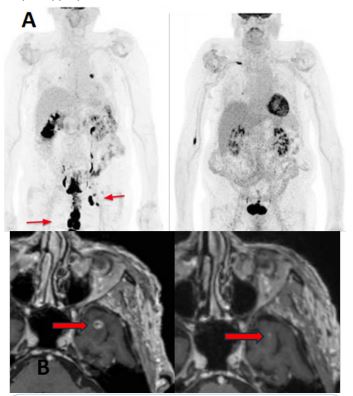
Figure 1: (A) MIP (Maximum Intensity Projection) of PET-CT FDG of the complete response before and after T-DXd (B) evolution of one metastasis on brain MRI after 1 cycle of Tdx.
This case report describes a complete and sustained remission in an 87-year-old patient with heavily pretreated metastatic urothelial carcinoma following treatment with T-DXd. Several key points emerge from this clinical case:
• Efficacy of T-DXd: Although the DESTINY-PanTumor02 trial demonstrated lower clinical activity in HER2 2+ tumors, the complete and prolonged response observed in this patient who remains disease-free 17 months after stopping treatment, is exceptional.
• Molecular synergy (BRCA2): The presence of a BRCA2 mutation may have acted as a sensitizing factor to T-DXd. This hypothesis is supported by exploratory biomarker analyses from the DESTINY-Breast 06 trial, which showed an impressive improvement in progression-free survival for patients with breast cancer and BRCA1/2 mutations treated with Tdx.
• Immunotherapy failure despite high TMB: Despite a high TMB, which usually predicts a better response to immunotherapy, the patient experienced rapid progression under avelumab. This failure might be explained by identified mechanisms of immune evasion, specifically CCND1 amplification which is correlated with poor prognosis and resistance to immune checkpoint inhibitors.
• Management of auto-immune disease: Administering immunotherapy to a patient with GPA required careful multidisciplinary coordination. While PD-1/PD-L1 blockade carries a significant risk of triggering vasculitis flares, the treatment was initiated after determining the risk of reactivation was low.
In summary, this case highlights the critical importance of extensive molecular profiling to identify targeted therapeutic opportunities.
Consent for publication
Written informed consent was obtained from the patient for the publication of this case report.
Competing interests
The authors declare no conflict of interests.
Funding
There was no source of funds for this case report.
Acknowledgements
Special thanks to my oncology colleagues and all the molecular tumor board colleagues.
We always work towards offering the best to you. For any queries, please feel free to get in touch with us. Also you may post your valuable feedback after reading our journals, ebooks and after visiting our conferences.

