


| Received | : | May 20, 2026 |
| Accepted | : | June 05 2026 |
| Published Online | : | Online: June 12, 2026 |
| Journal | : | Annals of Neurology and Neurosurgery |
| Publisher | : | MedDocs Publishers LLC |
| Online edition | : | http://meddocsonline.org |
Cite this article: Majumdar P, Jafarova U, Alakbarli Guliyeva K, Kaura S, Ahemad N, et al. Sacral Nerve Stimulation for Refractory Bowel Dysfunction: A Prospective pilot Study with 24-Month Follow-Up. Ann Neurol Neurosurg. 2026; 5(1): 1015.
Background: Sacral Nerve Stimulation (SNS) has been ex plored as a neuromodulatory therapy for refractory bowel dysfunction; however, evidence remains heterogeneous, particularly in constipation and functional bowel disorders.
Objective: To evaluate the feasibility, safety, and explor atory clinical outcomes of SNS in patients with refractory bowel dysfunction over 24 months.
Methods: This prospective single-centre interventional study included 35 patients with refractory bowel dysfunction (chronic constipation: n=17; IBS: n=18). Primary exploratory outcomes included bowel movement duration (constipa tion) and Bowel Frequency (IBS). Pre- and post-intervention outcomes were compared using paired statistical analysis.
Results: SNS therapy was associated with consistent di rectional improvement across all patients. In constipation, mean bowel movement duration decreased substantially (mean reduction up to ~102 minutes), although statistical significance was not reached (p=0.0806). In IBS, bowel fre quency decreased toward physiological ranges (p=0.0773). No major device-related adverse events were observed.
,Conclusion: SNS demonstrated clinically meaningful but statistically non-significant improvements in this small pro spective cohort. These findings support the feasibility and potential therapeutic role of SNS but require confirmation in larger, controlled trials with standardized outcome measures.
Keywords: Sacral nerve stimulation; Bowel dysfunction; Chron ic constipation; Irritable bowel syndrome; Neuromodulation.
Bowel dysfunction encompasses a broad spectrum of chron ic gastrointestinal disorders characterized by impaired bowel motility, abnormal defecatory coordination, and dysregulated visceral sensation. Among these, chronic constipation and Irritable Bowel Syndrome (IBS) are particularly prevalent and debilitating, exerting a profound impact on patients’ physical, psychological, and social well-being. Epidemiological studies suggest that chronic constipation affects up to 15% of the adult population, while IBS prevalence ranges between 10–20% glob ally, with substantial overlap between symptom domains [1,2].
Chronic constipation is a multifactorial condition involving delayed colonic transit, pelvic floor dyssynergia, impaired rectal sensation, and autonomic dysfunction. Patients frequently re port excessive straining, prolonged defecation time, incomplete evacuation, and reduced bowel frequency. IBS, particularly di arrhea-predominant and mixed subtypes, is characterized by in creased bowel frequency, urgency, abdominal pain, and visceral hypersensitivity, with growing evidence implicating altered gut brain communication and dysregulated autonomic control [3-5].
Despite the availability of numerous pharmacological agents including laxatives, prokinetics, antidiarrheals, and neuromodu lators—long-term efficacy remains limited for a significant sub set of patients. Behavioral therapies such as biofeedback may be beneficial but are resource-intensive and not universally ef fective. Surgical interventions are reserved for extreme cases and are associated with substantial morbidity and irreversible anatomical changes [6,7]. Consequently, there is increasing in terest in neuromodulation-based therapies that address the un derlying neural mechanisms of bowel dysfunction.
Sacral Nerve Stimulation (SNS) is an implantable neuromodu lation technique that delivers electrical stimulation to the sacral nerve roots (S2–S4), which play a central role in regulating co lonic motility, anorectal reflexes, pelvic floor coordination, and visceral sensory processing. SNS was initially developed for re fractory urinary disorders, where its safety and efficacy are well established. Over the past two decades, its application has ex panded to include fecal incontinence and, more recently, other forms of bowel dysfunction [8-10].
The therapeutic rationale for SNS lies in its ability to modu late both afferent and efferent neural pathways at the sacral spinal level, influencing enteric nervous system activity and higher autonomic centres. Experimental studies suggest that SNS enhances colonic propagating motor complexes, improves rectal compliance, normalizes anorectal reflexes, and attenu ates visceral hypersensitivity [11-13]. Importantly, SNS appears to induce long-term neuroplastic changes, offering sustained symptom relief beyond the stimulation period.
However, existing clinical studies are heterogeneous, often limited by short follow-up durations, small sample sizes, or nar row outcome measures. Long-term real-world data examining functional bowel outcomes across different bowel dysfunction phenotypes remain limited.
The present study prospectively evaluates the long-term ef fects of SNS in patients with refractory bowel dysfunction over a 24-month period. By stratifying patients into chronic constipa tion and IBS groups and employing objective, clinically mean ingful outcome measures, this study aims to provide robust evi dence supporting the clinical utility and suitability of SNS as a neuromodulatory therapy for bowel dysfunction.
Study design
This was a prospective, multi-centres pilot study conducted over a period of 24 months.
Study population
A total of 35 adult patients diagnosed with refractory bowel dysfunction were enrolled (Table 1). All patients had failed con ventional medical, dietary, and behavioural therapies prior to inclusion.
Patients were categorized into:
• Group A: Chronic constipation syndrome (n=17)
• Group B: IBS (n=18)
Subgroup classification
Group A (Chronic constipation): Participants in Group A were stratified into 3 subgroups according to bowel movement timeframes. Subgroup allocation was determined by the time required to complete bowel evacuation with each subgroup re flecting a different duration of bowel movement.
• Subgroup A1 (n = 6, female-3, male-3) (Bowel Movement time 140 – 150 min/day)
• Subgroup A2 (n = 6, female-3, male-3) (Bowel movement time 75 – 85 min/day)
• Subgroup A3 (n = 5, female-2, male-3) (Bowel movement time 60 – 70 min/day)
Group B (IBS): Participants in Group B were stratified into 2 subgroups according to bowel movement frequency. Subgroup allocation was determined by the time required to complete bowel evacuation with each subgroup reflecting a different du ration of bowel frequencies.
• Subgroup B1 (n = 8, female-3, male-5) (Bowel movement fre quency 12-15 times/day)
• Subgroup B2 (n = 10, female-2, male-8) (Bowel movement frequency 09-10 times/day)
 Table 1
Table 1: Demonstrating patients´ demographic details.
Intervention
\SNS was performed using a standardized two-stage approach by N.H and U.J. Patient selection and follow up were conducted by a multidisciplinary team including neuromodulation special ists and collaborating physicians.
During the first stage, a temporary quadripolar electrode was implanted under fluoroscopic guidance at the S3 sacral fo ramen, confirmed by appropriate motor and sensory respons es. Patients demonstrating clinically meaningful improvement in voiding parameters during the trial period proceeded to per manent implantation of an implantable pulse generator.
Stage I: Test stimulation (lead placement): Under fluorosco pic guidance, a foramen needle is inserted into the S3 sacral fo ramen. Correct needle placement is confirmed by both fluoros copic imaging and physiological responses to electrical stimu lation. Desired motor responses include bellows contraction of the pelvic floor, plantar flexion of the great toe, and anal sphinc ter contraction, while sensory responses are reported in the pe rineal or vaginal/rectal region.
Once appropriate positioning is confirmed, a quadripolar ti ned lead is introduced through the needle and positioned adja cent to the sacral nerve root. The lead is tested intraoperatively to ensure optimal stimulation thresholds and appropriate res ponses across multiple electrode configurations.
The lead is then secured in place using its self-anchoring ti nes. The proximal end of the lead is tunneled subcutaneously and connected to an external pulse generator for the trial sti mulation period. The incision is closed in layers.
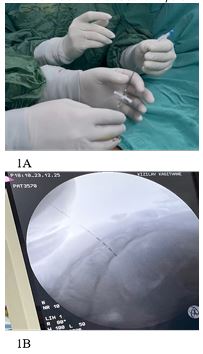
Figure 1: : (A) Illustrates the quadripolar tined lead is introduced through the needle and positioned adjacent to the sacral nerve root and (B) Illustrates the final lead placement under fluroscopy guidance.
Stage II: Permanent implantation: Patients demonstrating a successful response during the test phase proceed to perma nent implantation. Under local or general anesthesia, the previ ously placed lead is connected to a permanent İmplantable Pul se Generator (IPG). A subcutaneous pocket is created, most com monly in the upper gluteal region, to accomodate the IPG. The lead extension is tunneled to the pocket and securely connected to the IPG. Device integrity and stimulation parameters are veri fied intraoperatively. The IPG is programmed using an external programmer, and optimal stimulation parameters are selected based on patient comfort and therapeutic response. The surgi cal wounds are closed in layers, and sterile dressings are applied.
Postoperative management and programming: Patients are monitored regularly, and stimulation parameters such as amp litude, pulse width, and frequency are individualized based on clinical response. Long-term follow-up includes symptom as sessment, voiding diaries, and device checks. Sti mulati on pa Stimulation pa rameters are individually optimized post-implantation: Fre quency: 10–20 Hz, Pulse Width: ~210-260 microseconds, Amplitude: 1.5-8.0 mA. In some patients we used cycling pro gramming methods too.
Outcome measures
• Group A: Time required to complete bowel movement (min utes)
• Group B: Frequency of bowel movements per day
Assessments were performed at baseline and at 24-month follow-up.
Statistical analysis
Data were analysed using paired t-tests or Wilcoxon signed rank tests, depending on data distribution. Continuous vari ables are presented as mean ± standard deviation. A p-value < 0.05 was considered statistically significant.
Ethical approval
This study was approved by the institutional ethics commit tee of Nurax clinics (approval no- SNS018/20/2024). All patients provided written consent prior to participation. This study was conducted in accordance with the declaration of Helsinki.
Study setting
The study was conducted across affiliated clinical centres of Nurax clinics (India and Azerbaijan), where surgical implanta tion and follow up were performed.
Chronic constipation (Group A)
SNS therapy resulted in a marked reduction in bowel move ment duration across all constipation subgroups. However, this did not reach statistical significance (p=0.0806). despite this all patients demonstrated a consistent directional improvement, suggesting a potential therapeutic effect that warrants further investigation in larger cohorts.
Table
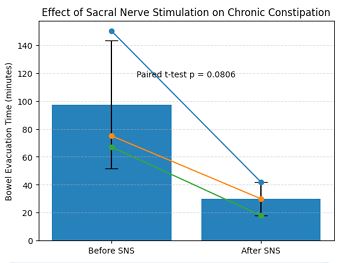
Figure 2: Effect of SNS on bowel evacuation time in chronic con stipation. Bars represent mean ± standard deviation before and after SNS therapy. Overlaid paired lines indicate individual patient responses. SNS resulted in a marked reduction in evacuation time in all patients, reflecting improved defecatory efficiency. Statistical analysis was performed using a paired t-test (p=0.0806).
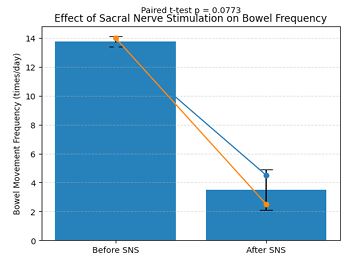
Figure 3: Normalization of bowel movement frequency fol lowing SNS in functional bowel dysfunction. Mean ± standard de viation of daily bowel movement frequency before and after SNS therapy are shown, with individual patient trajectories overlaid. SNS led to consistent reductions in bowel frequency across all pa tients, indicating restoration of bowel rhythm. Statistical compari sons were performed using paired analysis (p=0.0773).
Table
Irritable bowel syndrome (Group B)
SNS therapy was associated with reduction in bowel fre quency across all IBS patients. This improvement did not reach statistical significance (p=0.0773), likely reflecting limited statis tical power. The uniform direction of response suggests a pos sible neuromodulatory effect.
The present study demonstrates that Sacral Nerve Stimu lation (SNS) provides clinically meaningful and sustained im provement in patients with refractory bowel dysfunction, in cluding chronic constipation and functional bowel disorders. Over a 24-month follow-up period, SNS resulted in marked re ductions in bowel evacuation time among patients with chronic constipation and substantial normalization of bowel movement frequency in patients with functional bowel dysfunction. These improvements were consistent across individual patients and align with accumulating evidence supporting the role of SNS as an effective neuromodulatory therapy for lower gastrointestinal disorders.
Clinical interpretation of findings
Chronic constipation is a multifactorial disorder involving impaired colonic transit, anorectal dyssynergia, and disrupted sacral reflex pathways. Prolonged bowel evacuation time, as ob served in the present cohort prior to intervention, is commonly associated with ineffective recto-anal coordination and altered pelvic floor neuromuscular control. Following SNS therapy, all patients in the constipation group exhibited a marked reduction in evacuation time, suggesting improved defecatory efficiency and restoration of neuromuscular coordination. These findings are consistent with prior physiological studies demonstrating that SNS can enhance rectal sensitivity, normalize recto-anal in hibitory reflexes, and improve anorectal motor patterns [1-3]. Furthermore, SNS has been shown to modulate colonic motor activity beyond the direct sacral innervation territory, indicating a broader neuromodulatory influence rather than a purely local motor effect [4].
In patients with functional bowel dysfunction, particularly those with increased bowel frequency and urgency, SNS therapy resulted in a pronounced reduction in daily bowel movements, approaching physiological ranges. Functional bowel disorders are increasingly recognized as disorders of gut–brain interac tion, characterized by visceral hypersensitivity and dysregulated autonomic control [5]. The normalization of bowel frequency observed in this study suggests that SNS effectively modulates afferent sensory signalling and autonomic reflex pathways in volved in bowel rhythm regulation.
Mechanisms of action of sacral nerve stimulation
The mechanisms underlying the therapeutic effects of SNS are complex and involve both peripheral and central neural pathways. While early hypotheses proposed a direct motor stimulation effect, subsequent studies have demonstrated that SNS primarily exerts its effects through modulation of afferent sensory pathways and central autonomic circuits [1,6].
Neurophysiological investigations have shown that SNS al ters sacral afferent input to the spinal cord, influencing supra spinal centres involved in bowel control, including the pontine defecation centre and cortical regions associated with visceral sensation [7].
This neuromodulatory effect may explain the observed im provements in both bowel motility and sensory processing. Experimental and clinical studies have further demonstrated that SNS can induce changes in colonic motility patterns, rec tal compliance, and visceral pain perception, supporting its role as a regulator of the gut–brain axis rather than a symptomatic intervention alone [4,8]. These findings align with the durable clinical improvements observed over 24 months in the present study and suggest the induction of long-term neural plasticity within bowel control networks.
Comparison with previous studies
The efficacy of SNS in chronic constipation has been vari ably reported in the literature. Several long-term cohort studies have demonstrated clinically meaningful treand in constipation severity scores, bowel frequency, and quality of life following SNS implantation [2,9]. Kamm et al. reported sustained symp tom improvement in patients with slow-transit and outlet-type constipation, particularly in carefully selected individuals [2].
Conversely, other studies have reported more modest long term success rates, with approximately one-third of patients maintaining satisfactory symptom control over extended fol low-up [10]. These discrepancies are likely attributable to het erogeneity in patient populations, constipation subtypes, out come measures, and follow-up duration. Importantly, studies emphasizing physiological phenotyping and rigorous patient se lection have consistently reported higher response rates [9,11].
Compared with these reports, the present study demon strated consistent individual-level improvement across all pa tients, despite the modest cohort size. This may reflect targeted selection of patients with refractory symptoms and structured neuromodulation protocols. With respect to functional bowel disorders, fewer studies have evaluated SNS; however, available evidence supports its therapeutic potential. Systematic reviews have reported improvements in bowel frequency, urgency, and quality of life in patients with irritable bowel syndrome and functional diarrhea treated with SNS [12,13]. Our findings cor roborate these reports and extend them by demonstrating sus tained benefit over a two-year period (Table 2).
Table 2
Table 2: Comparison of the Present Study with Previously Published Studies on Sacral Nerve Stimulation for Bowel Dysfunction.
• Stimulation Site S3 sacral nerve root.
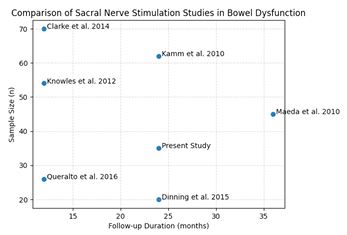
Figure 4: Comparison of published SNS studies for bowel dysfunction. Scatter plot illustrating follow up duration and sample size major clinical studies evaluating SNS for bowel dysfunction. The present study demonstrates comparable long-term follow-up with a balanced cohort size relative to existing literature, supporting its contribution to the evi dence base for neuromodulation in bowel disorders.
Interpretation with caution
Although clinically meaningful improvements were ob served, the lack of statistical significance limits definitive con clusions regrading efficacy. The findings should therefore be in terpreted as exploratory and hypothesis generating rather than confirmatory [6-8].
The absence of a sham control group represents a major limitation, particularly given the well documented placebo re sponse in neuromodulation and IBS studies. Therefore, the ob served improvements cannot be directly attributed to the direct physiological effects of SNS [9,11]
Limitations
This study is limited by its single-centre design and modest sample size, which restrict statistical power and generalizabil ity. The absence of standardized symptom severity scores and a sham-controlled comparator limits the ability to quantify place bo effects. Nonetheless, the magnitude and consistency of indi vidual improvements, together with the durability of response, strongly support a true therapeutic effect.
Future directions
Future research should focus on multicentre randomized controlled trials with standardized outcome measures, strati fication by bowel dysfunction subtype, and integration of ob jective physiological endpoints. Advances in closed-loop neuro modulation and biomarker-guided stimulation paradigms may further enhance therapeutic precision and outcomes.
In conclusion, this study provides evidence that sacral nerve stimulation is a safe, effective, and durable therapy for refrac tory bowel dysfunction. SNS may represent a promising neuro modulatory approach for refractory bowel dysfunction however in this study improvements did not reach statistical significance. Larger randomised controlled trials with standardised out comes measures are required before definite conclusions can be drawn.
Authors participation
U.J: Clinical and Manuscript, K.A: Manuscript, S.K: Manu script, N.H: Clinical and Manuscript, G.M: Manuscript, P.M: Clinical and Manuscript.
Consent to participate
Informed consent was prepared for all induvial participants and will be obtained from all individual participants who are included in this study.
Human ethics and consent to participate declaration
This study was designed in accordance with the ethical stan dards of the institutional research committee and with the 1964 Helsinki Declaration and its later amendments. Informed con sent was prepared to obtain from all individual participants who will be included in this study.
Ethical approval
Nurax Clinics- India, Turkey and Azerbaijan (NX-08/12/ PM/2024).
We always work towards offering the best to you. For any queries, please feel free to get in touch with us. Also you may post your valuable feedback after reading our journals, ebooks and after visiting our conferences.

