


| Received | : | July 18, 2026 |
| Accepted | : | July 31, 2026 |
| Published Online | : | Online: Aug 07, 2026 |
| Journal | : | Annals of Epidemiology and Public Health |
| Publisher | : | MedDocs Publishers LLC |
| Online edition | : | http://meddocsonline.org |
Cite this article: Joseph AB. From Legionnaires’ Disease to Vaccine Safety: Reflections on Five Decades of Scientific Progress, Public Concern, and Public Trust. A Epidemiol Public Health. 2026; 9(2): 1137.
The modern history of vaccine safety in the United States evolved through a series of interconnected scientific, legal, and societal events that transformed both public health policy and public perceptions of immunization. Beginning with the 1976 outbreak of Legionnaires’ disease and the contemporaneous National Swine Flu Immunization Program, concerns regarding vaccine-associated adverse events became increasingly visible within public discourse. Questions surrounding Guillain–Barré syndrome following swine flu vaccination, reports of neurologic injury after whole-cell pertussis immunization, the emergence of parent advocacy organizations, and the subsequent establishment of the National Childhood Vaccine Injury Act of 1986 collectively shaped a new era of vaccine safety oversight. The publication and later retraction of Andrew Wakefield’s 1998 Lancet article alleging a relationship between Measles-MumpsRubella (MMR) vaccination and autism further transformed the debate, contributing to the rise of modern vaccine hesitancy and organized vaccine-safety activism. This historical perspective reviews the evolution of vaccine safety concerns from the late twentieth century to the present day, emphasizing the complex relationship between scientific evidence, public perception, legal frameworks, and public trust. Particular attention is given to the 1978 Public Concerns of Immunization Symposium, organized by Vija Melnick and the author, which sought to address vaccine safety questions through open scientific dialogue and anticipated many of the issues that continue to shape vaccine policy today.
Keywords: Vaccine safety; Vaccine injury compensation program; Vaccine hesitancy; Guillain–barré syndrome; Swine influenza vaccine; Pertussis vaccine; Vaccine injury compensation; Wakefield; Autism; Public trust; Immunization policy; Vaccine advocacy.
Vaccines represent one of the most successful public health interventions in the history of medicine, contributing to the prevention of millions of deaths annually and the global control or eradication of numerous infectious diseases [1,2]. Their widespread use has led to the control, elimination, or neareradication of numerous infectious diseases that once caused substantial morbidity and mortality throughout the world. During the twentieth century alone, vaccines contributed to the elimination or dramatic reduction of smallpox, poliomyelitis, diphtheria, measles, pertussis, and numerous other infectious diseases that had previously claimed millions of lives [2].
Yet the remarkable success of vaccination created an unexpected challenge. As vaccine-preventable diseases became less visible, public attention increasingly shifted toward the rare adverse events associated with immunization. Questions concerning vaccine safety, causation, risk communication, and compensation emerged as major public health issues. The resulting dialogue involved not only scientists, physicians, epidemiologists, and public health officials, but also legislators, journalists, lawyers, and parents whose children experienced devastating illnesses that they believed might be vaccine-related [3-6].
Today, questions regarding vaccine safety remain among the most important and challenging issues confronting physicians, scientists, public health officials, and policymakers. The COVID-19 pandemic, the rapid development of novel vaccine technologies, and the continuing influence of social media have amplified public discussion regarding vaccine benefits and risks. Although many contemporary debates may appear new, they are in fact part of a much longer historical narrative extending back several decades [7-11].
Many younger physicians, scientists, and public health professionals have little direct knowledge of the events that shaped the modern vaccine safety movement. The 1976 Fort Dix swine influenza vaccination program[12], the subsequent recognition of Guillain-Barré syndrome following vaccination [13], the emergence of parent advocacy organizations during the pertussis vaccine controversy of the 1980s [14,15], the creation of the National Childhood Vaccine Injury Compensation Program [16], the publication [17] and eventual retraction [18] of the Wakefield article linking measles-mumps-rubella vaccination to autism, and the more recent evolution of vaccine-safety activism are often discussed as isolated episodes. In reality, these events represent interconnected chapters in a continuing story that profoundly influenced public perceptions of vaccine safety and helped shape modern vaccine policy.
Following the retraction of Wakefield’s 1998 Lancet paper, vaccine-safety activism did not disappear but rather evolved into a broader movement centered on concerns regarding vaccine safety, governmental transparency, pharmaceutical industry influence, and individual autonomy [19-21]. The rise of social media transformed what had once been relatively small advocacy organizations into highly interconnected national and international networks capable of rapidly disseminating information and mobilizing public opinion. During the COVID-19 pandemic, vaccine hesitancy became increasingly intertwined with political polarization, mistrust of public institutions, and online misinformation, creating a new phase in the history of vaccine-safety activism.
The modern vaccine-safety movement did not emerge suddenly. Rather, it evolved over several decades through a sequence of scientific discoveries, public health crises, legal reforms, and societal debates that progressively shaped public attitudes toward vaccination. Understanding this history is important not only because it provides context for current discussions, but also because it offers valuable lessons regarding scientific integrity, risk communication, transparency, compensation, and the preservation of public confidence in immunization programs.
Recent historical analyses have emphasized that many contemporary challenges involving vaccine development, public acceptance, risk communication, and pandemic preparedness have deep historical roots. In an important review published in Vaccine, Halwe and Krammer [22] examined vaccine strategies before and during the 1968 H3N2 (“Hong Kong”) influenza pandemic and demonstrated how scientific innovation, surveillance systems, vaccine production capacity, public communication, and public confidence influenced responses to a major global health crisis. The authors noted that many of the issues encountered during the 1968 pandemic—including rapid vaccine development, evolving scientific knowledge, public expectations, and the need for effective communication—remain highly relevant to contemporary vaccinology. Viewed within this broader historical context, the vaccine-safety controversies that emerged during the decade following the 1968 pandemic can be understood as part of a continuing effort to balance scientific innovation, public health protection, and public trust.
My interest in these issues has both professional and personal roots. During a career spanning more than six decades in academic pediatrics, clinical immunology, vaccinology, and allergy-immunology, I have had the opportunity to observe— and in some instances participate directly in—many of the events described in this narrative. These experiences included involvement in discussions surrounding vaccine safety concerns following the Fort Dix swine influenza vaccination program, coorganizing with Dr. Vija Melnick the landmark Public Concerns of Immunization Symposium held in Washington, D.C., in 1978 [23], observing the development of the National Childhood Vaccine Injury Act and the Vaccine Injury Compensation Program, and later serving as an expert witness in selected vaccine-related legal proceedings. These experiences provided a unique vantage point from which to observe the evolving relationship among scientific evidence, public concern, public policy, and public trust.
The purpose of this historical perspective is not to revisit old controversies for their own sake, nor to advocate for a particular position in contemporary debates. Rather, it is to examine how concerns regarding vaccine safety emerged, how they were addressed by the scientific and medical communities, how compensation mechanisms evolved to address rare but legitimate adverse events, and how these developments influenced public confidence in vaccination. The lessons derived from this history remain highly relevant today as we continue to balance the extraordinary public health benefits of vaccines with the responsibility to maintain scientific rigor, transparency, accountability, and public trust.
The history of vaccine safety is ultimately not simply a story about vaccines. It is a story about science, uncertainty, communication, accountability, and trust. Understanding that history may help guide future generations of physicians, scientists, and policymakers as they confront the vaccine-related challenges that inevitably lie ahead.
Legionnaires’ disease and the public health environment of the 1970s
In July 1976, attendees of an American Legion convention in Philadelphia developed a mysterious and frequently fatal pneumonia [24]. More than 200 individuals became ill, and dozens died. The outbreak generated national concern and intense media coverage. After months of investigation, scientists at the Centers for Disease Control identified a previously unknown bacterium, later named Legionella pneumophila [25]. The successful identification of the pathogen became a landmark achievement in epidemiology and reinforced public confidence in scientific investigation.
The Legionnaires’ disease outbreak occurred during a period of heightened public concern regarding emerging infectious diseases. While the eventual identification of Legionella demonstrated the power of modern epidemiologic investigation, the outbreak also highlighted the uncertainty that often accompanies newly recognized infectious threats and the challenges faced by public health authorities in responding to them.
The outbreak occurred at a particularly sensitive moment in American public health history. Earlier that year, in January 1976, military physicians at Fort Dix, New Jersey, had identified a strain of swine influenza among Army recruits [26] (Figure 1). Although the outbreak was limited, memories of the devastating 1918 influenza pandemic remained vivid among public health officials.
At the same time, discussions in Congress regarding a proposed national swine influenza immunization program were encountering significant obstacles. Vaccine manufacturers were reluctant to participate because of concerns regarding potential liability and indemnification, and legislative deliberations had become increasingly complex [27].
When the mysterious outbreak of severe pneumonia occurred among attendees of the American Legion convention in Philadelphia, the causative agent had not yet been identified. Before investigators determined that the illness was caused by a previously unrecognized bacterium, influenza was among the leading diagnostic possibilities being considered by investigators and the media. Against the backdrop of the recent Fort Dix episode, fears that the nation might be confronting the beginning of a major epidemic intensified public attention and political urgency [24,26,28].
Although Legionnaires’ disease was ultimately shown to be unrelated to influenza, the uncertainty surrounding the outbreak contributed to a climate of heightened concern regarding emerging infectious diseases. Against this backdrop of uncertainty and public anxiety, federal officials moved forward with what would become one of the most ambitious public health interventions in American history—the National Swine Flu Immunization Program [27,28]. The decisions that followed, and the unexpected events that emerged in its aftermath, would become a defining chapter in the evolution of vaccine safety and public confidence in immunization programs.
The swine flu program and guillain–barré syndrome
Haunted by memories of 1918, public health officials recommended a nationwide immunization campaign. President Gerald Ford endorsed the effort, Congress appropriated funds, and approximately 45 million Americans ultimately received the vaccine (Figure 1). The anticipated pandemic never materialized.
However, epidemiologists subsequently detected an increased incidence of Guillain–Barré Syndrome (GBS) among vaccine recipients (Figure 1). Although the absolute risk remained small, the association received considerable public attention. Subsequent analyses eventually supported a causal relationship between the 1976 swine influenza vaccine and an increased risk of GBS. The vaccination program was suspended, and what had begun as an ambitious public health initiative became one of the most debated episodes in modern vaccinology.
For many Americans, this was the first widely publicized example of a serious vaccine-associated adverse event. The experience demonstrated that even well-intentioned public health programs could encounter unforeseen complications and underscored the importance of rigorous post-licensure vaccine safety surveillance.
The swine flu episode also had significant legal implications. Because the federal government had assumed liability for vaccine-related injuries during the campaign, numerous claims were filed by individuals who developed Guillain–Barré syndrome. The resulting litigation highlighted a fundamental ethical and public policy question: if society encourages individuals to accept a small risk for the benefit of public health, what responsibility does society have toward those who experience serious adverse outcomes?
The public concerns of immunization symposium
The symposium proceedings were subsequently published in Pediatric Research [22]. Rather than dismissing public anxieties, participants sought to examine questions of vaccine safety rigorously and objectively.
The meeting provided an interdisciplinary forum in which experts from medicine, public health, law, and government engaged with members of the public to address emerging questions regarding vaccine safety and public confidence in immunization. Topics discussed included methods of adverse-event surveillance, approaches to assessing causation, risk-benefit analysis, public communication strategies, and mechanisms for maintaining confidence in immunization programs.
In retrospect, the symposium anticipated many of the debates that would dominate vaccine policy for decades to come. It reflected a principle that has guided my thinking throughout my career: public confidence in vaccination is strengthened not by ignoring concerns but by investigating them honestly, transparently, and scientifically.
Although the concerns surrounding the 1976 swine influenza vaccination program centered on a specific adverse event associated with a single public health campaign, subsequent controversies would arise in the context of routine childhood immunization, bringing questions of vaccine safety into the daily lives of millions of families. Among the most influential of these was the controversy surrounding the whole-cell pertussis component of the Diphtheria-Pertussis-Tetanus (DPT) vaccine.
The pertussis vaccine controversy
During the late 1970s and early 1980s, increasing attention focused on reports of neurologic complications following administration of the whole-cell pertussis component of the Diphtheria-Tetanus-Pertussis (DPT) vaccine [29-31]. Whole-cell pertussis vaccines had been extraordinarily effective in reducing the burden of whooping cough. However, they were also known to be reactogenic. Fever, prolonged crying, local reac-tions, febrile seizures, and hypotonic episodes were recognized adverse events.
More controversial were reports of severe neurological disorders, including encephalopathy, developmental delay, seizure disorders, and permanent brain injury occurring shortly after vaccination. The scientific community confronted a difficult question that remains central to vaccine safety today: did temporal association imply causation?
Many physicians believed that most reported neurological injuries represented coincidental events occurring during infancy, a period when numerous neurologic disorders first become apparent. Parents often viewed the situation differently. For families who witnessed an apparently healthy child experience seizures or developmental regression following vaccination, the temporal relationship appeared compelling.
The debate became increasingly emotional because it involved profoundly disabled children and families searching for answers. As scientific uncertainty persisted, public concern intensified, setting the stage for the emergence of organized parent advocacy groups that would profoundly influence the vaccine-safety movement.
Parent advocacy, dissatisfied parents together, and the origins of the modern vaccine safety movement
By the early 1980s, vaccine safety concerns had moved beyond scientific meetings and professional journals into the homes of American families. Among the most influential parent advocates were Barbara Loe Fisher and Jeff Schwartz. Both became involved after concerns regarding neurological problems in their children that they believed were related to DPT vaccination [14,15] (Figure 1).
In 1982, together with other concerned parents, they established an organization known as Dissatisfied Parents Together (DPT) (Figure 1). The name itself reflected both parental frustration and the vaccine that lay at the center of the controversy. The organization would later evolve into the National Vaccine Information Center (NVIC).
Importantly, these early advocates were not initially opposed to vaccination itself. Rather, they sought recognition that serious adverse reactions could occur, greater scientific investigation into vaccine safety, improved physician awareness, and assistance for affected families.
The movement gained national visibility through the 1982 television documentary DPT: Vaccine Roulette. The program featured emotionally powerful accounts of children believed by their families to have suffered devastating neurological injuries following vaccination. Millions of Americans were introduced for the first time to the possibility that vaccines could cause serious injury. The documentary transformed what had previously been a limited scientific controversy into a national public health debate.
The emergence of parent advocacy groups represented a pivotal moment in vaccine history. Their concerns stimulated broader discussions regarding vaccine safety monitoring, informed consent, adverse-event reporting, manufacturer liability, and compensation for vaccine injuries. At the same time, escalating litigation against vaccine manufacturers threatened the continued availability of essential childhood vaccines, creating a public health dilemma that demanded a national solution.
Crisis for vaccine manufacturers and the national childhood vaccine injury act
The controversy surrounding DPT vaccination had consequences extending far beyond scientific debate. An increasing number of lawsuits were filed against vaccine manufacturers, jury awards became larger and more frequent, and liability insurance costs rose dramatically. Several manufacturers ceased vaccine production or considered leaving the market altogether. By the mid-1980s, policymakers became increasingly concerned that litigation might threaten the nation’s vaccine supply. Public health officials feared that vaccine shortages could undermine immunization programs and permit the resurgence of vaccinepreventable diseases.
An unusual coalition emerged. Parents seeking recognition and compensation for vaccine injuries, physicians committed to preserving immunization programs, public health officials, legislators, and vaccine manufacturers all recognized that the existing system was failing. These concerns ultimately culminated in passage of the National Childhood Vaccine Injury Act of 1986 [16,32] (Figure 1). The legislation represented one of the most innovative public health policies of the twentieth century. Congress sought to balance two important objectives. First, individuals who experienced vaccine-related injuries deserved fair compensation. Second, society required a stable vaccine supply and robust immunization infrastructure.
The Act established the National Vaccine Injury Compensation Program (VICP), a no-fault compensation system funded through an excise tax on vaccines [33] (Figure 1). Claims would be heard by Special Masters within the United States Court of Federal Claims rather than through traditional civil litigation. The goal was to provide compensation more efficiently while reducing the adversarial nature of conventional lawsuits. Importantly, compensation under the program did not necessarily imply proof of biological causation. Rather, the program was designed as a public policy mechanism to provide equitable compensation while maintaining confidence in immunization programs and preserving vaccine availability.
The legislation also stimulated broader vaccine-safety initiatives, including enhanced adverse-event reporting and the eventual development of surveillance systems such as the Vaccine Adverse Event Reporting System (VAERS). The VICP remains one of the most significant legislative responses to vaccine-safety concerns in modern medical history and continues to influence vaccine policy, compensation, and public trust today. For a time, the creation of the compensation program appeared to ease many of the tensions that had characterized the DPT controversy. Yet the underlying questions regarding vaccine safety, causation, and public trust did not disappear. Instead, they would re-emerge in a new and far more consequential form during the 1990s.
Evolution of vaccine injury compensation: from VICP to CICP
Two federal compensation programs currently exist in the United States to provide financial assistance to individuals who experience serious vaccine-related injuries: the National Vaccine Injury Compensation Program (VICP) and the Countermeasures Injury Compensation Program (CICP) [16,32-35].
The National Childhood Vaccine Injury Act of 1986 represented a landmark effort to address one of the most challenging questions in public health policy: how should society respond when an individual experiences serious injury following vaccination undertaken for the benefit of both the individual and the community? The legislation established the National Vaccine Injury Compensation Program (VICP), a no-fault compensation system funded through an excise tax on covered vaccines. The program was designed to provide fair compensation for vaccinerelated injuries while preserving the nation’s vaccine supply and reducing the adversarial nature of traditional civil litigation. Claims are adjudicated by Special Masters within the United States Court of Federal Claims, providing a specialized forum for evaluation of complex medical and scientific evidence.
The VICP currently covers routinely recommended childhood vaccines and selected adult vaccines recommended for routine use. The program reflected an important societal principle: individuals who accept a small risk associated with vaccination in support of public health should have access to an equitable and efficient compensation mechanism should serious injury occur. Importantly, compensation under the program does not necessarily imply definitive proof of biological causation but rather recognizes the need to balance scientific uncertainty, public confidence, and fairness to affected individuals.
A second federal compensation mechanism, the Countermeasures Injury Compensation Program (CICP), was established under the Public Readiness and Emergency Preparedness (PREP) Act of 2005 [35] and was subsequently applied to vaccines and other countermeasures deployed during public health emergencies, including the H1N1 influenza pandemic and the COVID-19 pandemic, following provisions incorporated into subsequent federal emergency legislation, including the CARES Act of 2020 [37]. Unlike the VICP, the CICP operates through an administrative process within the Department of Health and Human Services and provides more limited opportunities for judicial review and compensation. The principal differences between the VICP and CICP are summarized in Table 1.
The differences between these programs became the subject of renewed public discussion during the COVID-19 pandemic. Critics argued that the CICP provided more limited procedural protections and compensation benefits than the VICP, whereas supporters emphasized the unique circumstances surrounding emergency countermeasures deployed during a public health crisis. Regardless of perspective, the comparison highlights the continuing challenge of balancing public health priorities with society’s responsibility to individuals who experience rare but serious vaccine-associated injuries. The establishment of the VICP would later influence my own professional activities as an expert witness in vaccine compensation proceedings.
Service as an expert witness
The creation of the Vaccine Injury Compensation Program opened a new chapter in my own professional life. Over the ensuing years, I served as an expert witness in numerous cases brought before the Special Masters of the United States Court of Federal Claims. Many of my colleagues appeared on behalf of respondents, whereas I frequently testified on behalf of petitioners whom I believed had suffered genuine vaccine-related injuries. These experiences provided a unique opportunity to observe how scientific evidence was translated into legal decision-making within the vaccine compensation system.
My role was never to advocate for a predetermined outcome but rather to provide my best scientific judgment regarding causation. In many cases, I found myself examining the difficult intersection between epidemiologic evidence and individual clinical experience. These proceedings reinforced a lesson that has remained with me throughout my career: scientific objectivity and compassion are not mutually exclusive. The obligation of the physician-scientist is to follow the evidence wherever it leads while never losing sight of the individuals whose lives have been profoundly altered by illness or injury.
The Wakefield controversy
A new and far more consequential chapter began in 1998 when Andrew Wakefield and colleagues published a paper in The Lancet describing twelve children with developmental disorders and gastrointestinal symptoms [17] (Figure 1). Although the paper did not establish causation, public statements surrounding its publication suggested a possible relationship between MMR vaccination and autism. The media amplified these concerns dramatically.
Public reaction was immediate. Vaccination rates declined in parts of the United Kingdom and elsewhere. Measles outbreaks followed. What distinguished the Wakefield controversy from earlier vaccine debates was the scale of the response. The autism diagnosis touched one of the most emotionally charged conditions affecting children, and parents understandably searched for explanations.
Over the following decade, researchers conducted numerous large-scale epidemiologic investigations involving hundreds of thousands of children. Repeatedly, these studies failed to demonstrate an association between MMR vaccination and autism.
Subsequent investigations revealed serious methodological flaws, undisclosed conflicts of interest, and ethical concerns regarding the original study. In 2010, The Lancet formally retracted the paper [18].
Yet the damage had already been done. The Wakefield episode became one of the most consequential scientific controversies of modern medicine. It demonstrated how a small study, amplified by media attention and public anxiety, could influence global public health despite overwhelming contradictory evidence.
The emergence of modern vaccine skepticism
The autism controversy marked a transition from focused concerns regarding specific adverse events to broader skepticism regarding vaccines, pharmaceutical companies, regulatory agencies, and public health institutions. Organizations originally devoted to vaccine safety increasingly became associated with wider challenges to vaccine policy. Public debates became more polarized, making constructive dialogue increasingly difficult.
During the early twenty-first century, Robert F. Kennedy Jr. emerged as one of the most visible public advocates questioning vaccine safety and government transparency (Figure 1). Historically, however, it is important to recognize that he did not create the vaccine-safety movement. Rather, he entered a movement that had already evolved over several decades through the experiences of swine flu vaccine recipients, DPT families, parent advocacy groups, vaccine litigation, and the autism controversy.
His prominence as a lawyer, activist, and member of a nationally recognized political family gave these concerns a larger public platform. Supporters viewed him as an advocate for vaccine-injured individuals and greater governmental accountability. Critics argued that many of the claims promoted by vac-cine-skeptical organizations lacked adequate scientific support. Whatever one’s perspective, Kennedy’s involvement illustrates how vaccine policy had evolved from a primarily scientific issue into a broader political and cultural debate.
Lessons from fifty years of vaccine safety
Several enduring lessons emerge from this history. First, vaccine safety concerns cannot simply be dismissed. Public confidence depends upon transparent investigation of adverse events and honest communication of uncertainty. Second, scientific rigor remains essential. The credibility of vaccine programs ultimately rests upon the quality of evidence supporting their safety and effectiveness. Third, rare vaccine injuries can occur and deserve careful evaluation and fair compensation. Recognition of these events strengthens rather than weakens public trust. Fourth, scientific institutions must be willing to acknowledge uncertainty and correct errors. The Wakefield episode demonstrated both the dangers of flawed science and the importance of self-correction within the scientific enterprise. Finally, maintaining confidence in vaccination requires balancing two truths simultaneously: vaccines are among the most successful public health interventions ever developed, and no medical intervention is entirely without risk.
Historical lessons from the 1968 pandemic and their relevance today
The historical review by Halwe and Krammer [22] of the 1968 H3N2 influenza pandemic provides an important perspective for understanding subsequent developments in vaccine safety and public confidence. Their analysis demonstrates that concerns regarding vaccine development, production timelines, vaccine effectiveness, public communication, and public acceptance were already present during the response to the Hong Kong influenza pandemic. Importantly, the authors emphasize that successful pandemic responses require not only scientific innovation but also effective communication and public trust.
The events described in the present review may be viewed as a continuation of this historical trajectory. Whereas the 1968 pandemic highlighted challenges associated with vaccine development and deployment during a public health emergency, the decades that followed increasingly focused attention on vaccine safety, adverse-event surveillance, compensation mechanisms, and public confidence. Together, these experiences illustrate that scientific advances alone are insufficient to ensure successful immunization programs. Public trust must be continually earned through transparency, rigorous safety monitoring, open communication, and a willingness to address public concerns honestly and respectfully.
The COVID-19 pandemic once again demonstrated the central importance of these principles. Rapid vaccine development was accompanied by unprecedented public scrutiny, widespread dissemination of information and misinformation, and renewed debate regarding vaccine safety and public trust. As Halwe and Krammer observed, lessons from earlier pandemics remain highly relevant to future preparedness efforts [22]. The history of vaccinology suggests that maintaining public confidence may ultimately be as important as scientific innovation itself in determining the success of vaccination programs.
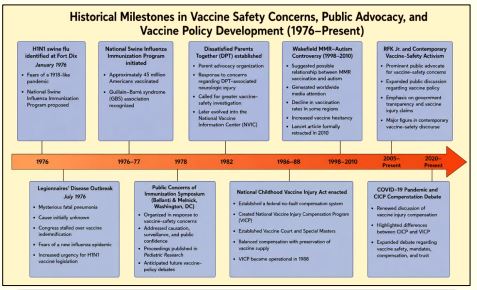
Figure 1: Timeline illustrating major events that influenced public perceptions of vaccine safety, the emergence of vaccine-injury advocacy organizations, the establishment of the National Vaccine Injury Compensation Program, and contemporary vaccine-safety debates in the United States from 1976 to the present.
 Table 1
: Comparison of the two federal vaccine injury compensation systems currently operating in the United States. The National Vaccine Injury Compensation Program (VICP), established under the National Childhood Vaccine Injury Act of 1986, provides compensation for injuries associated with routinely recommended vaccines. The Countermeasures Injury Compensation Program (CICP), established under the PREP Act, provides compensation for injuries associated with vaccines and other countermeasures deployed during declared public health emergencies, including the COVID-19 pandemic.
Abbreviations: VICP: Vaccine Injury Compensation Program; CICP: Countermeasures Injury Compensation Program; PREP: Public Readiness and Emergency Preparedness Act; HRSA: Health Resources and Services Administration.
The historical journey from Legionnaires’ disease and the swine flu vaccination program to contemporary debates regarding vaccine safety reflects an ongoing effort to balance scientific evidence, public health priorities, individual rights, and public trust. The questions debated during the 1970s remain relevant today. How should rare adverse events be evaluated? What constitutes evidence of causation? How should society compensate those who are injured? How can public confidence be maintained while scientific uncertainty is acknowledged openly?
Looking back over five decades, I remain convinced that public trust is built not through certainty alone but through transparency, scientific integrity, and compassion. The vaccine compensation system, the evolution of vaccine-safety surveillance, and continuing efforts to investigate adverse events all emerged from a recognition that public health and individual justice must coexist. The answers to these questions will continue to evolve as science advances. Yet the guiding principles remain unchanged: rigorous investigation, intellectual honesty, respect for differing viewpoints, and a commitment to protecting both individual patients and the public’s health.
Throughout this history, compensation programs have served not only as mechanisms for assisting individuals who experience rare vaccine-related injuries but also as important instruments for maintaining public confidence in immunization programs. As recently emphasized by Halwe and Krammer in their review of the 1968 H3N2 influenza pandemic [22], the recurring challenges of vaccine development, public communication, and public acceptance underscore that the preservation of public trust remains a central pillar of successful vaccination programs across generations. The story of vaccine safety is therefore not simply a story about vaccines. It is a story about how a democratic society confronts uncertainty, balances competing interests, learns from experience, and strives to preserve both scientific progress and public trust.
We always work towards offering the best to you. For any queries, please feel free to get in touch with us. Also you may post your valuable feedback after reading our journals, ebooks and after visiting our conferences.

