


| Received | : | Aug 20, 2026 |
| Accepted | : | Sep 07, 2026 |
| Published Online | : | Online: Sep 14, 2026 |
| Journal | : | Annals of Epidemiology and Public Health |
| Publisher | : | MedDocs Publishers LLC |
| Online edition | : | http://meddocsonline.org |
Cite this article: N’guessan K, Attoh-Touré H, Audrey Marie Michelle A, Sidoine K, Sérigbalet A, et al. Development of a protocol for assessing health impacts during the technical review of environmental and social impact assessment reports in the Republic of Côte d’Ivoire. A Epidemiol Public Health. 2026 ; 9(2): 1140.
This study, conducted within the framework of development projects in Côte d’Ivoire subject to an Environmental and Social Impact Assessment (ESIA), evaluates the health risks identified during the review of ESIA reports. The objective is to propose a protocol to improve the assessment of health impacts.
Methods This was a descriptive, retrospective, and crosssectional study. Data were collected using an observation grid. The analysis focused on one hundred ESIA reports submitted to the Ministry of Health, Public Hygiene, and Universal Health Coverage between 2021 and 2023.
Results: These reports mainly concerned mining (50%), infrastructure (19%), as well as the agri-food (12%), chemical (9%), and hydrocarbon (10%) sectors. The pollutants identified were fine particulate matter, emitted primarily by the mining and chemical industries. However, no pollutants affecting soil or water were mentioned, thus limiting a comprehensive assessment of health risks. Surrounding populations, exposed through inhalation, are the most affected. However, the reports provide no data on vulnerable groups (children, women, the elderly), which is a significant shortcoming.
Conclusion: The study proposes a protocol for assessing health impacts and recommends more effective mitigation measures. Reports adequately document air pollutants, such as fine particulate matter from the chemical and mining industries. However, none of the reports mentioned specific pollutants affecting water resources, soil, or subsoil, even though these environmental matrices are essential for public and environmental health. This lack of information on these pollutants hinders accurate risk identification and complicates the implementation of preventive measures. Health impacts on workers were reported (100%) in all types of projects studied.
Keywords: Impact assessment; Health risks; Environmental assessment; Pollution.
Economic and industrial development, while essential to the prosperity of nations, is often associated with adverse consequences for the environment and health. To mitigate these undesirable effects, at the United Nations Conference on Environment and Development held in Rio de Janeiro in 1992, nations were recommended to conduct an environmental impact assessment before implementing any project whose activities are likely to have significant adverse effects on the environment [1,2]. Indeed, the Environmental and Social Impact Assessment (ESIA) is a tool for protecting the human, natural, and economic environment, and for supporting decision-making. Its effective implementation could contribute to achieving sustainable development. With this in mind, many countries have adopted regulations requiring that investment projects, whether public or private, undergo a prior environmental assessment before implementation [3]. In Côte d’Ivoire, this concern for environmental preservation and public health protection materialized in the adoption of Law No. 96-766 of October 3, 1996, establishing the Environmental Code, and Decree No. 96-894 of November 8, 1996, determining the rules and procedures applicable to studies relating to the environmental impact of development projects [4].
Thus, the Ivorian State, aware of the environmental and social challenges linked to development, has put in place structures and procedures aimed at ensuring the appropriate management of high-risk projects. Among these structures is the National Environment Agency (ANDE), the one-stop shop for environmental assessments, which plays a central role in the implementation of environmental projects and programs. The ESIA procedure comprises six stages, including the technical review. At this stage, ANDE requests the ministries concerned by the development project to examine the quality of the ESIA report and assess the environmental and social viability of the project. These sessions aim to identify the environmental and social risks of a project and to provide feedback on the relevance of the security measures proposed in the report. It is at this stage of the ESIA process that the Ministry of Health intervenes.Thus, the Ivorian State, aware of the environmental and social challenges linked to development, has put in place structures and procedures aimed at ensuring the appropriate management of high-risk projects. Among these structures is the National Environment Agency (ANDE), the one-stop shop for environmental assessments, which plays a central role in the implementation of environmental projects and programs. The ESIA procedure comprises six stages, including the technical review. At this stage, ANDE requests the ministries concerned by the development project to examine the quality of the ESIA report and assess the environmental and social viability of the project. These sessions aim to identify the environmental and social risks of a project and to provide feedback on the relevance of the security measures proposed in the report. It is at this stage of the ESIA process that the Ministry of Health intervenes.
According to the World Health Organization (WHO), the links between health and the environment must be considered within the framework of sustainable development. This underscores the importance of going beyond the determinants of health present in the physical environment and encompassing the health consequences of the interaction between populations and all the factors present in their physical and social environment.
However, this has so far only been taken into account to a limited extent, mainly in relation to environmental and social impact assessments [6]. This is the case for the ESIAs carried out in Côte d’Ivoire.
So, how can we guarantee an assessment of health impacts during the technical review of ESIA reports in order to ensure the protection of health?
Therefore, to ensure greater relevance in the technical review of Environmental and Social Impact Assessment (ESIA) reports and to address health concerns, this study aimed to assess health risks based on these reports.
More specifically, the objectives were to:
- Categorize ESIA reports according to project type;
- Identify the environmental and social impacts described in the ESIA reports;
- Describe the health risks associated with the projects;
- Propose a protocol for assessing the health impacts of the ESIA reports
Justification for the choice of study area
The Directorate of Public Hygiene and Environmental Health (DHPSE) is located in the Cocody district of Abidjan, Côte d’Ivoire. This département is under the supervision of the Ministry of Health, Public Hygiene, and Universal Health Coverage. The DHPSE was chosen because of its involvement in the technical review of Environmental Impact Assessment (EIA) reports organized by the National Environment Agency (ANDE) of the Ministry responsible for the environment.
Materials
The study materials consisted primarily of:
An observation grid used to record all information concerning the types of negative impacts, the affected populations, the proposed mitigation measures, and the observed gaps.
Study population
The study population (N) consisted of 186 Environmental Impact Assessment (EIA) reports submitted to the DHPSE for technical review sessions at the ANDE between 2021 and 2023 and available at the DHPSE.
Study type
This was a cross-sectional, descriptive, prospective, and retrospective study. It aimed to describe the current state of the negative impacts mentioned in the EIA reports.
Sample Size
The total size (n) of our sample was 100 reports.
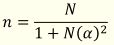
To determine this, we used the formula of Yamane Taro (1967) [7].
Where,
n is the required sample size, expressed as the number of reports;
N is the total number of reports submitted to the DHPSE between 2021 and 2023 ;
α is equal to (7%); this is the margin of error for a 93% confidence interval.
n = 186 / (1 + 186 * (0.07)^2) = 97.31
n = 97.31, which we rounded up to 100 reports.
Sampling method
We used stratified sampling. First, we inventoried the EIA reports available at the DHPSE that underwent technical review from 2021 to 2023. This inventory yielded a total of one hundred and eighty-six (186) EIA reports. Then, we separated them into different strata based on the type of project. Five (5) project types, representing five (5) strata, were identified based on Decree No. 96-894 of November 8, 1996, which establishes the rules and procedures applicable to studies relating to the environmental impact of development projects.
 Table 1
: Distribution of project types and their associated population.
Each project was assigned a number in ascending order.
We determined the proportion of each project type (stratum) in the total population using the following formula:
 Table 2
: Proportion of each project type in the total population proportion.
In addition, we determined the number of reports in each type of project that were part of the sample in proportions based on the following formula:
 Table 3
: Number of projects in each project type.
We rounded the values obtained as non-integers to the nearest whole number
Then, we selected the desired number of reports for each project type using simple random sampling with the RANDOM function (Strat Size x RANDOM + Number) on our CASIO calculator.
The selected reports were then combined to form the final sample of 100 reports.
Inclusion criteria
The inclusion criterion consisted of all EIA reports submitted to the DHPSE, available and reviewed between January 2021 and December 2023.
Exclusion criteria
The exclusion criterion consisted of reports that had undergone at least one second technical review session to avoid counting them twice in our defined sample of 100 reports.
Study procedure
A pre-test was conducted on twenty (20) reports between July 30 and August 2, 2024, to test and improve the data collection grid. The study spanned four (4) months, from May 2nd to August 31st, 2024, and included data collection and, where possible, data analysis.
Data collection : we obtained authorization from the DHPSE before accessing the ESIA reports available between 2021 and 2023. The data was collected on site at the DHPSE from July 25 to August 8, 2024. We have compiled a list of all the ESIA reports available for each type of project over the period concerned. The reports were categorized by project type. The selected reports were reviewed to collect the necessary data relating to negative environmental, social and health impacts, and mitigation measures.
- Data analysis : the data were analyzed using Epi Data and Excel software.
Variables studied
- Types of projects.
- Negative environmental, social and health impacts mentioned in the reports.
- Groups of exposed people
- Mitigation measures for negative impacts.
- Gaps in reporting on health impacts.
Ethical considerations
We sent a letter to the Direction of Public Hygiene and Environmental Health (DHPSE) requesting permission to access internal information. Once permission was granted, we strictly adhered to the DHPSE’s guidelines regarding document dissemination. The documents were consulted solely by me. All information was analyzed internally and used only for the purposes of this study.
Characteristics of the projects reviewed
Type of projects reviewed between 2021 and 2023
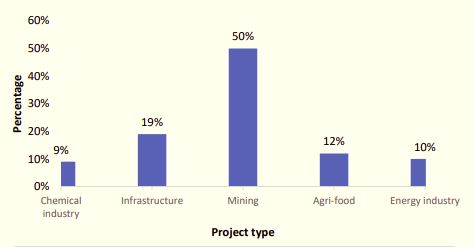
Figure 1: Percentage distribution of projects examined from 2021 to 2023 (N=100).
The figure above shows a high concentration of projects in the mining sector, which represents 50% of the projects followed by infrastructure projects, 19%, for the agri-food, energy industry and chemical industry sectors are significantly less represented, with 12%, 10% and 9% respectively.
Nature of projects examined from 2021 to 2023 by project type
Table 4
Table 4: Percentage distribution of the nature of the projects examined (N=100).
Table IV presents the distribution of project types according to the nature of the activity. Mining projects focus primarily on gold extraction and granite quarries, while the chemical industry encompasses chemical production and latex processing. Infrastructure projects are diversified, including road, administrative, and hotel projects. In the agri-food sector, projects are centered on oil mills, cashew nuts, cocoa, and fruit juice beverages. Finally, energy industry projects are divided between service stations and filling centers. Gold mining projects are by far the most prevalent, representing 38%, followed by granite quarries at 12%. Other project types are less represented, each accounting for between 1% and 8%.
Environmental and social impacts contained in EIA reports
Air pollutants mentioned in EIA reports
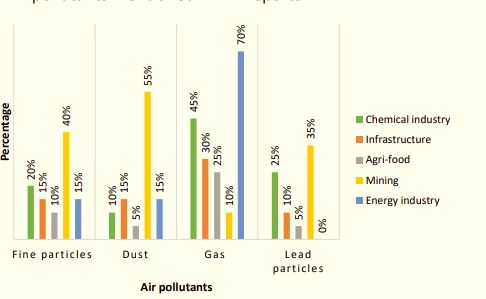
Figure 2: Percentage distribution of air pollutants mentioned in EIA reports by type of project examined (N=100).
The results show that mining projects emit the most fine particulate matter (40%) and dust (55%). The energy industry is responsible for 70% of gas emissions but does not emit lead. The agri-food sector contributes little, with 10% of fine particulate matter, 5% of dust, and 5% of lead particles.
Sources of Soil and Subsoil Pollutants Mentioned in Environmental Impact Assessments (EIAs)
The sources of soil and subsoil pollutants show that wastewater and solid waste are consistently mentioned in 100% of chemical, infrastructure, agri-food, and energy industry projects. Plant protection products are particularly associated with agri-food projects, with 83.33% of mentions.
Social impacts
The most frequently mentioned social impacts in the reviewed reports concern land loss and crop destruction, with 100% mention in mining projects and approximately 89% in infrastructure projects. Furthermore, negative impacts on workers’ health are reported (100%) in all types of projects studied.
Health risks related to projects
The results show that the local population is the main group exposed to pollutants, with high percentages in the following project types: 100% in energy industry projects, 89% in the chemical industry, and 80% in mining. No other vulnerable groups (children, women, the elderly, immunocompromised individuals) were identified as being exposed in the reviewed reports.
Health Risks Related to Air Pollutants Mentioned in the Reports
Respiratory infections affect 100% of projects in all sectors except mining (96%).
Heavy metal poisoning primarily affects the chemical industry (55.56%).
Foodborne illnesses mainly affect the food processing sector (41.67%) and, to a lesser extent, infrastructure projects (10.53%). Skin diseases are present in the chemical industry (55.56%) and the energy industry (40%).
Measures to reduce air pollutant emissions
Installing particulate filters and reducing vehicle speeds are the most frequently adopted measures in the chemical, food processing, and energy industries (100% each). Watering roads is common practice in the chemical industry (100%) and, to a lesser extent, in infrastructure and mining.
Protocol for assessing health impacts
The study’s results reveal a predominance of mining projects in Environmental Impact Assessment (EIA) reports, representing 50% of all projects, of which 38% are related to gold mining and 12% to granite quarries. These figures illustrate the strategic importance of the mining sector for Côte d’Ivoire, considered a key driver of economic growth [8]. Indeed, strong demand for minerals such as gold and granite has led to an increase in the number of mining projects, with 94.91% of exploration permits issued for gold at the end of 2020 [9]. This dynamism is accentuated by Côte d’Ivoire’s desire to maximize its geological potential to support its economy [10]. However, this concentration of mining activities poses major environmental and health challenges, particularly in terms of natural resource degradation and risks to public health.
Furthermore, one of the main shortcomings identified in the EIA reports is the lack of specific mention of pollutants affecting water resources, soil, and subsoil, even though these environmental matrices are essential for public health. Pollutants such as heavy metals, nitrates, and pesticides, widely documented for their adverse effects on human health [11], are not sufficiently taken into account. This omission would hinder the identification of health risks and prevent the implementation of appropriate preventive measures. In contrast, air pollutants are better documented in the reports reviewed, particularly fine particulate matter from the chemical and mining industries. These particles, known for their toxic effects, are reminiscent of historical events such as the “Great London Smog” of 1952, which revealed the dangers of fine particulate matter to public health [12]. Furthermore, the reports show that local populations are the most exposed to pollutants during the operational phase of projects (100% of the reports examined), but other vulnerable groups, such as children, pregnant women, and the elderly, are not mentioned in the reports. Yet, these groups are particularly sensitive to environmental risks [13]. Their absence from the EIA reports is a deficiency, compromising the assessment of specific risks for these vulnerable populations.
Moreover, the pathways of exposure to pollutants are also underestimated. The reports focus primarily on inhalation as the exposure pathway (100% of cases), while ingestion is only mentioned in agri-food projects. According to Chevalier et al. [14], other sectors may also be affected by the ingestion of pollutants, particularly through the consumption of contaminated food or the ingestion of soil, which is especially dangerous for children. This omission reveals a partial assessment of health risks, particularly in sectors other than food and agriculture.
Furthermore, although heavy metal poisoning is mentioned in 55.56% of reports related to the chemical industry, it is not sufficiently documented in other sectors, despite the fact that heavy metal pollution poses a major threat in mining and industrial areas [15]. These pollutants can accumulate in human organs and lead to serious chronic effects. This underscores the need to integrate a better assessment of these pollutants into all sectors of activity.
Mitigation measures, such as the installation of particulate filters and reduced vehicle speeds, are well adopted in some sectors (chemical, food and agriculture, and energy industries), but remain insufficient in others, such as the infrastructure sector. Moreover, the need for ongoing monitoring of mitigation measures is rarely mentioned, which compromises.
Finally, the shortcomings identified in EIA reports regarding health risk management underscore the importance of developing an assessment protocol. This protocol would allow for better consideration of the specific characteristics of each type of project, precise identification of the risks associated with pollutants, and the implementation of sustainable mitigation measures. By integrating vulnerable groups, different exposure pathways, and continuous monitoring of the measures, this protocol would help prevent potential public health problems.
Finally, the shortcomings identified in EIA reports regarding health risk management underscore the importance of developing an assessment protocol. This protocol would allow for better consideration of the specific characteristics of each type of project, precise identification of the risks associated with pollutants, and the implementation of sustainable mitigation measures. By integrating vulnerable groups, different exposure pathways, and continuous monitoring of the measures, this protocol would help prevent potential public health problems.
Author declarations
Conflicts of interest
The authors declare no conflicts of interest.
We always work towards offering the best to you. For any queries, please feel free to get in touch with us. Also you may post your valuable feedback after reading our journals, ebooks and after visiting our conferences.

