


| Received | : | June 18, 2026 |
| Accepted | : | July 06, 2026 |
| Published Online | : | Online: July 13, 2026 |
| Journal | : | Annals of Cardiology and Vascular Medicine |
| Publisher | : | MedDocs Publishers LLC |
| Online edition | : | http://meddocsonline.org |
Cite this article: Goldenberg G, Kassotis J. Veins and Hypertension. The Circadian Roller Coaster Syndrome and the Venous Knob in the Mosaic Model of Essential Arterial Hypertension. Ann Cardiol Vasc Med. 2026; 9(2): 1093.
Background: The clinical scenario of essential arterial Hypertension (HTN) is heterogenous and influenced by co morbid conditions. The venous system and the delivered cir culatory volume are determinants of the preload and con tributors to the arterial blood pressure. Hypothesis. Chronic venous insufficiency (CVI) affects the clinical scenario of HTN.
Aims of the study:| 1. To evaluate the influence of CVI on the BP pattern in patients with HTN. 2. To develop a treat ment plan for patients with co-existing HTN and CVI.
Methods: 1. Analysis of the diurnal BP pattern in twenty two patients (7 males, 81.4 years, SD 4.9) with HTN and co morbid CVI. 2. Evaluation of a treatment algorithm in this cohort of patients.
Results: The BP pattern observed in this cohort of pa tients entailed a morning BP peak (SBP 177.6, DBP 100.5), early daytime BP decrease (SBP 134.8, DBP 78.1), BP rise in the late afternoon/evening (SBP 146.7, DBP 85.2) and then through the night towards the morning peak. The pattern, named by the authors the Circadian Roller Coaster (CRC), is explained by the positional fluid shifts, augmented by CVI, superimposed on the pathophysiology of HTN. The current guidelines were adapted to the CRC pathophysiology to de velop a treatment algorithm which led to a change in the circadian BP curve with a reasonable control of BP in the morning, (SBP 135.9, DBP 99.6), early daytime (SBP 125.5, DBP 68.1) and evening (SBP 135.3, DBP 71.2).
Conclusion: Patients with co-existing HTN and CVI can present with a certain diurnal BP pattern, CRC. As inverse dippers, these patients are at elevated risk for target organ damage. The authors recommend screening for CRC in pa tients with co-existing HTN and CVI and a treatment algo rithm tailored to the complex pathophysiology present in these patients.
The mosaic model of arterial Hypertension (HTN) [1] ex plores the interaction of multiple contributors (nodes) to the pathophysiology of HTN including but not limited to neural dysregulation, circulatory volume, renal function, cardiac out put, increased blood viscosity, altered vascular caliber, vascular elasticity, endocrinologic factors. This mosaic model was then expanded to include other contributors, for instance, the role of mitochondria, the immune system, inflammation, cellular sig naling. Because of its complex pathophysiology and influence of co-morbid conditions, clinical presentation of HTN is heterog enous. The venous system and the delivered circulatory volume are determinants of the preload and contributors to the arterial blood pressure. Chronic Venous Insufficiency (CVI) impairs ve nous return and affects BP. However, the mosaic model of HTN does not include the “venous knob.”
Hypothesis
CVI affects the clinical scenario of HTN.
Aims of the study
1. To evaluate the influence of CVI on BP in patients with HTN. 2. To develop a treatment plan for patients with co-exist ing HTN and CVI.
Study design, participants, and methods
This interventional cohort study was performed in the set tings of a private office. Verbal consent was obtained from the patients/caregivers for publishing the data. The diurnal BP pat tern of twenty-two patients (7 males, age 81.4 SD 4.9 years) with co-existing HTN and CVI was analyzed. The treatment algorithm integrated into the treatment of these patients, is an adapta tion of the current guidelines to their complex pathophysiology. Patients’ data before and on treatment are presented in Tables 1, 2 and 3; the circadian patterns are illustrated by Figures 1 and 2. The BP and HR were recorded by an automatic device and present an average of three readings. By the time of this report, patients have been treated for over 6 months and continue the treatment regimen.
Presentation and analysis
Index patient 1, a - 84 – year – old-female with essential HTN and co – morbid conditions including arthritis of the hips and knees, type 2 diabetes mellitus, and varicose veins. She is cog nizant, ambulates with a walker, adheres to cardiac diet, 1 liter of fluid restrictions but cannot tolerate compression stockings. Upon awakening, she experiences general malaise, her head “feels heavy,” her Systolic Blood Pressure (SBP) is 170 mm Hg, and the diastolic BP (DBP) is 100 mm Hg, the Heart Rate (HR) is 65 beats / min. Within the next few hours, her SBP decreases to 110 mm Hg and DBP to 60 mm Hg, the heart rate rises to 80 beats / minute, she develops 2+ pitting edema and feels dizzi ness. She experienced several falls. She needs to lie down to relieve her dizziness. In the afternoon/evening, her BP rises to 150/70 mm Hg, HR is 80 beats / min. She has nocturia, passes 4-5 times a fair amount of urine. She does not have postpran dial hypotension. She is tall, well nourished (BMI is 26.3), lungs are clear, heart sounds are regular with loud A2, a short 2/6 mid-systolic murmur over the aorta, the abdomen is benign on exam. She has osteoarthritic deformities of both knees and varicose veins on both lower extremities with chronic venosta sis dermatitis. There is no distention of the jugular veins, pedal pulses are palpable. The chest X ray is within normal limits, the EKG reveals normal sinus rhythm and Left Ventricular Hypertro phy (LVH), the 2D echocardiogram reveals myocardial thickness of 1.2 cm with preserved myocardial contractility. The labora tory data, including beta natriuretic peptide, complete blood count, chemistry profile, liver function tests, renal markers, thy roid function, lipid panel are all within normal range.
Index patient 2, a - 85 – year - old male with essential HTN, coronary heart disease, arthritis of the knee joints, low back pain, chronic venous insufficiency and venostasis dermatitis. He is cognizant, adheres to the diet and treatment regimen, wears compression stockings although not every day. He ambulates with a cane but reports no falls. He complains of a headache upon awakening and nocturia, 3-4 trips. His morning BP is 180 mm/100 mm, HR is 70 beats/ min. In the early daytime, his BP is 120/80 mm, HR is 80 beats/min. In the afternoon, his BP rises to 160/80 mm with HR of 80 beats/min. He does not have post prandial hypotension. On exam, he is of medium height, well nourished (BMI 29.2), has clear lungs, regular heart sounds, be nign abdomen, no distention of the jugular veins, by midday he has 1 + edema of the legs. His EKG reveals sinus rhythm, the 2D echocardiogram reveals LVH, (myocardial thickness of 1.2 cm) with preserved myocardial contractility. The chest X-ray reveals clear lungs; the beta natriuretic peptide and other laboratory data are within normal limits.
Both patients have established essential HTN and co-morbid illnesses, notably CVI. Both patients present with a circadian pattern of BP where the SBP and DBP rise through the night re cumbency, peak in the morning, come down with early daytime orthostasis and rise again in the late afternoon/evening. Every clinician, especially in geriatric medicine, encounters patients with co-existence of the two common ailments, essential HTN and CVI, presenting with this circadian/positional BP pattern. In this report, we present a cohort of 22 patients with co-existent HTN and CVI and a similar clinical scenario. We analyze and explain this circadian BP pattern and suggest a treatment plan tailored to the complex pathophysiology. Tables 1and 2 summa rize patients’ data on presentation and Figure 1 illustrates their circadian BP pattern.
 Table 1
Table 1: Patients, co-morbidities, and the circadian BP pattern.
Age is expressed in years, BP in mm Hg, HR in beats /minute. All values are summarized as average and standard deviation. DM = diabetes mellitus. CKD = chronic kidney disease. All patients have CVI.
Table 2
Table 2: Circadian BP pattern on presentation.
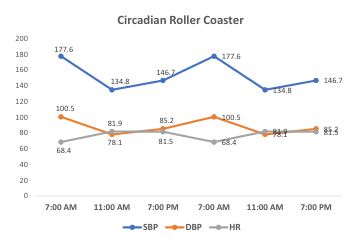
Figure 1:
We named this BP pattern with consistent diurnal peaks and troughs, the Circadian Roller Coaster (CRC) syndrome. The morning/recumbent BP peak in the presented patients is not associated with symptoms of a catecholamine surge (tachycar dia, flush), the early daytime orthostatic decrease in the BP may or may not meet the criteria for Orthostatic Hypotension (OH) and may (patient 1) or may not (patient 2) be associated with orthostatic intolerance.
The variability of BP in patients with essential HTN has been noted and addressed. For instance, postural orthostatic hypo tension was found in 17.3 % of patients in the Systolic Hyper tension in the Elderly Program [2], in 5.5% of patients in Italian Hypertension clinics [3], in 14.6% of patients in a primary care study in Spain [4]. The day-night BP variability was addressed in ambulatory BP monitoring studies. The collected data re vealed different circadian BP patterns, extreme “dippers” with nocturnal BP decrease by 20%, “Dippers,” (D) with nocturnal BP decrease by 10-20 % “Non-Dippers” (ND) with no nocturnal decrease and “Inverse Dippers” (ID) or “Reverse Dippers’ (RD) with nocturnal BP higher than daytime BP [5-9]. As could be ex pected, patients with a longer exposure to elevated BP, the ND and ID, are at higher risk for target organ damage both asymp tomatic such as LVH, proteinuria, carotid atherosclerosis [6,8] and clinical i.e. stroke, heart failure, coronary disease, kidney failure [5,7-9].
The referenced studies, however, did not address the patho physiology of ND and ID. Co-morbid illnesses such as DM, CKD and sleep apnea have been identified as risk factors for the ND and ID BP patterns [8]. All 22 patients presented in this report are ID and hence, high risk patients. Only four out of twenty-two patients have co-existent DM and only three out of twenty-two patients have CKD stage 3, these co-morbidities are unlikely to account for the ID pattern. Their ID/CRC pattern, however, can be explained by the co-existence of HTN and CVI present in all patients. Under physiological conditions, orthostasis is associat ed with pooling 500-1000 ml of blood in the venous splanchnic and lower limbs circulation. Compensatory sympathetic activa tion, increase in the HR and vascular tone, assures orthostatic tolerance [10].
In patients with CVI, venous pooling in daytime orthostasis, the caudal shift is augmented and can reach 800-1200 ml. Even with a preserved autonomic response, it leads to the decrease in arterial BP (trough of the curve) with or without orthostatic intolerance. This is the descent part of the CRC syndrome. The ascent part of the CRC, rise of BP in the afternoon/ evening is due to the existing pathophysiology of essential HTN. The noc turnal recumbency and the augmented rostral shift, recruit ment of the pooled volume back into the circulation, interacts with the pathophysiology of HTN, increased arterial tone and inability to accommodate a larger blood volume. The result is the morning BP peak. A predictable nocturia and natriuresis contribute to the following daytime decrease in the BP.
The CRC syndrome needs to be distinguished from the “hyp-hyp” syndrome which refers to the combination of Cli nostatic Hypertension and Orthostatic Hypotension (CH/OH) or SH/OH (supine hypertension/orthostatic hypotension). CH/ OH syndrome is associated with various illnesses burdened by autonomic dysfunction [11-13] and elevated BP is limited to clinostasis. A review of the CH/OH is beyond the scope of this report. The CRC syndrome seen in our patients does not suggest dysautonomia, there is no postprandial hypotension and there is a rise in the HR in response to the orthostatic decrease in the BP. The CRC differs from OH in patients with CVI by the presence of HTN, the latter attenuates the descent part of the CRC and “protects” from orthostatic intolerance i.e., the index patient 2. In addition, there are no unpredictable spikes of BP as seen in the syndrome of baroreceptor failure [14].
Treatment
The treatment algorithm applied to the treatment of these patients is adaptation of the current guidelines to the discussed pathophysiology.
Step 1. Non-pharmacological measures to attenuate the flu id shifts caused by the CVI. Use of a compression system while in orthostasis, high thigh stockings or ace bandage. Assumption of a recumbent position in the second half of the day for 2-3 hours i.e., from 3-5 pm, with leg elevation (2 hours 2 pillows procedure) to partially “decompress” the venous system. Head and trunk elevation during nocturnal sleep to decrease the ros tral shift.
Step 2. Pharmacological interventions. Use of a short – acting vasodilator given in the evening in anticipation of the nocturnal rostral fluid shift and hypertension. Examples of such agents are enalapril, losartan, transdermal nitroglycerin, prazosin. A simi lar approach has been suggested for treatment of clinostatic hypertension in patients with dysautonomia [15].
Step 3. Use of short-acting diuretics, i.e., bumetanide or torsemide, in the late afternoon together with 2-3 hours of re cumbency.
Veno-dilating agents can be used overnight but not in the daytime. Caution needs to be exercised with control of noctur nal BP to avoid OH and nocturnal falls [16]. In the presented co hort, integration of this algorithm into the individualized antihy pertensive regimen led to a reasonable BP control and change of the diurnal curve (Tables 1 and 3, Figure 2).
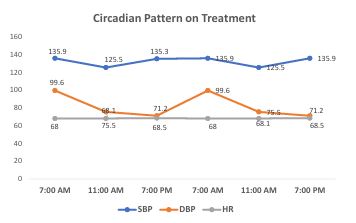
Figure 2:
Table 3
Table 3: Circadian BP on treatment.
Table 3 Circadian pattern of BP and HR on treatment
The described algorithm has been successfully applied to the reported group of patients with CRC. Non - pharmacological and pharmacological measures are combined, timing of both is “circadian.” Change in the circadian BP curve is clinically mean ingful since it corrects the ID pattern and should lead to lesser target organs damage.
Strength of the study
The report extends the mosaic model of HTN by inclusion of the venous node. The venous system can either increase or decrease the preload with respective changes in BP. In patients with HTN and CVI, the effect of the venous system on the BP is enhanced, by its incompetence, and leads to a predictable CRC pattern. The current report highlights this important crossroad. Further research should address the prevalence of the CRC syn drome and validate the suggested treatment approach.
Limitations of the study
The presented cohort is relatively small. The prevalence of the CRC and its treatment algorithm need to be re-validated in larger studies.
In patients with essential HTN, a co-morbid CVI can affect the circadian BP pattern and present as the CRC. The CRC syn drome highlights the influence of the venous system on the BP and warrants the inclusion of the venous node into the mosaic model of arterial HTN. Patients with co-existing HTN and CVI need to be screened for the CRC syndrome; as ID, they are at el evated risk for target organ damage and complications of HTN. Ageing changes, loss of the venous tone, deterioration of the venous valves, loss of arterial elasticity and inability to accom modate a larger intravascular volume increase the likelihood of the CRC syndrome. These, often aged and frail patients require careful and balanced approach to treatment. In the presented cohort of patients, the treatment algorithm integrated into the individualized antihypertensive regimen, led to a reasonable BP control and correction of the ID pattern.
Summary
The co-existence of arterial hypertension and venous insuf ficiency affects the diurnal pattern of blood pressure. The blood pressure peaks in the morning, decreases early in the daytime, and rises in the afternoon, evening and overnight. The authors named this pattern the circadian roller coaster syndrome and recommend a treatment algorithm tailored to its complex pathophysiology. Further research is needed to address the prevalence of this syndrome and validate the suggested treat ment algorithm.
Conflict of interest
The authors report no conflict of interest.
Disclosures
The authors have no disclosures.
Acknowledgments
The authors are grateful to librarians Arpita Bose, Yvette Walton, and Naomi Benoit for their kind assistance
We always work towards offering the best to you. For any queries, please feel free to get in touch with us. Also you may post your valuable feedback after reading our journals, ebooks and after visiting our conferences.

