


| Received | : | Oct 08, 2025 |
| Accepted | : | Nov 24, 2025 |
| Published Online | : | Dec 02, 2025 |
| Journal | : | Annals of Cardiology and Vascular Medicine |
| Publisher | : | MedDocs Publishers LLC |
| Online edition | : | http://meddocsonline.org |
Cite this article: Madias JE. Non-Infarctional Inferolateral Q-waves Due to Discrete Basal Septal Hypertrophy. Ann Cardiol Vasc Med. 2025; 8(2): 1090.
Noninfarctional Electrocardiogram (ECG) Q-waves are occasionally encountered in association with a variety of normal and pathological states. Such Q-waves, particularly involving the inferior or inferolateral ECG leads in association with segmental left ventricular hypertrophy of the basal septum and/or anterior left ventricular wall, are encountered in patients with hypertrophic cardiomyopathy and sigmoid septum, with as yet unknown pathologoanatomic and nosological significance, thus requiring long-term ECG/ imaging follow-up.
In a recent comprehensive review [1], this author has expounded on the general issue of non-infarctional Q-waves, which are encountered in a large array of pathologoanatomic and pathophysiologic cardiovascular entities; in particular the focus of that work was on the association of inferior non-infarctional Q-waves in patients with a discrete septal and/or left anterior ventricular hypertrophy related to some well-established pathologies or some still unexplained causes. Although this author has occasionally encountered this electrocardiographic (ECG)/Echocardiographic (ECHO) association for many years, he had only recently appreciated that this syndrome is found frequently, if sought after, by ECG readers. One of the reasons that this association has not been appreciated, is that the contemporary ECG readers interpret ECGs in conjunction with the employment of the output of automated interpretation applications, available now in all contemporary electrocardiographs. Accordingly, the cardiologists entrusted with the ECG interpretation service look at each ECG on a computer screen, inspect the electronically provided measurements of amplitudes and durations of all the components of the ECG curve (i.e., P-waves, P-R intervals, QRS complexes, QTc intervals) read the summary ECG interpretation statement provided by the electronic interpretation application, and delete and/or add more diagnostic statements, all of these constituting the “overreading” function of the human interpreters, supervising the output of the electronic interpretation application. Indeed, because the output statement of the automated application in such cases as the one presented below frequently reads as “inferior myocardial infarction of undetermined age”, and the cardiologists interpreting/overreading the ECGs often do so in the absence of other clinical or laboratory information about the patients’ whose ECGs they interpret, most frequently it is not appreciated by them that such patients with “non-infarctional Q-waves”, have not suffered a Myocardial Infarction (MI) after all. This author has frequently predicted the presence of basal segmental septal and/or anterior hypertrophy in the ECHO by looking at the ECGs of some patients whom he encounters in the cardiology clinic or the Observation Ward, where patients who have been transferred from the Emergency Department, are monitored (vide infra). It is advisable that the readers study the present communication along with the aforementioned review [1], which has explored in detail the non-infarctional Q-wave ECG/ECHO entity. Cardiovascular imaging specialists (echocardiographers and cardiac magnetic resonance imagers) are often relied upon to explain why a patient with normal (indeed sometimes hyperdynamic) Left Ventricular (LV) Ejection Fraction (LVEF) and/or no symptoms or history of coronary artery disease reveal pathologically-looking Q-waves in inferior or inferolateral ECG leads.
Illusrative case
The patient was a 77-year old woman who was referred for an evaluation by cardiology, triggered by her ECG which revealed inferolateral MI (Figure 1), and for medical clearance, in preparation for a referral for work up of a pulmonary nodule. She was a non-smoker, and had history of hypertension, hypercholesterolemia, diabetes mellitus, status post hysterectomy, and osteoporosis, and she did not have any symptoms suggestive of lung or heart pathology. The patient had presented to the hospital 3 months earlier with home systolic blood pressure readings ranging between 150-160 mm Hg, was asymptomatic, but occasionally felt palpitations when exposed to “bad news” from her family abroad, and when she became nervous, but otherwise she felt well and walked on the treadmill at home for 20 min daily, without chest pain or shortness of breath. She was afebrile, and her blood pressure was 127/74 mm Hg, heart rate 86 beats/min, respiratory rate 18/min, oxygen saturation 97% on room air, weight 62.1 Kg, body surface area of 1.59 m2 , and body mass index of 26.78 Kg/m2 . Examination of her neck, thyroid, lung, and heart was normal, she was found to have a regular rhythm, and a 2/6 systolic murmur along the left sternal border. The abdomen and legs were normal with well-felt peripheral arterial pulses, and no peripheral edema. All laboratory tests were within normal limits with the only abnormality being an increased hemoglobin A1c, indicative of her diabetes. The patient’s medication regimen included aspirin 81 mg, atorvastatin 20 mg, empagliflozin 25 mg, losartan 50 mg, and metformin 750 mg per day. The ECG (Figure 1) revealed a heart rate of 90 beats/min, P-R interval of 152 ms, QRS duration of 92 ms, QTc of 467 ms, and mean frontal axes of P waves, QRS complexes, and T-waves of 600 , 1530 , and 530 , correspondingly; the rightward shift of the frontal QRS axis was suggestive of Left Posterior Fascicular Block (LPFB); there was no right and left atrial or right and left ventricular hypertrophy’ as per established ECG criteria; [2] there were Q-waves in leads II, III, aVF, and V4-V6 suggestive of an inferolateral MI of undetermined age, as indicated by the ECG automated analysis program. The patient’s ECHO (Videos 1-3) revealed normal right and left ventricular size and function with a LVEF of 70%, normal LV global longitudinal strain of 18.8%, normal left atrial size, mild diastolic dysfunction (Grade 1) with increased left atrial pressure, mitral annular and posterior mitral valve calcification, trace mitral regurgitation, normal right atrial size, normal right ventricular contractility, trace tricuspid regurgitation, pulmonary systolic pressure of 24 mm Hg, right atrial pressure of 3 mm Hg, normal aortic valve without stenosis or regurgitation, large anterior epicardial fat, no pericardial effusion, normal aortic root, and discrete upper septal hypertrophy, appearing sigmoid-shaped, with otherwise normal LV wall thickness. The patient was advised to continue her currently prescribed drugs, follow a healthy diet, continue being physically active, and return to the cardiology clinic in 6-9 months for reevaluation, with recommendation to the primary physician to focus on the management of hypertension and coronary risk factors. The author was exposed to the patient’s ECG (Figure 1) in his daily routine of reading all the ECGs in his hospital, without knowing anything about the patient. Based on his previous encounters with ECGs showing Q-waves in the inferior ECG leads, particularly in the absence of QRS notching or inverted T-waves, he suspected segmental basal septal and/or anterior LV hypertrophy, and proceeded to evaluate the ECHO, which confirmed his suspicion. The author showed the ECG of the patient (Figure 1) to several of his cardiology colleagues and trainees, who agreed with the output of the automated interpretation application, that the ECG was suggestive of inferolateral MI.
The presented case of a patient whose ECG suggested an underlying inferolateral MI, while such diagnosis could not be corroborated by historical and ECHO-based evidence requires an explanation, which can be supported by previous experience with ECG/imaging correlations of the author, and some proposed speculations which could be explored in this patient’s follow-up, and future other patient cases. The reasons that the author suspected that the Q-waves were not necessarily due to a previous MI, upon evaluation of this patient’s ECG (Figure 1), were based: 1) on the previous literature revealing that Q-waves are not always generated by an underlying scar of an acute or chronic MI, [1] but by anatomical and electrical shifts of the QRS axis, pregnancy, segmental or asymmetrical LV hypertrophy, and an enlargement of the right ventricular outflow tract [3], which however were not detected in the ECHO; both of which however were not detected in the ECHO; due to hypertension, and a large array of cardiomyopathies (e.g., Hypertrophic Cardiomyopathy [HCM], infiltrative cardiomyopathies, like amyloid heart disease, and others), intraventricular conduction and accessory pathways atrioventricular preexcitation conduction dis orders; 2) on the Q-waves appearing relatively narrow, although such Q-waves are also often encountered in patients with an MI, in-spite of the literature refering to ≥30 or ≥40 ms duration of Q-waves being compatible with the diagnosis of MI; 3) on the ECGs often in patients with extensive MI (e.g., a possible inferolateral MI in the present patient’s case could apply) revealing “notching” in one or more ECG leads, corresponding to the MI’s territory, which was not encountered in the present case; 4) and on the repolarization changes (i.e, ST-segment elevation or depression, and peaked or inverted T-waves) eventually being abolished in the time evolution of an MI, and replaced by either flat or slightly inverted T-waves in ECG leads associated with Q-waves in patients with old MI, features not found in the ECG of Figure 1.
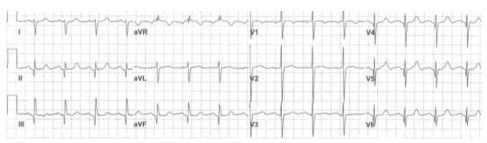
Figure 1: A 12-lead ECG recorded on admission with the diagnosis of inferolateral MI, as indicated by the ECG automated analysis program.
An additional issue herein was the frontal plane rightward QRS axis shift (1530 ) of the ECG (Figure 1). Rightward frontal QRS axis, could be due to a lateral MI/lateral component of an inferolateral MI, excluded in the present patient, but also due to Right Ventricular Hypertrophy (RVH), which also is excluded herein in the absence of clinical and laboratory evidence of such diagnosis, or finally due to LPFB which is present in this patient. One wonders whether the LPFB had contributed (even slightly) to the large Q-waves, in the present case, where the Q-waves were primarily attributed to the discrete upper septal hypertrophy [1,3]. Indeed, this is a theoretical possibility, since in LPFB there is an initial force directed upward and to the left [4], which can lead to a small q-wave in the inferior leads and a small r-wave in lead I (actually present in Figure 1), followed by a strong downward rightward axis shift. Support for this speculation could be provided if this patient’s LPFB proves to be intermittent at follow-up, in which occasion, future ECGs are expected to show inferolateral Q-waves of slightly smaller amplitude and shorter duration, in the absence of LPFB. It would have been useful to have a corresponding to the ECG of Figure 1 Vectorcardiogram (VCG) [4] to evaluate the 3-D QRS VCG loops, and the early, mid-, and late components and their contributions in the diagnosis of LPFB and segmental hypertrophy; however, although the ECG system used in the presented case supports an exported functionality for VCG, the author’s hospital equipment lacks the specific hardware, software version, and configuration, to provide it. Finally, the mechanism of LPFB in the present patient case is puzzling, since this conduction disturbance is rare, and is often associated with multi-vessel coronary artery disease [4]. Perhaps, the LPFB is related to the basal LV hypertrophy, and its specific histopathological nature, not as yet apparent in the present case. In the previously patient case [1], the seemingly inferior MI was associated with a normal frontal QRS axis.
The 2 ECGs in the patient case recorded 13 years apart, [1] revealed that the patient’s oldest ECG did not show Q-waves, and thus the more recent ECG with the Q-waves supported an inciting role of the upper segmental hypertrophy as the underlying mechanism; unfortunately there was no previous ECHO of that patient, corresponding to the ECG recorded 13 years earlier, to explore whether there was no septal hypertrophy at the time that her ECG did not reveal Q-waves. Similarly, there are no previous ECGs or ECHOs in the present case to evaluate a possible association of Q-waves and developing segmental LV hypertrophy. What could be done however in order to clarify the mechanism of nonifarctional inferior/inferolateral Q-waves is long-term follow-up of such patients, with ECGs/imaging studies, as elaborated elsewhere [1], to evaluate for changes (i.e., increase or decrease) of the amplitude and duration of Qwaves, as LV hypertrophy increases locally, involves other myocardial territories, or becomes generalized (leading to partial or total electrical cancellation), or reveals changes of electrical properties (i.e., delays in electrical conductiom or total electrical inertia), resulting from alterations in tissue characteristics (i.e., fibrosis, scar formation, progression of pathology [e.g., HCM, amyloidosis, sarcoidosis, primary and secondary hemochromatosis, Fabry disease, or other infiltrative cardiomyopathies]).
A number of physiological states and pathological conditions are associated with noninfarctional ECG Q-waves and require explanation. Such Q-waves are encountered in inferior/inferolateral ECG leads may occasionally be associated with discrete basal septal/anterior LV hypertrophy, are found in patients with sigmoid septum, HCM, and other as yet unexplored pathologoanatomic/nosological entities, and will require longitudinal over many years ECG/imaging follow-up corellation, for their elucidation.
Funding
No funding was received for this work.
We always work towards offering the best to you. For any queries, please feel free to get in touch with us. Also you may post your valuable feedback after reading our journals, ebooks and after visiting our conferences.

